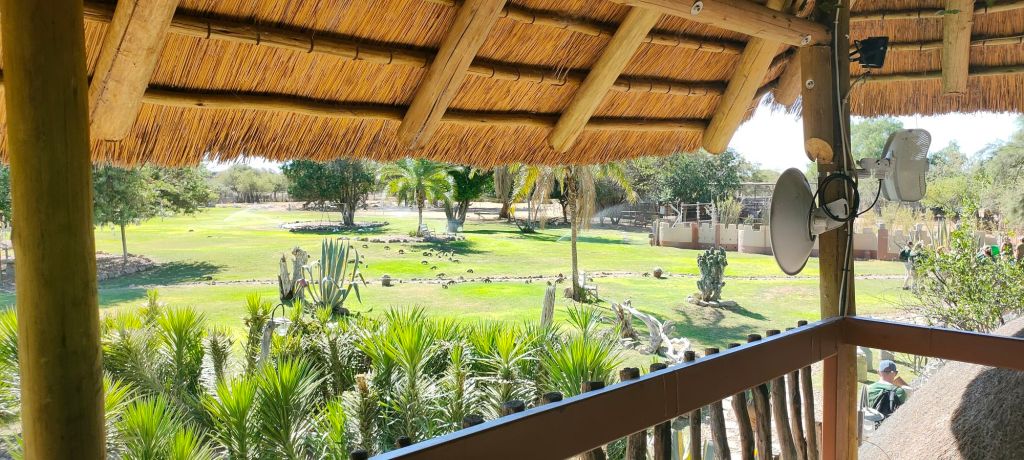
Two baby crocs have done a runner from their enclosure and an escapee baboon is lurking on the roof at breakfast eyeing up the croissants. No-one seems especially worried about the crocs but a man with a slingshot turns up 10 seconds behind the baboon. The newbies except us are excited to see the baboon; the old timers, mostly Germans, are terrified.
“They are NOT friendly” Nicole shouts “they are HORRIBLE”.

Harnas History
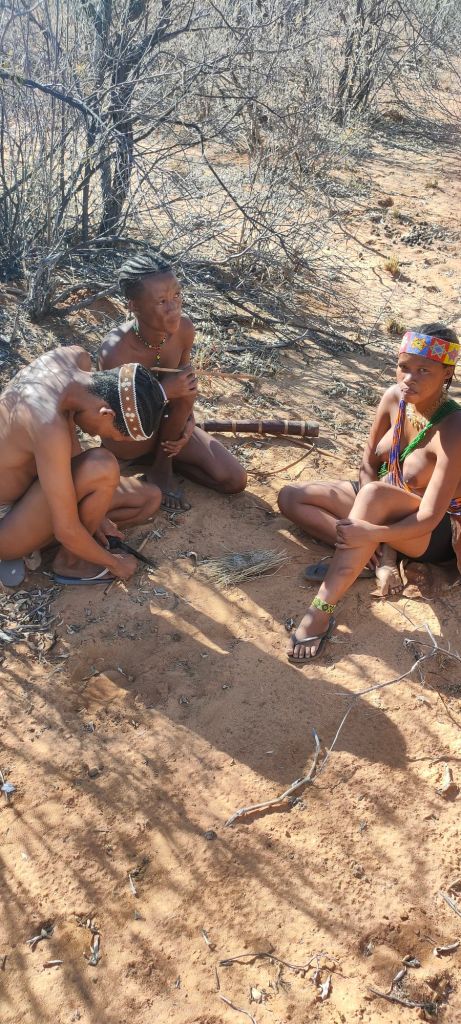
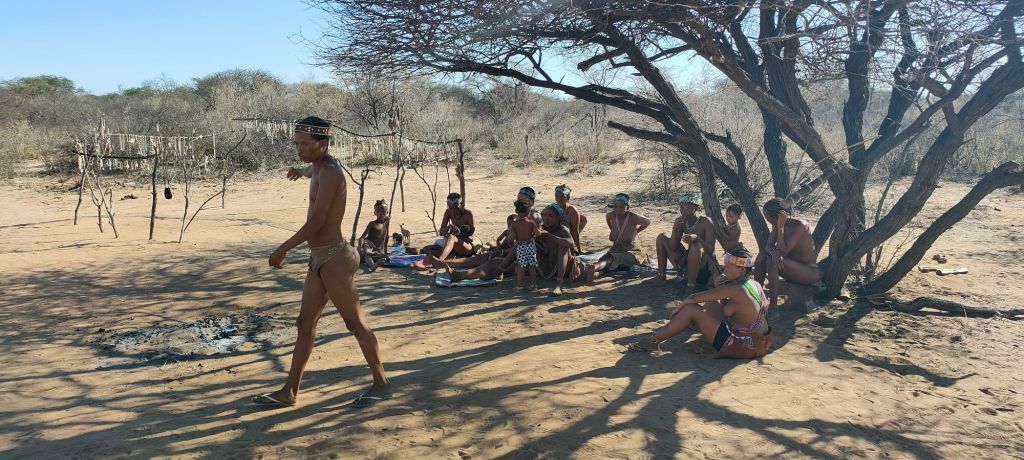
Harnas wildlife Foundation started with an abused vervet monkey rescued by the Van Der Merge family 46 years ago. Over the years it has expanded to play a major role in conservation. A large focus of the work achieved at Harnas is preserving the San culture, one of the most ancient in the world.


Survival tactics.
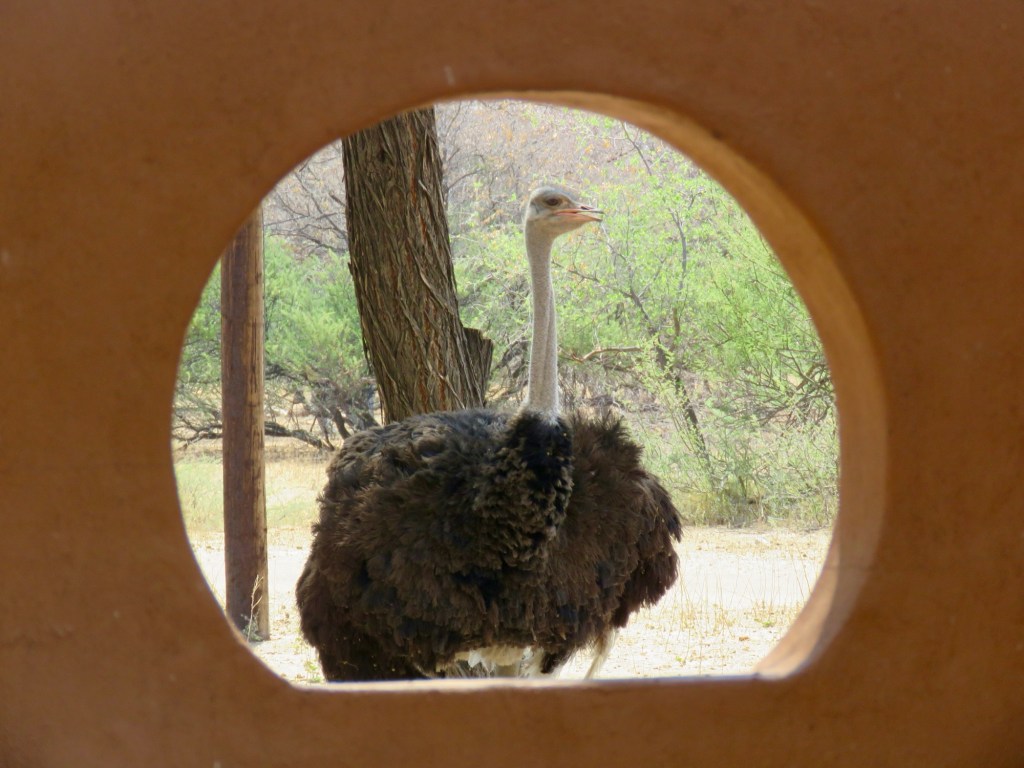
We have learnt to stand stock still when threatened by an agressive goose, and to run for your life if a baboon or ostrich attacks you. Or make like an ostrich by putting one arm up in the air and flapping your hand. I am not kidding. However the ostriches seem pretty chilled, and love a spray down with the hose from our garden. Threatened vervet monkies apparently distract you with lots of false feints while one makes for your jugular. When feeding the crocs you keep your back to the wall and all sphincters on high alert.
In the absence of climbable trees, we are told to run away from a charging rhino in a zig-zag as rhinos don’t turn quickly. Neither do I, frankly.
The leopards miaow and purr like cats – who knew this about cats?!! They are leopards in disguise, but less likely to eat your face off when you get too close.
There is a particularly perilous narrow corridor where you have to walk between the mean, grasping arms of the vervets on one side and the garden sprayer on the other; the water is semi-treated sewage water I think, although when you ask any of the staff they become very vague. It certainly adds an extra layer of jeopardy in getting from A to B.




Silly things humans do.
At the induction yesterday, Maria, our San tribe leader, regales us with tales of the hapless things volunteers have done in the past. Reaching into the lions’ den to take a better picture, trying to get a selfie with the rhinos, stroking a mongoose and losing a finger, carrying a baby giant tortoise the wrong way round and everyone watching in amazement as he suddenly threw the tortoise up in the air after it bit his penis.
We are also told to hide from poachers, as they will kill us aswell as the rhino. If caught they will be in prison for life, so have nothing to lose.
The Volunteers.
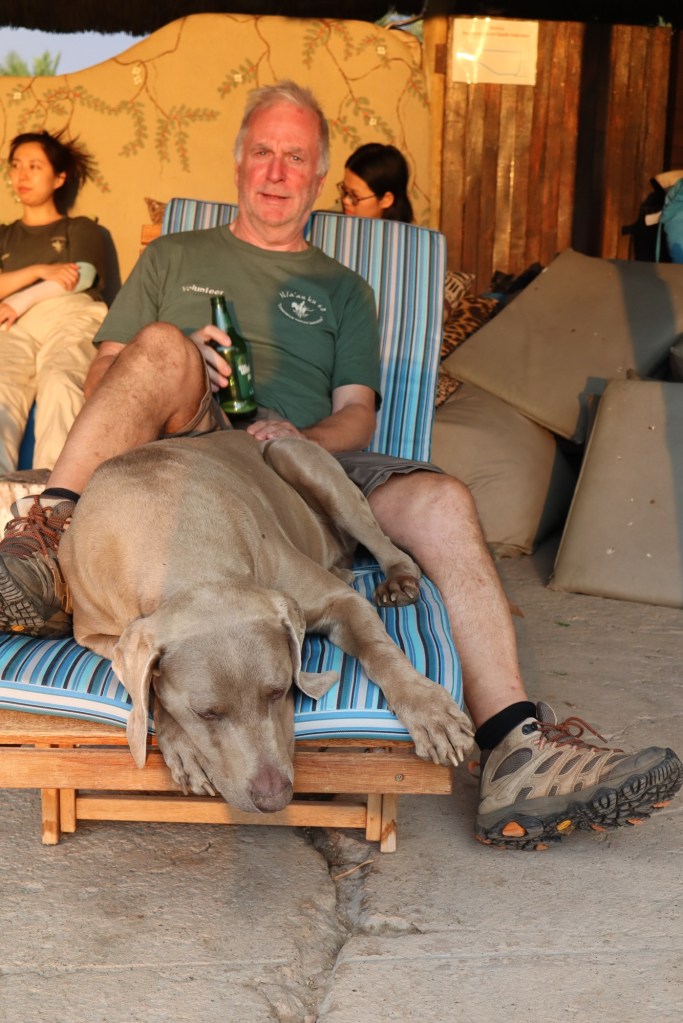
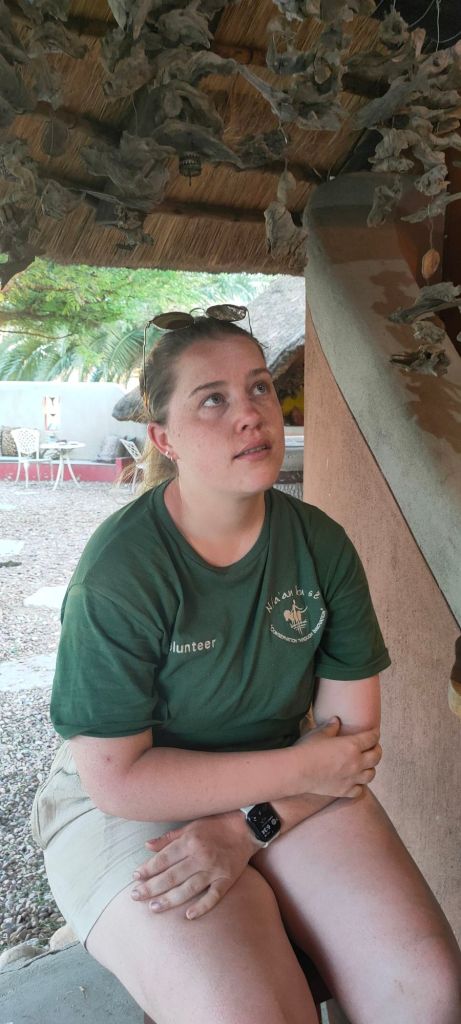
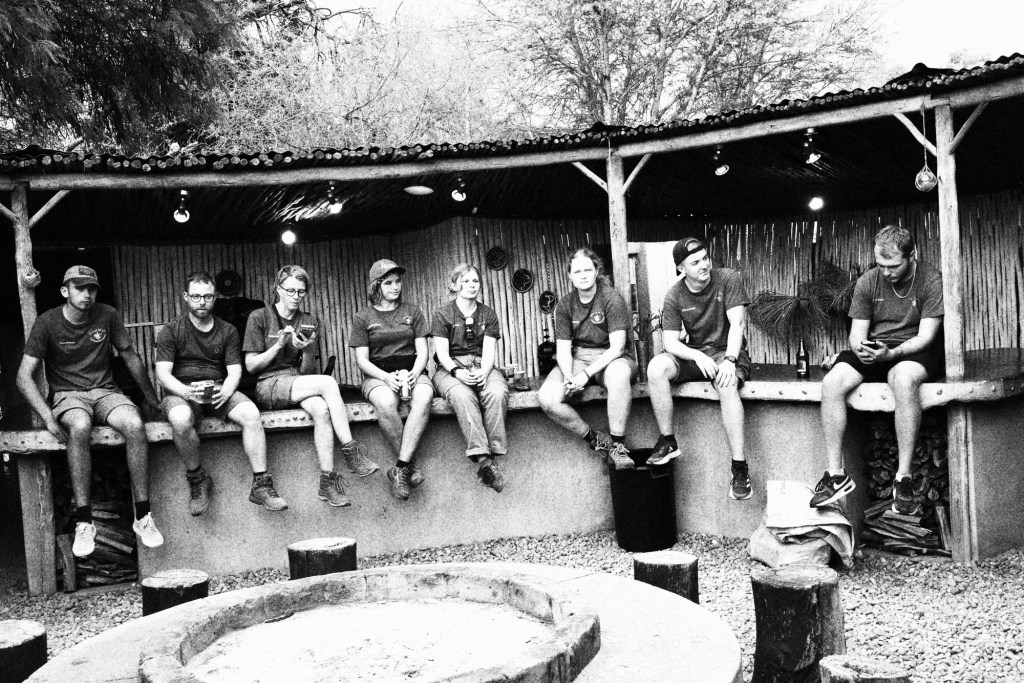
They are a sociable and friendly group, mostly 18-30 ish but with a few young at heart outliers like us, Christine (50) and Simon (78). There are very few Americans, one in fact, a Mexican lad who when he goes accidentally leaves behind a litre and a half of tequila, much to the unbridled joy of Toby, Philip and James sharing his bunk room.
Rhino tracking.
The 6 rhinos on the reserve have to be accounted for daily in case of poaching. Poachers can be in and out of the reserve in 10 minutes. The poachers put bottles in the electric fence to see if they’re still there the next day as if they are, it means no one is patrolling. The two San tribe trackers start at the watering hole and fan out from there.

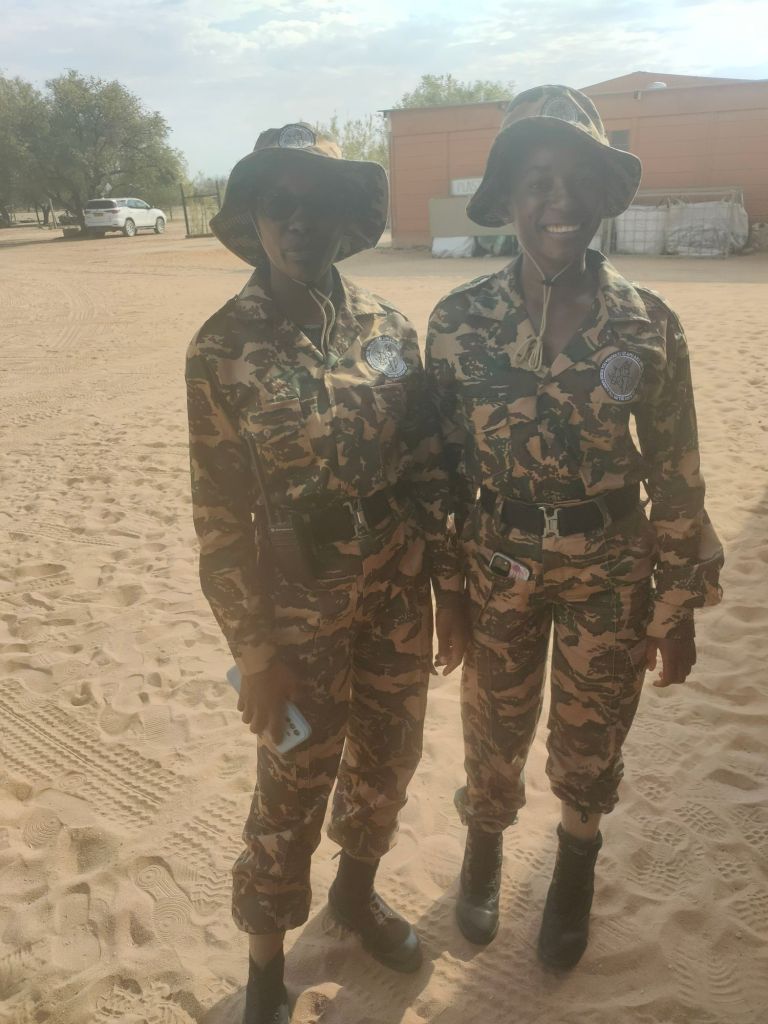

They follow their tracks, which are both footprints and troughs where they have dragged their feet to mark their territory. They also leave enormous piles of poo which I thought would be a composters dream but it is apparently very dry and mostly grass. I thought their skill in finding these creatures incredible.
The Worst Jobs.
Farm work.
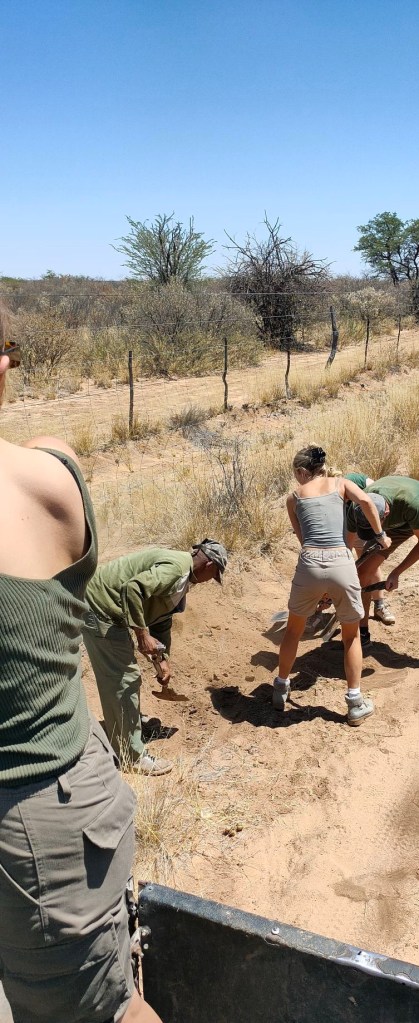
Filling holes.
There is no upper age limit on how much fun it is standing up in the back of a truck that’s rattling along dirt tracks, wind in your face, wild grin spreading ear to ear, sand between your wind blasted teeth. Our job was to hop on and off the truck to shovel sand back into holes that various hopeful animals from the outside – cheetahs, aardvarks, porcupines – have dug under the fence in a bid to reach Harnas’s watering holes and delectable selection of impala, springbok, dikdik and goats.
Wooding.
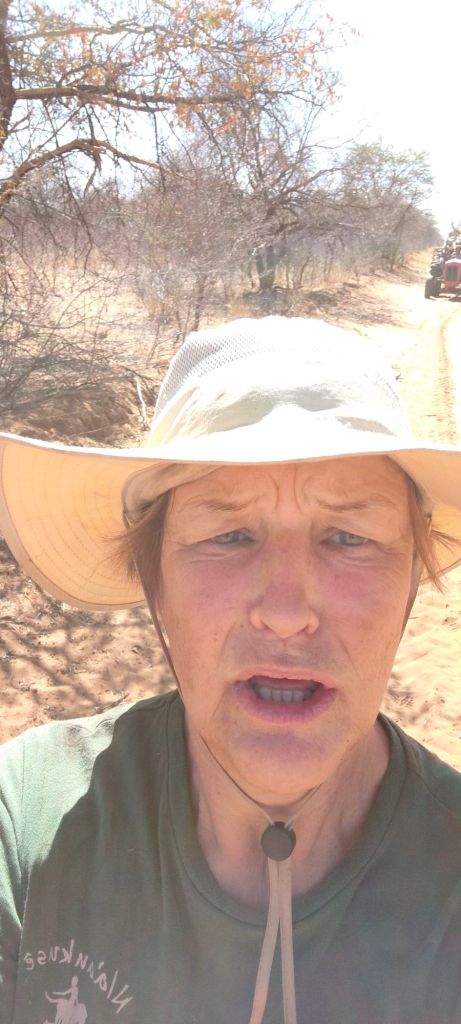
It’s another morning and we are sent to collect wood. I began with great girl guide level enthusiasm, hauling huge logs out of the bush and hurling them onto the lorry, she-woman style. But by the second collection, shallow breathing the hot air, huge sweat droplets stinging my eyes, I lurked in the shadows, hoping no-one would notice my reduction in productivity, and wandered what symptoms preceed keeling over from heat exhaustion. When I told this tale to Tanya, the research manager, she laughed and said “now you know why you see 5 people at work in Namibia and only one of them is working while 4 are resting”.

The Best Jobs.
Lion feeding.
This is definitely a fun activity. There are at least 10 lions, five cheetahs, and two leopards, in various massive enclosures. Some are there because their mothers have been hunting farm animals and have been shot by farmers, who then ring Harnas to collect the cubs. They often don’t know the full story, as they don’t want to discourage people from asking them for help. There is an 8 year old leopard that used to be called Ingwe, an African name for Leopard. Bottle-fed and hand-reared alongside the many dogs at Harnas at the time, his feral instinct kicked in a little earlier than at the expected 2 years old. At 16 months he blotted his copybook overnight by eating all the dogs. The volunteers renamed him Hellboy.

In another enclosure there are five lion brothers all reared in Marietta’s kitchen – the lady who started Harnas 25 years ago. Flown across the border by a mysterious man, they were destined to be cuddly fluff balls on a Botswana game reserve and then shot for sport in an area no bigger than Trafalgar Square. But their Botswana heritage means the Namibian Governemt will not help rehome them. So there they are, five muscle bound testosterone fuelled beasts all vying for territory they shouldn’t be sharing. To reduce the fighting potential, at feeding time we have to strat them at one end of the enclosure and then race in the truck to the other send, the lions giving chase, so that each one is fed as they arrive.




I have yet to regale you with tales of the school and the medical clinic but think I’ll post this as we are going up to a wifi free zone for 4 days – Etosha.
 Travellinglight
OMG….how bloody exciting is all that! So privileged to see such wonderful animals up close and personal, a bit too personal with the flea monkey though Pip! 😳 Some hilarious stories and well done with yours and others hard work to help with the conservation……take care you two! Axx
LikeLike