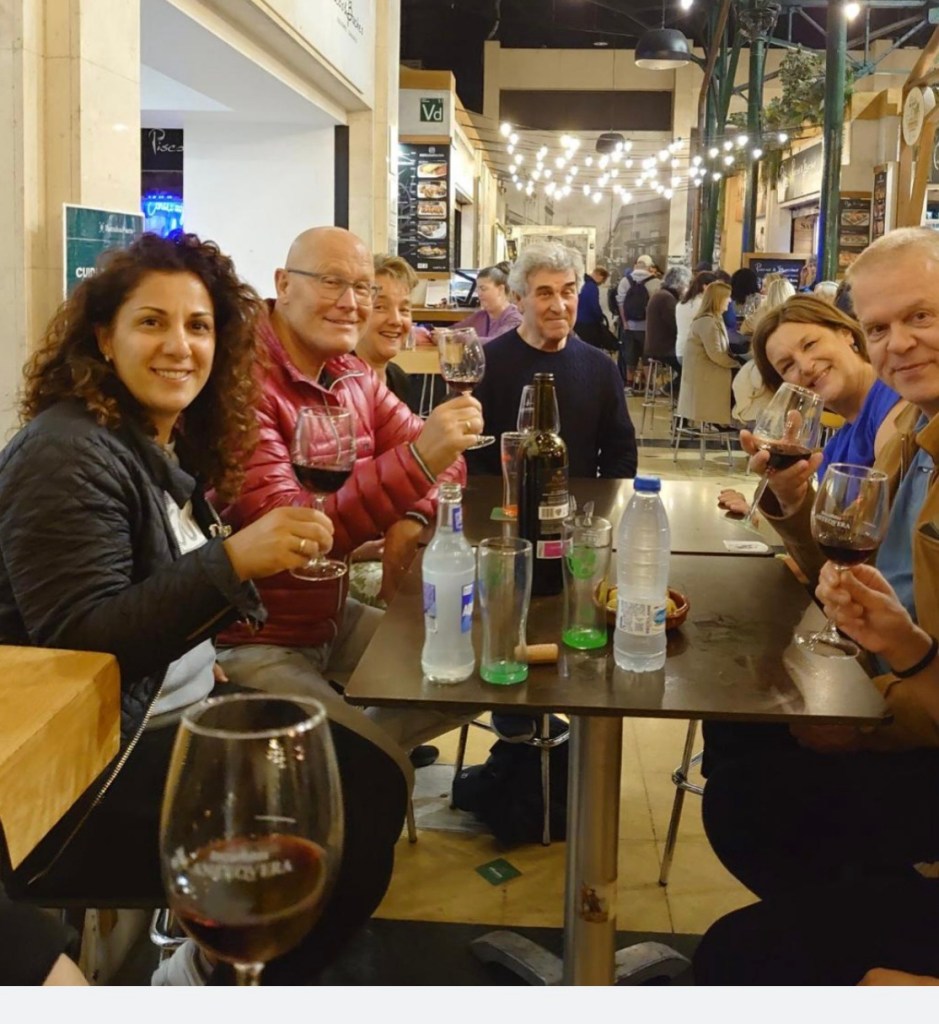
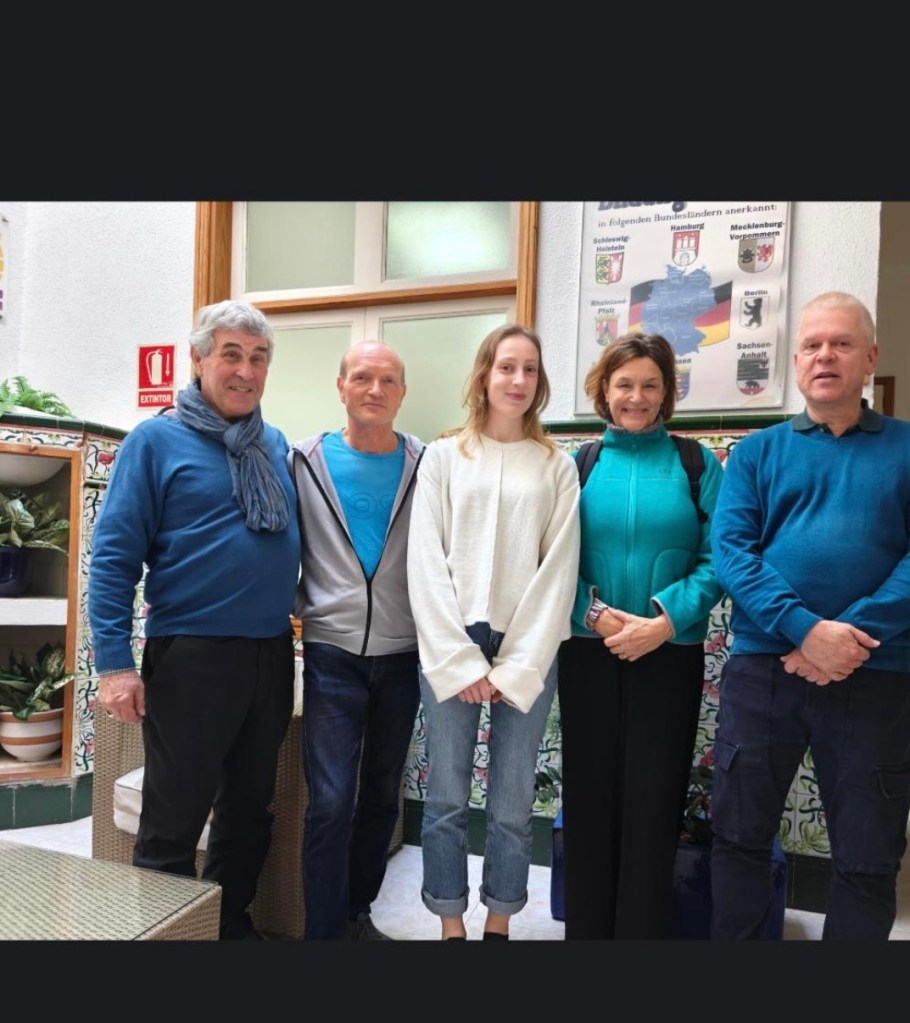
Some of our Spanish school with random friendly strangers we met in the Marcado while drinking and eating tapas.
These are the stories I will never tell. Like a stand-up comedian destined to stay forever in the wings. Hiding from two German friends to avoid joining them in what seemed to be a fiendishly difficult salsa class in the square. Breaking my toe on the bedpost, and while it was still numb, getting Clive to pull it straight and buddy-strap it, as it stuck out at an alarming angle. Yesterday. On my birthday. Having my legs and bikini line waxed in faulty Spanish. All I’ll say is that Spanish women are a lot less prudish than the average English woman.
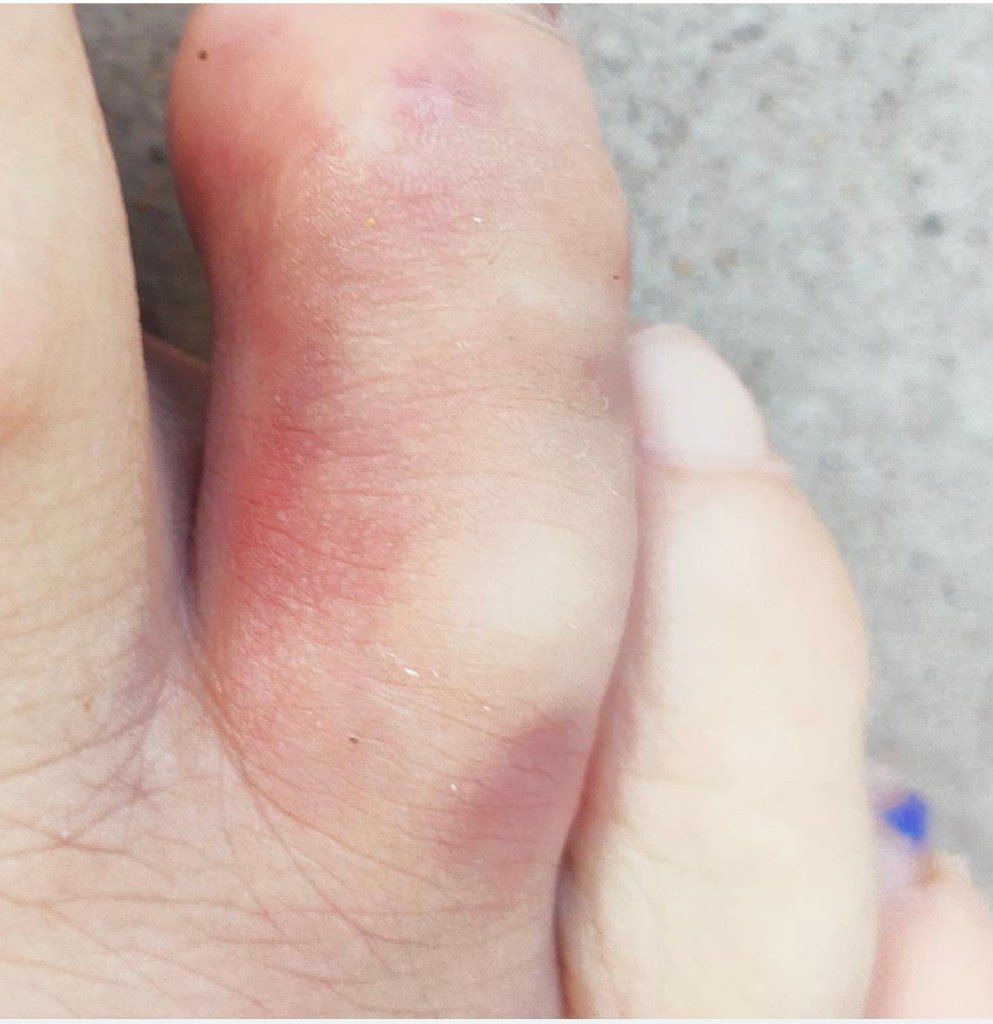
My broken toe. Sorry, I don’t have a lot of photos this week.
This week I’m in a class of twelve, and the vibe is very different to the previous weeks when there were five to eight people in each class. So our teacher never asks me what I did yesterday, although I studiously prepare it each morning, just in case. The adult me knows this is just how it goes. I’m at the back, hidden behind a row of people; I planned to move after the first day but the class is mostly German and when I arrived a little early the next day to execute my plan they were already sitting in the exact same seats they had put their towels on from the day before.
The schoolgirl in me is in a right old strop about being ignored. Or perhaps it’s the middle child.
“Look at me!”
I’m shouting in my head, while studiously staring at the table trying not to catch the teacher’s eye. Old habits die hard, even when they’re doing the exact opposite of what I long for.
There’s a bit of relief there too, as no matter how much we plan our responses, we are level B1’s, so our speeches usually cause expressions of puzzlement to appear on everyone’s face except the teacher’s.
“He’s doing something three times a day, but I don’t know what. Everyone seems very impressed. What could it be?” is an example of my thoughts.
“He’s sailing with the assistant in the bakery opposite?” No, actually, he’s dancing. But often the conversation moves on and I never find out. I still have no idea what he did three times a day.
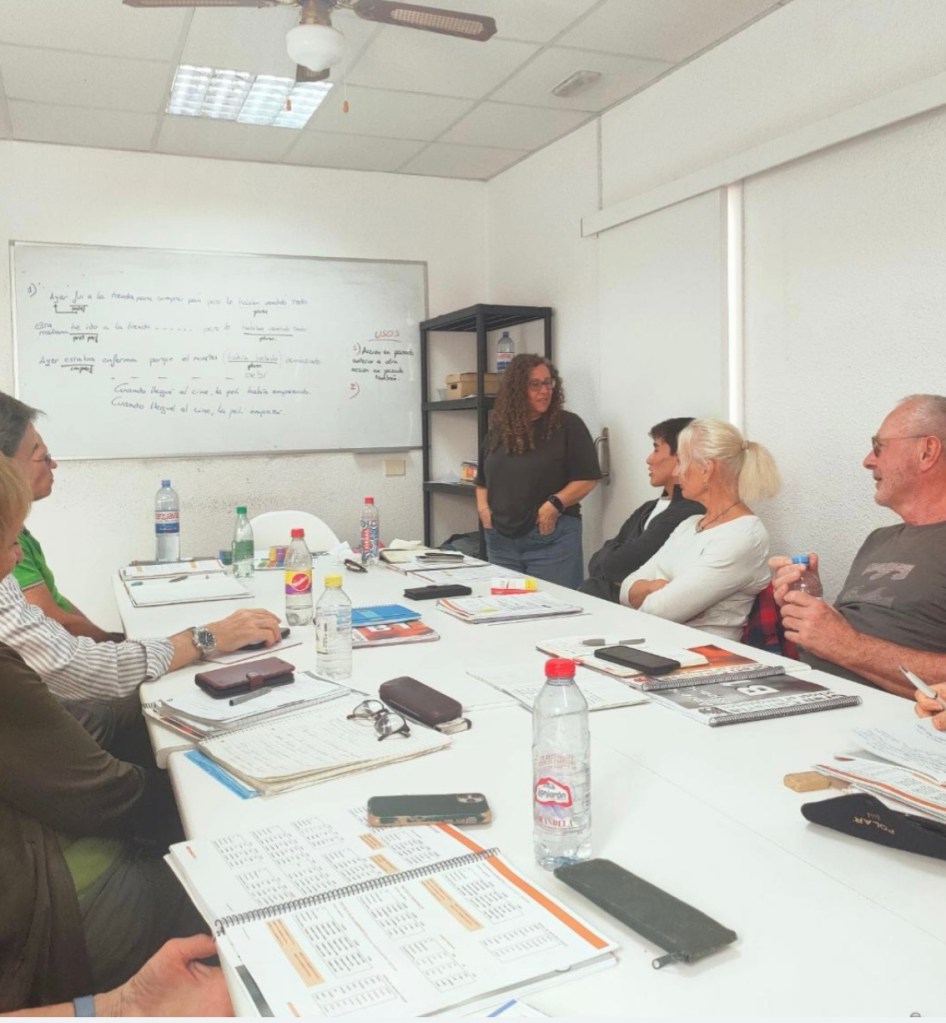
Some of the twelve people in my class this week. Natalia, our teacher, is standing at the front.
An Italian student who has never done any Spanish before, rattles off paragraphs of speech that the teacher totally understands. She gently corrects about one word in thirty. He works in a hotel in Italy and and is doing the course to get better tips.
Italian and Spanish are called Romance languages, and are based on Latin. So he understands about 70% of Spanish already. When I am casting around for a Spanish word, the English ones that work tend to be Latinate or French-derived. For want of another word, these are usually posh words, brought to us by William the Conquerer, originally used mainly by the upper echelons. The Anglo-Saxon words never disappeared, because the majority peasant class carried on using them. The posh words often cluster around law, medicine and government. So in law there are an awful lot of phrases that basically are two words, one based on French, one Anglo-Saxon, meaning the same thing. Law and order, cease and desist, null and void, terms and conditions – everyone needed to know what these meant, not just the poshos.
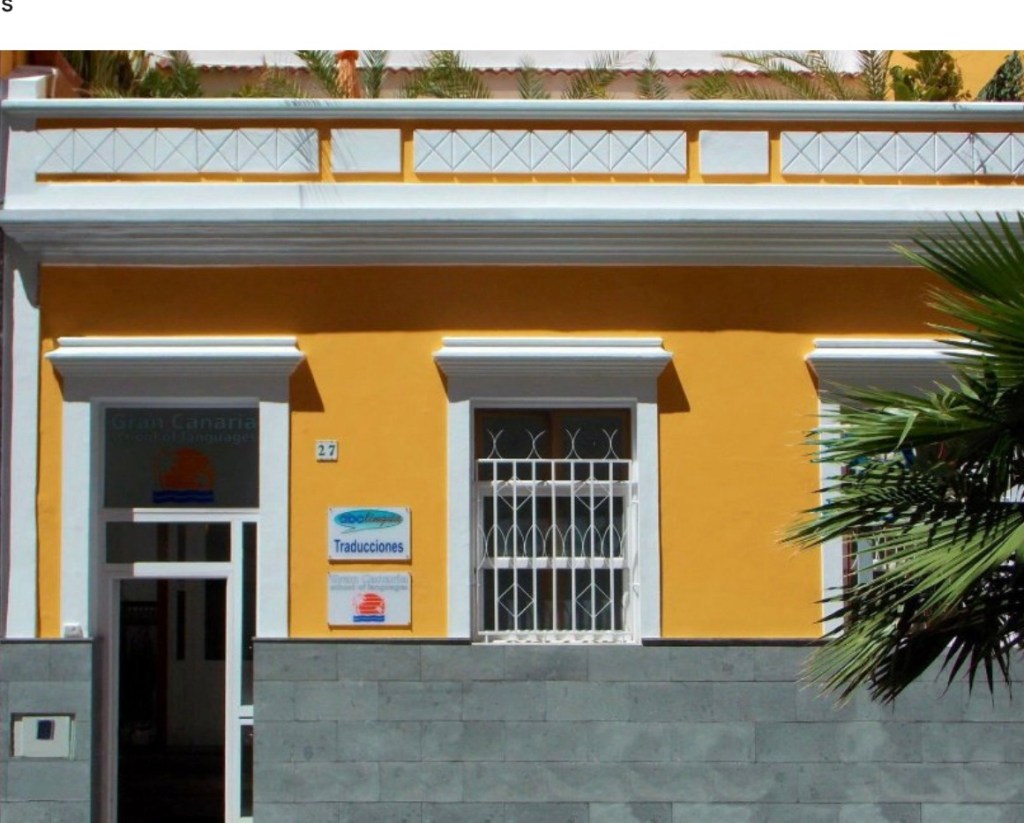
The Canarian School of Languages.
In order to level the playing field, when we socialise with people from other countries, we all try and speak in Spanish. Most people from other European countries can speak English, but attempting to speak Spanish for the last four weeks has made me realise how exhausting that must be for them. The only trouble is we are beginners, and so most of the time after a glass of wine or two, we haven’t the faintest idea what they are saying, and vice versa.
Tomorrow is my last day at school. I must say I’m glad. I now have a rickety scaffolding of tenses and vocabulary that I need to start using. If I learn much more, like Homer in The Simpsons, it’ll push the old stuff out of my brain.
We now have three weeks to properly explore the island, host friends, and have a go at practising what we’ve learned.
Probably my favourite class, the second week, on left Trevor, an amazing Welsh linguist/author, my mate Norb, who hypnotises people presurgery so that they heal fast and don’t bleed, Michelle, a sweet and very young German person, me, and Uwe, a German journalist.
If I hadn’t restarted learning Spanish around 18 months ago, this trip to Las Palmas simply wouldn’t have happened. Last year we both needed surgery, so it felt sensible not to plan anything too ambitious in case one or both of us ended up incapacitated. We aren’t. Well, no more than usual. Fingers crossed.
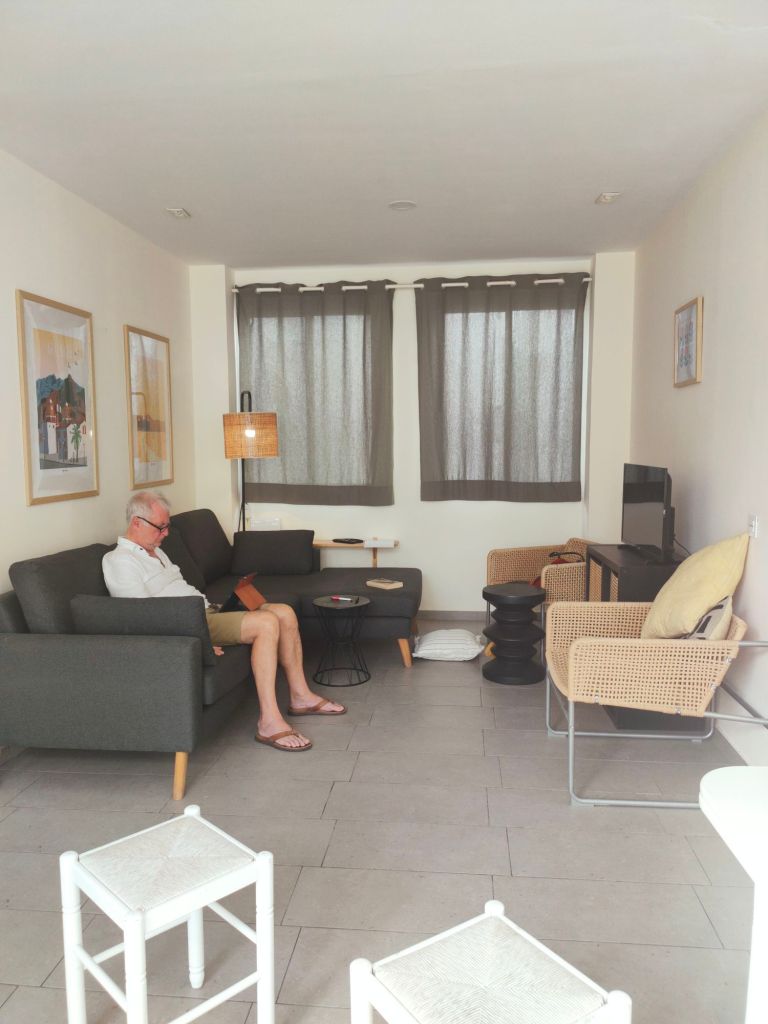
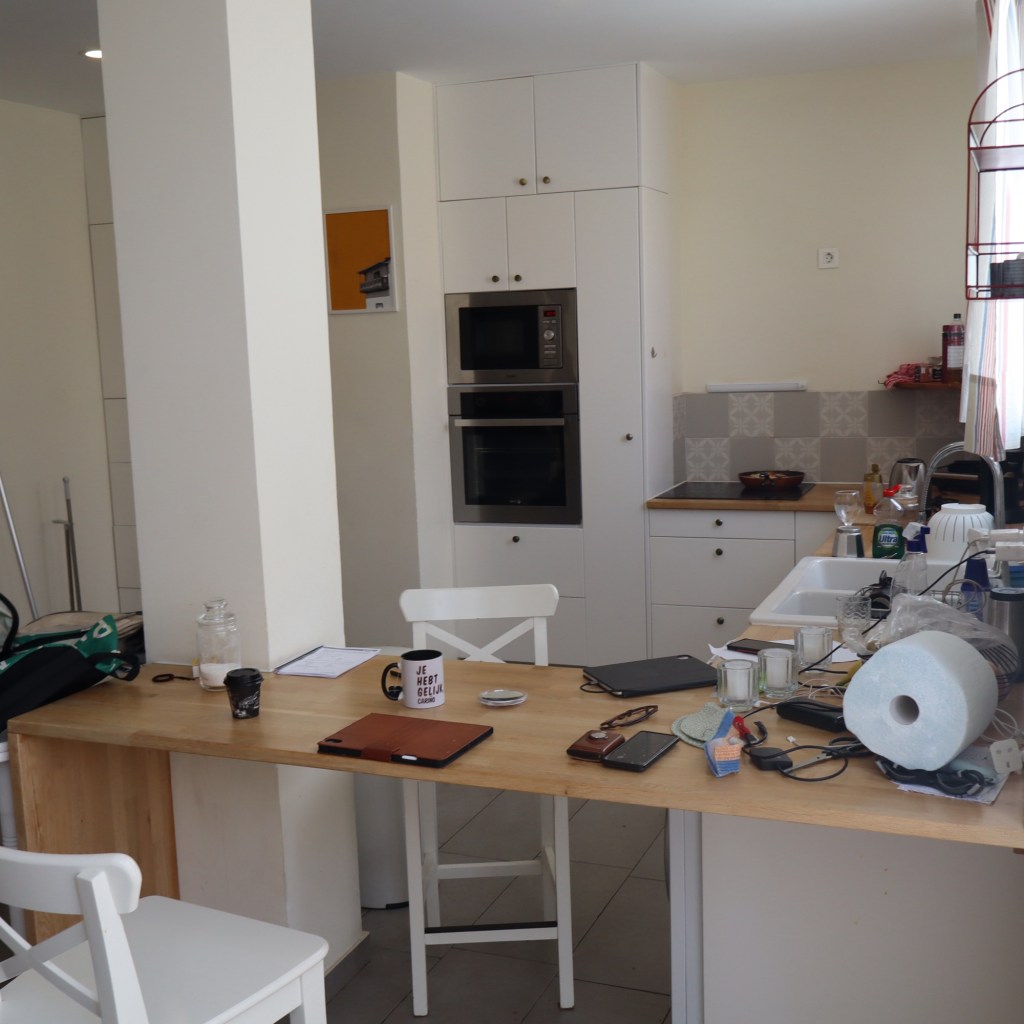
Terrace. Living room area. Untidy kitchen.
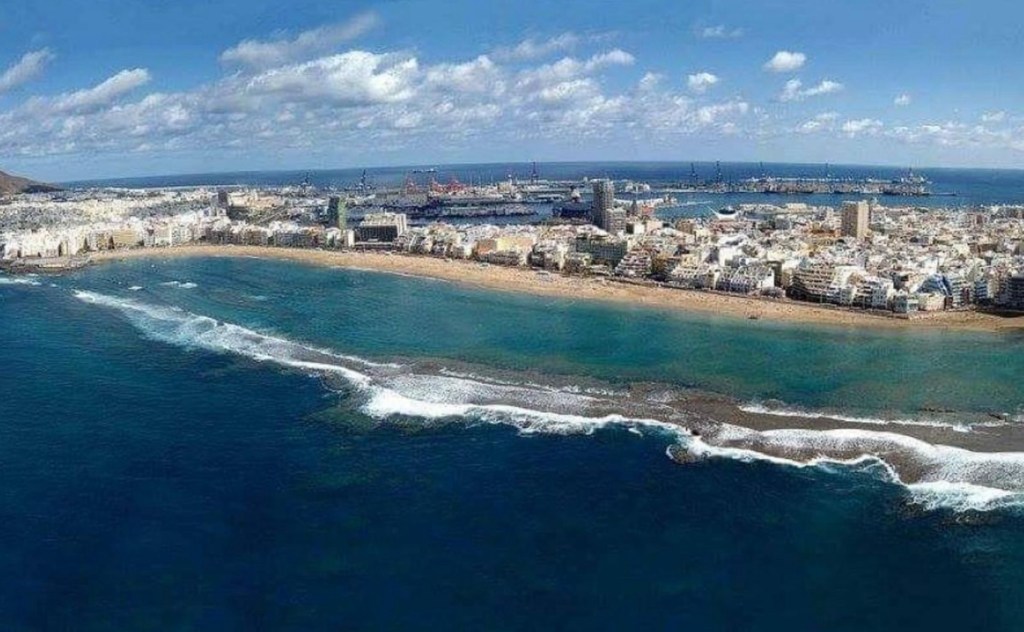
We settled into our airbnb flat 2 weeks ago. It’s on the top floor of a six story building, by Las Canteras – a 3km beach which is around three blocks west of us.
It is bright, with two bedrooms and an open plan kitchen and a sunny terrace. It’s been quite wet, although it’s warming up now, This is apparently unusual weather for The Canaries, which is supposed to be year round sub-tropical. Around 80% of the clothes I brought are useless, unless I wear them all at once. The shops are doing a roaring trade in jumpers. I’d kill for my slippers.
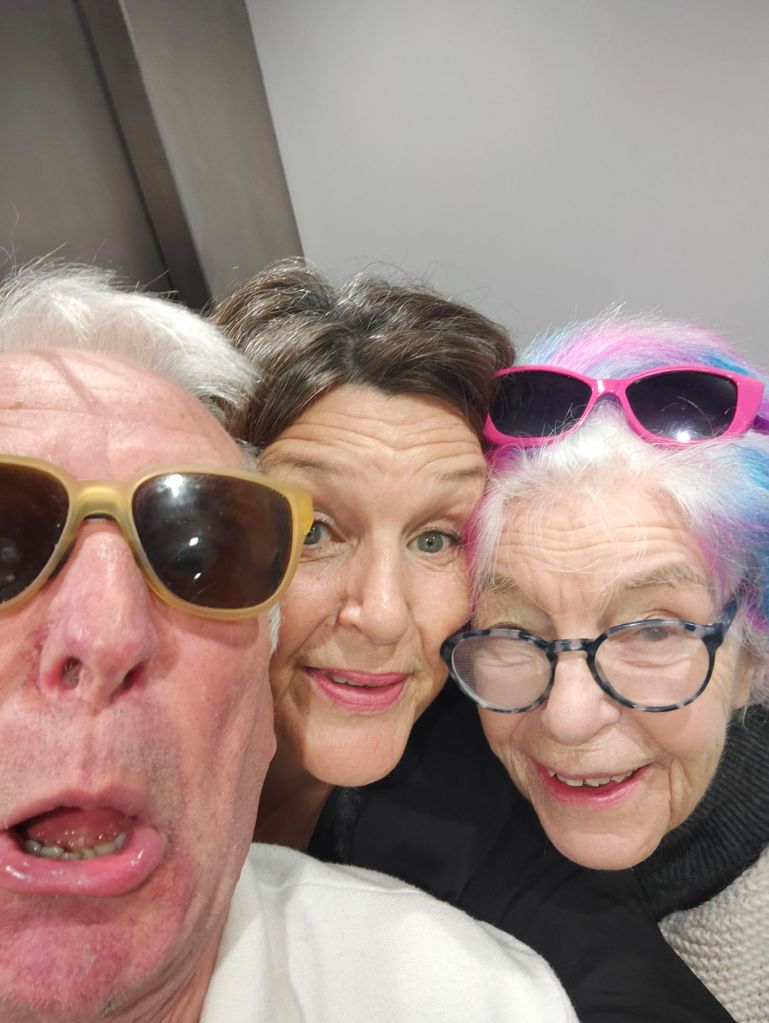
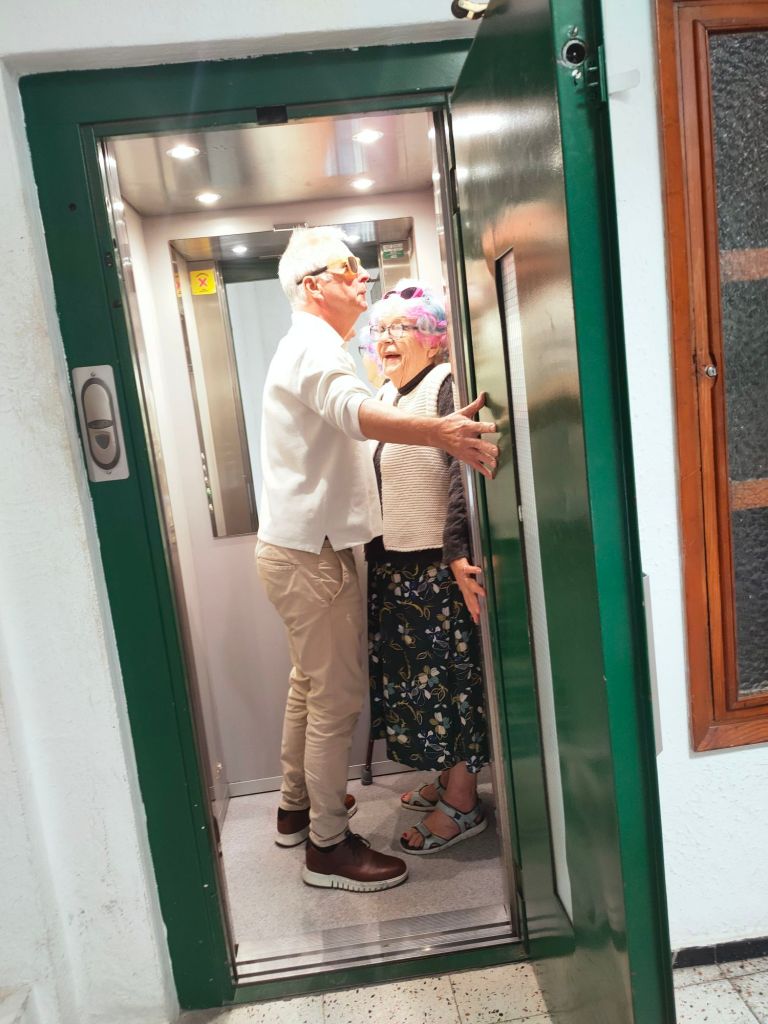
There’s a small lift, shared by everyone in the building. On several occasions I’ve ascended with a tiny Spanish old lady’s chin nestled into my cleavage, or been wedged nose-to-nose with a friendly local, a toddler nibbling my knees. Nobody cares. There are too many stairs to walk up, so we all squash in regardless.
Selfie in a lift.The lift space is limited.
The flat is intermittently noisy: odd buzzing sounds, a dog barking, drilling, traffic honking, laughter drifting up from cafés below, and always, the roar of the sea in the distance. The noises come and go, and we’ve grown used to them. Bookshops, beach, cafes, supermarkets, bars that open improbably late, (Bochinche, which means chaos, is one of them), the school, all on our doorstep. It makes us feel alive.
When we’re not nose-to-the-grindstone learning Spanish, the beach is good for snorkelling and safe for swimming — no violent undertow, only the risk of being gently shredded on the reef. Last week, it all suddenly took on an air of Clacton-on-sea, as the wind picked up, the sea boiled, and we stayed home wrapped in duvets.
At the southern end the reef disappears and the surfers lurk further out. Without my glasses they look like hundreds of bobbing seals. Further along there’s a posse of extraordinarily skilled frisbee players, apparently immune to both wind and gravity.
At the week-ends, however hard we try to channel our inner night owl, we’re usually tucked up in bed at midnight, while outside small kids play football in the pedestrianised street below our terrace while their parents sit drinking at the bar opposite. I’m tempted to stake out the scene one night with binoculars to see how they manage it. The adults never seem drunk, yet they sit there for hours.
One end of the beach.
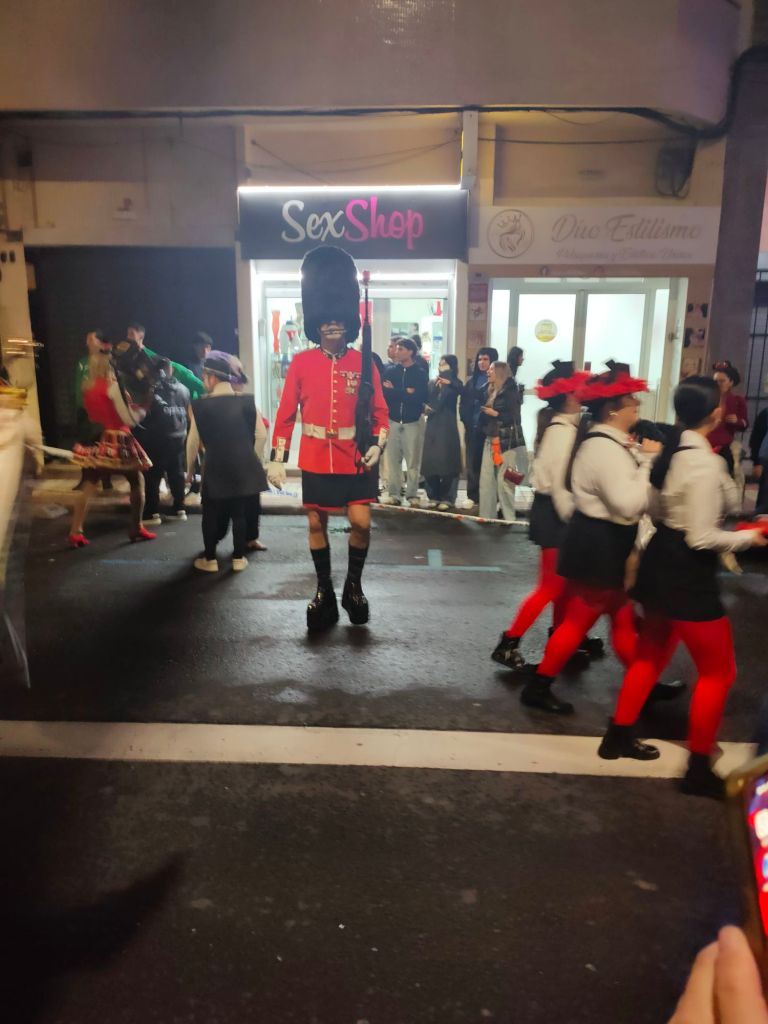
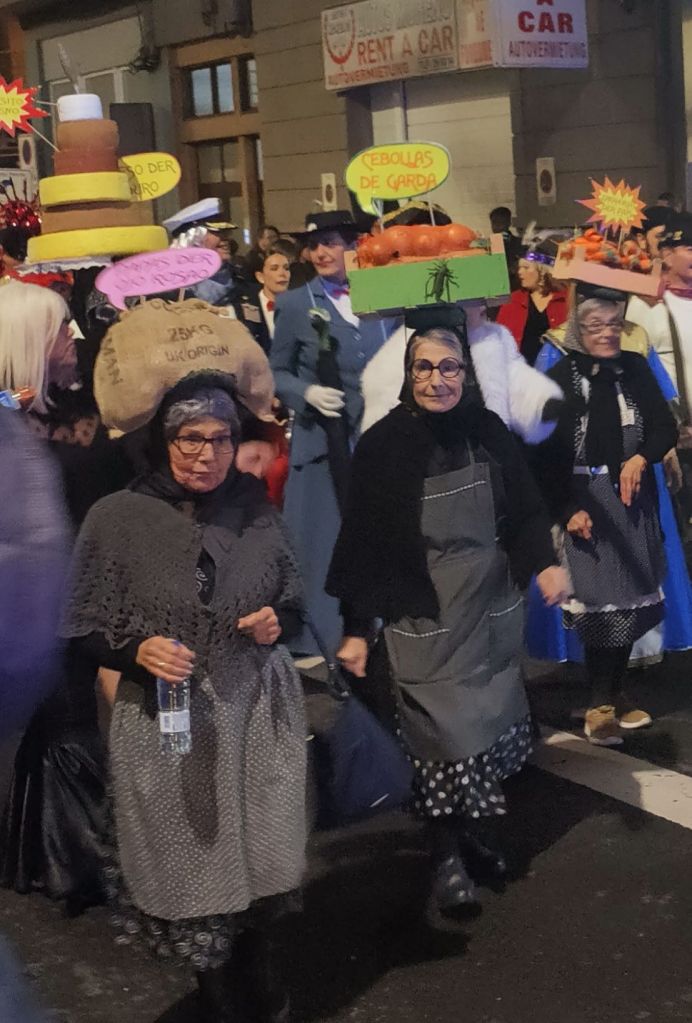
My mum’s come to see us for a few days. We went to the opening parade of a month-long festival that apparently ends in March with a giant papier-mâché fish being thrown into the sea. Who knows why? Another thing to ask our teachers’ about. They are very useful sources of local information, like how does everyone function on so little sleep? Apparently the children don’t, and fall asleep at their desks at school. With less people working in the city able to take a siesta, they function on less sleep than anywhere else in Europe. My teacher Anna isn’t one of them, as she is a “Madrugadora”; an early bird, usually in bed by 10pm.
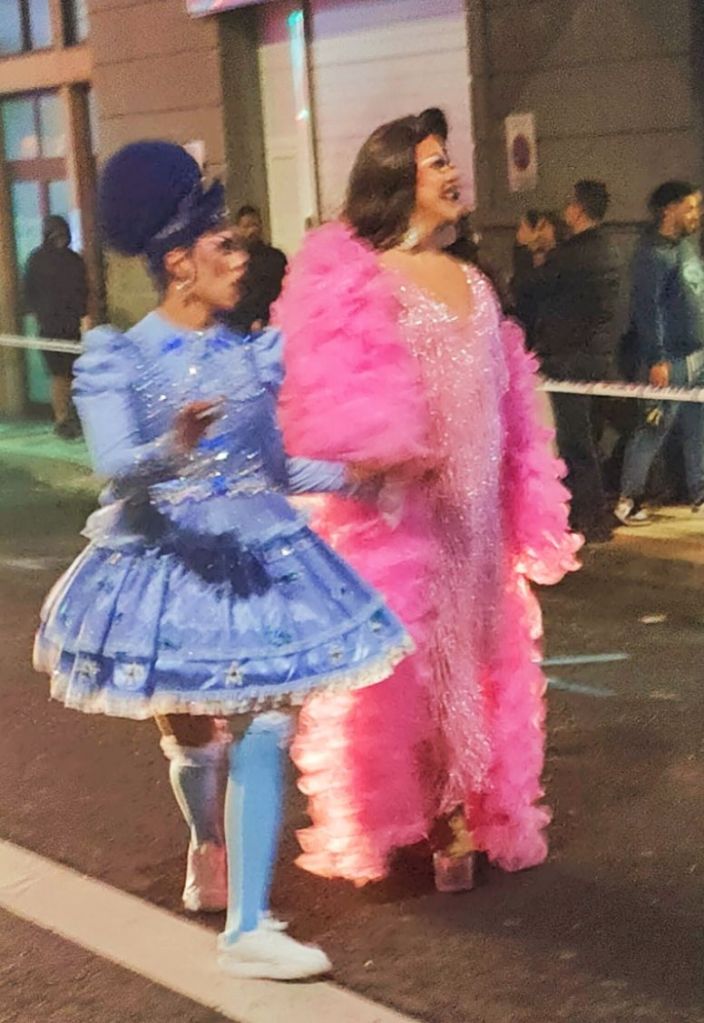
On 20th of Feb, there’s going to be a drag queen parade. I didn’t realise the background until after I’d taken the photo. These ladies were right at the front of the parade.
I’m ridiculously thrilled with the four bored Elvis Presleys.
I love how everyone dances and sings along behind the bus.
Following the parade bus.
Next week we’re going on a trip with the school into the mountains. I’ll keep you posted.
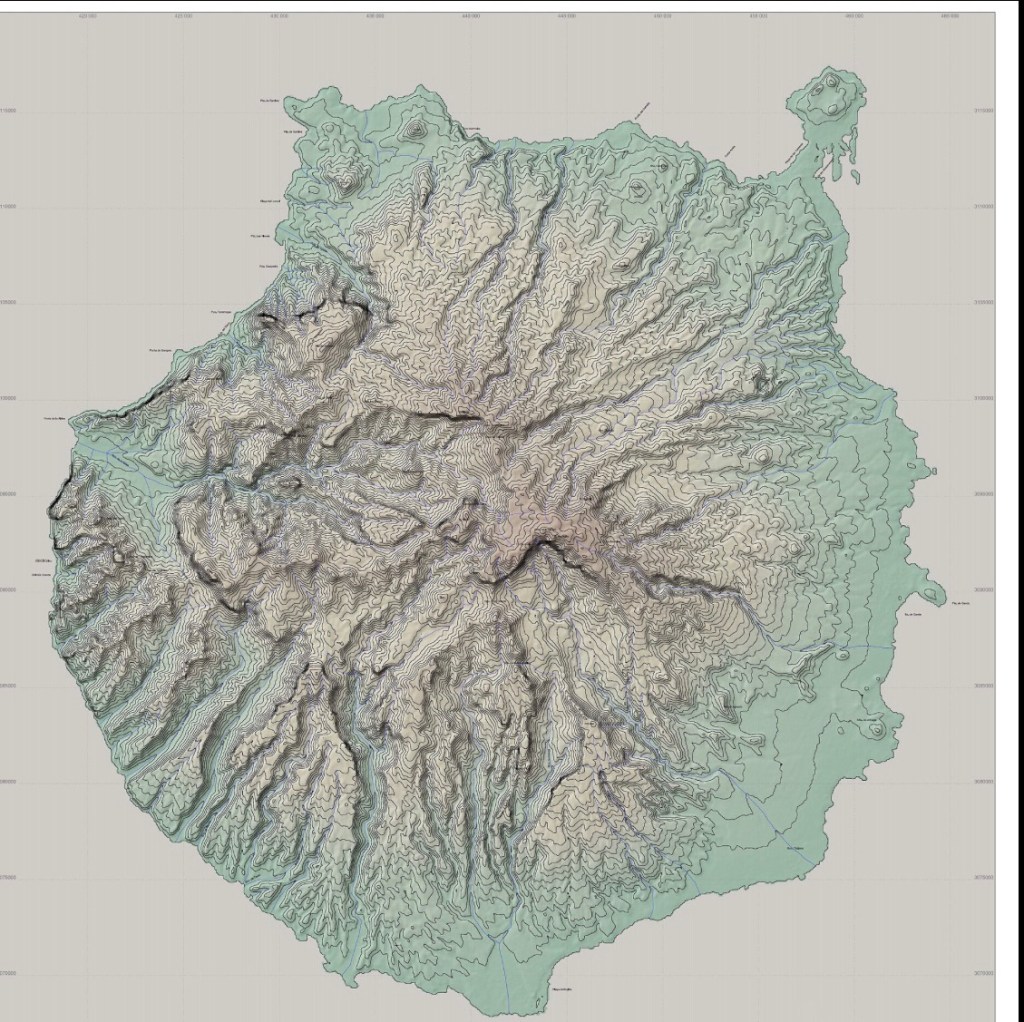
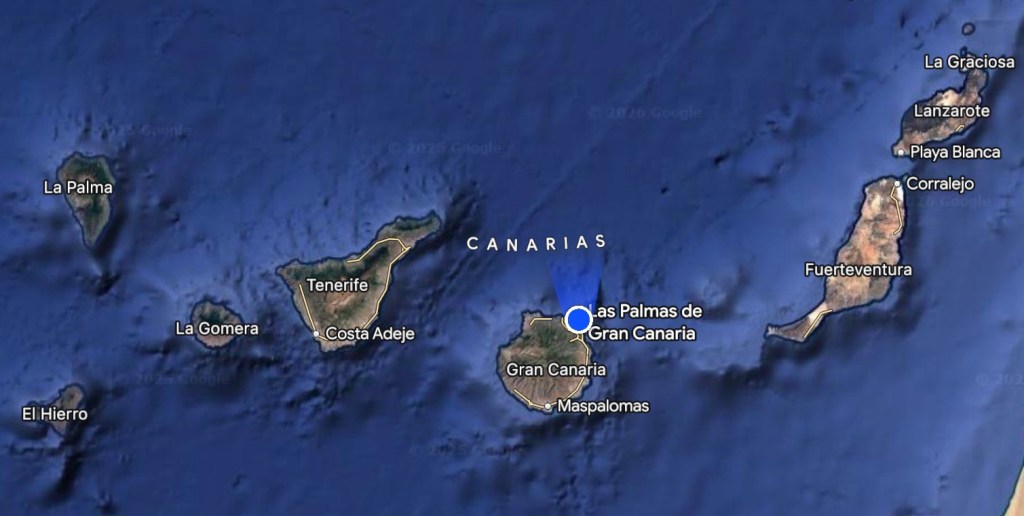
Gran Canaria – a volcanic island known as a “miniature continent” due to its diverse climates and landscapes, ranging from the Maspalomas sand dunes to northern pine forests. Gran Canaria lies (93 miles off the North-West coast of Africa.
Whenever I’m in a bus or taxi here, waiting at a crossing, and a car pulls up alongside us, a lone driver patiently waiting for the lights to change, I am so jealous of them I want to wrench them out of the driving seat, jump in and drive, goodness knows where. My car is a slice of personal space, of autonomy, me-time. Here I am never further away from Clive than a King penguin and it’s baby. I don’t miss my garden at all, as it’s November and is probably under water; instead of pruning my roses, I tend Clive’s eyebrows. But boy, do I miss my car.
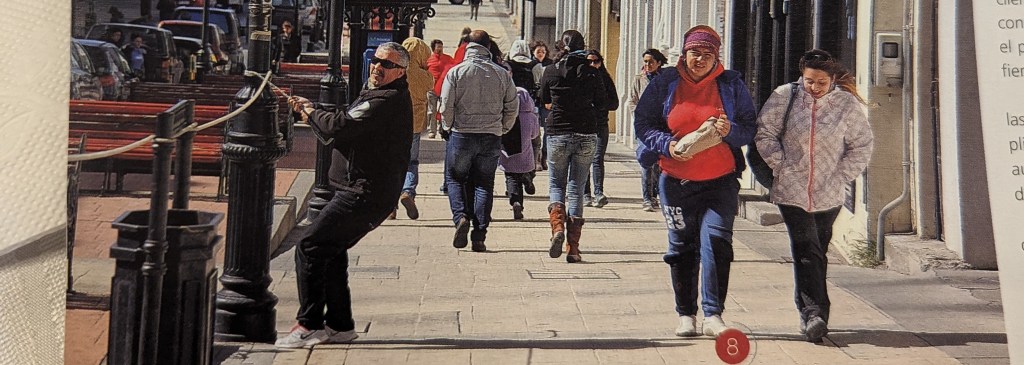
Since we’ve been in Patagonia, where ropes are strung between lamposts so you can cling on to them rather than be tossed rolling down the street like tumble weed, I have worn the same clothes for two weeks, maybe longer now – black action pants, t-shirt, snug, coat, thick socks, walking boots, woolly hat, gloves +/- thermals.
Man clinging to rope so he’s not blown away.
We stay for such short times in hotels I can’t face opening my suitcase, putting on make-up, taking it off, wearing jewellery, getting out my pj’s, moisturising, brushing my hair. My face is reptilian, wizened, dry and scaly from the wind and cold; my legs hairier than a baboons. I draw the line at not cleaning my teeth; even baboons have standards. It’s 90% liberating and 10% unhinging to be so free of any aesthetic concerns. Our waistlines, despite us being much fitter, are no thinner as our diet here, born of late night arrivals and early morning starts, centres around croissants, bread, crisps, chocolate, beer and fanta orange. I know “No friday night feeling!” is the complaint of some retirees, but the opposite can also be true – every day is a Friday.
We’ve gone feral.
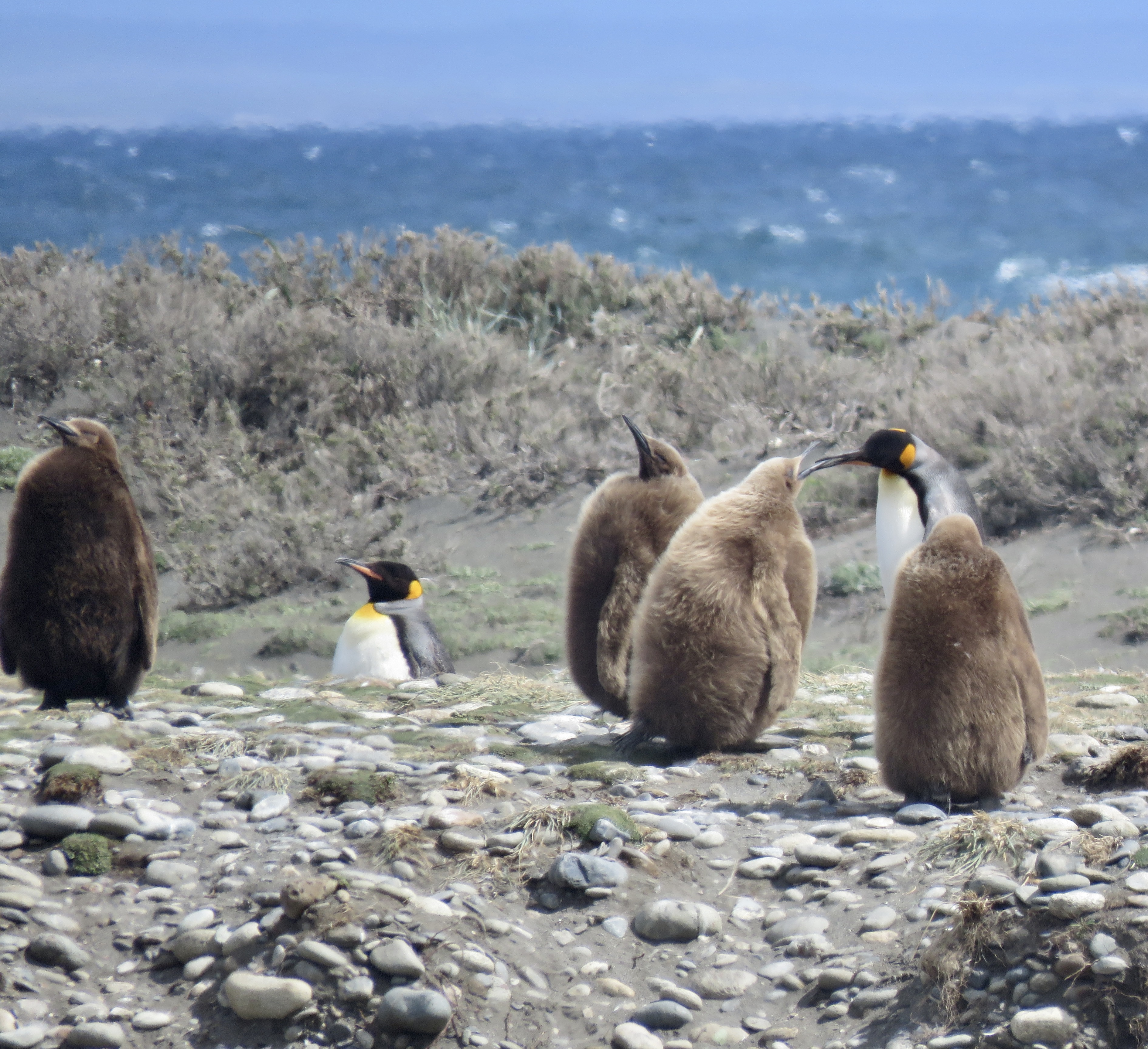
King Penguins.
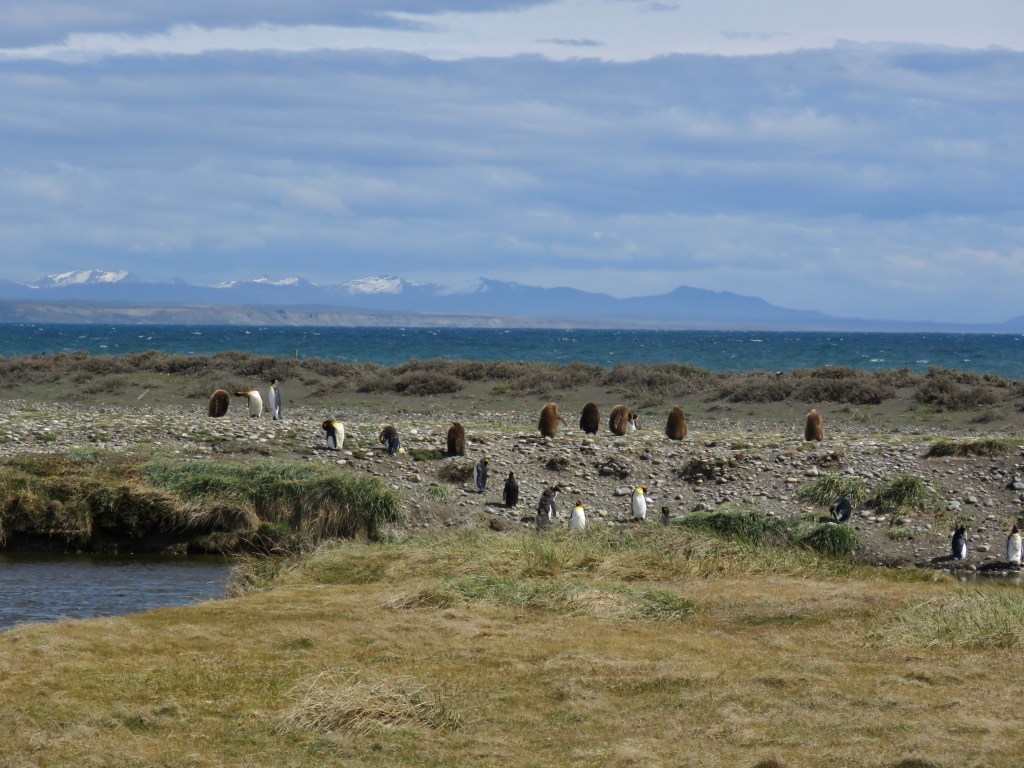
King penguins don’t care what I look or smell like. It is difficult, as we peer through our binocs off the coast of Terra del Fuego, not to attribute human feelings to them. A large wobbling ball of brown feathers shuffles alongside their smaller parent squawking up a storm, beak wide open, never more than 3 mm away, and as they gently peck him on top of his head to get him to give it a rest his head keeps popping back up, beak ever wider, squawks ever louder. A nice little metaphor for parenthood right there. They are 10 months old and in a few weeks will moult and be sea-bound, and on their own. Only around 60% of them will survive to breed. There will be about a weeks gap and then their parent will have a new pregnancy on the go. Brutal.
Most of the baby’s bulk is their feathers. When they’re in the water they look more like seabirds than land animals.
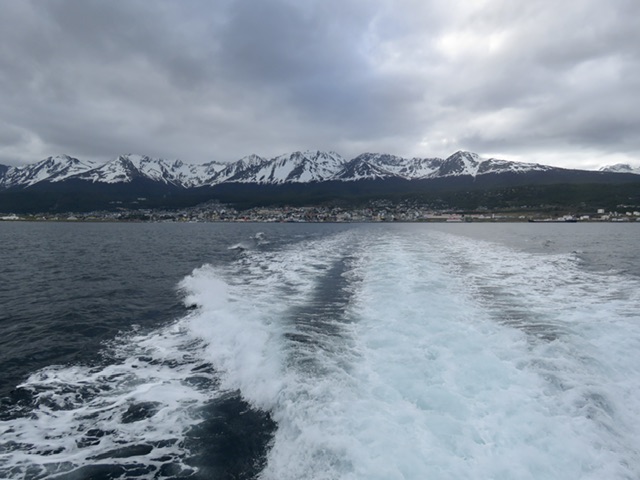
Ushuaia.
Defies expectations.
I am always struck by the difference between my expectations of a place I’ve never seen and the reality, as they rarely match (Santiago, I’m looking at you.) I thought Ushuaia would be a cruise terminal with a few scattered tourist offices, restaurants and hotels, teetering on the end of the world like the bus in The Italian Job. It turns out it’s a vibrant, smart, port town that caters for skiers in the winter and cruises in the summer, with an alpine vibe, timbered restaurants,expensive adventure gear shops, weather that turns on a sixpence from blinding bright sunlight to sleeting snow, and a bone-chilling wind blowing up the Beagle Channel straight from the Antarctic.
Old and new- the wreck a reminder that this stretch of water is perilous. Great ambience here. A church in the Main Street.
Ear wigging.
Eavesdropped gossip on our journey down, which involved our fourth passage through border control between Chile and Argentina, is that everything in Ushuaia is fully booked. Not to be disheartened, we decided on arrival to walk down to the office and try our luck.
Perseverance pays off.
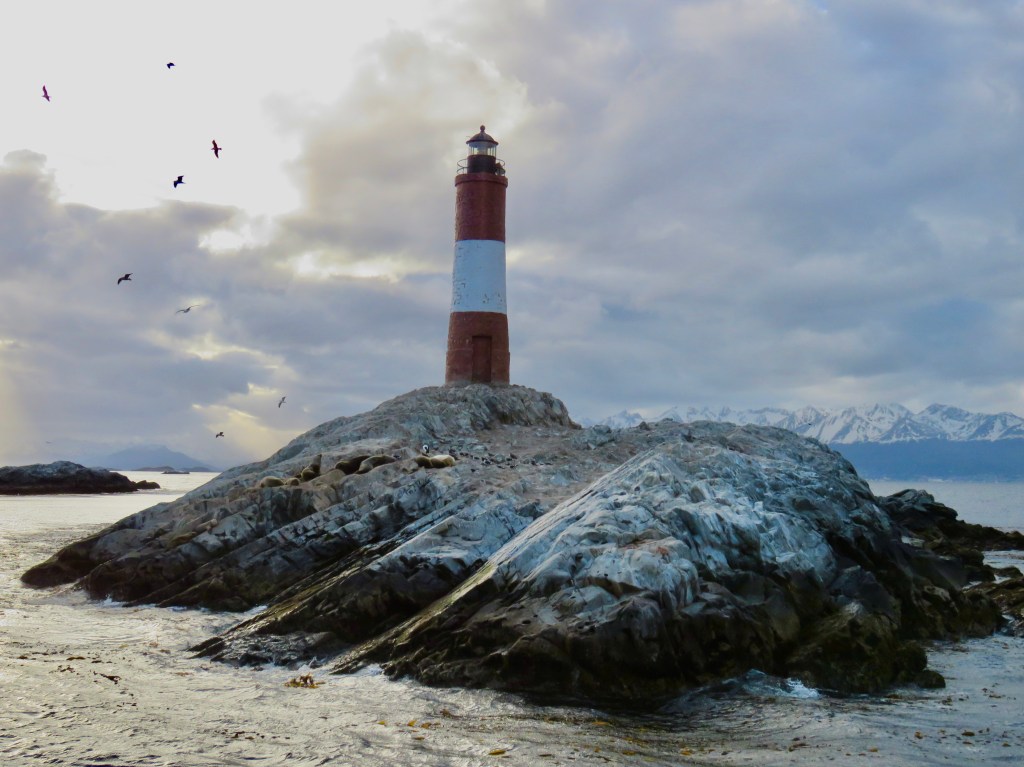
We strike gold, booking one of the last penguin viewing slots that probably hasn’t shown up on-line. The English couple in front of us booked this 3 months ago and are only here to pay, but a Frenchman who did this has discovered that because he didn’t pay on-line, he’s lost his place. We’re all trying to pay upfront in cash, as it costs a third as much than if you pay on-line in dollars, but even more if you book it through a tour operator. Pirator is the only place in Ushuaia that has a licence to let people set foot on the penguin island, and they are only allowed to take 80 people a day in 4 groups. We also have to pay for a separate boat trip on a different day, which Clive is very sniffy about but it turns out to be tremendous, with several birds we’ve never seen before, including a blackish cinclodes:
They only ever come onto the boat at the lighthouse, to drink the fresh water that lies in puddles on the deck. A rather non-descript looking bird, nevertheless it is almost extinct and can only be seen in the Beagle Strait and The Falklands.
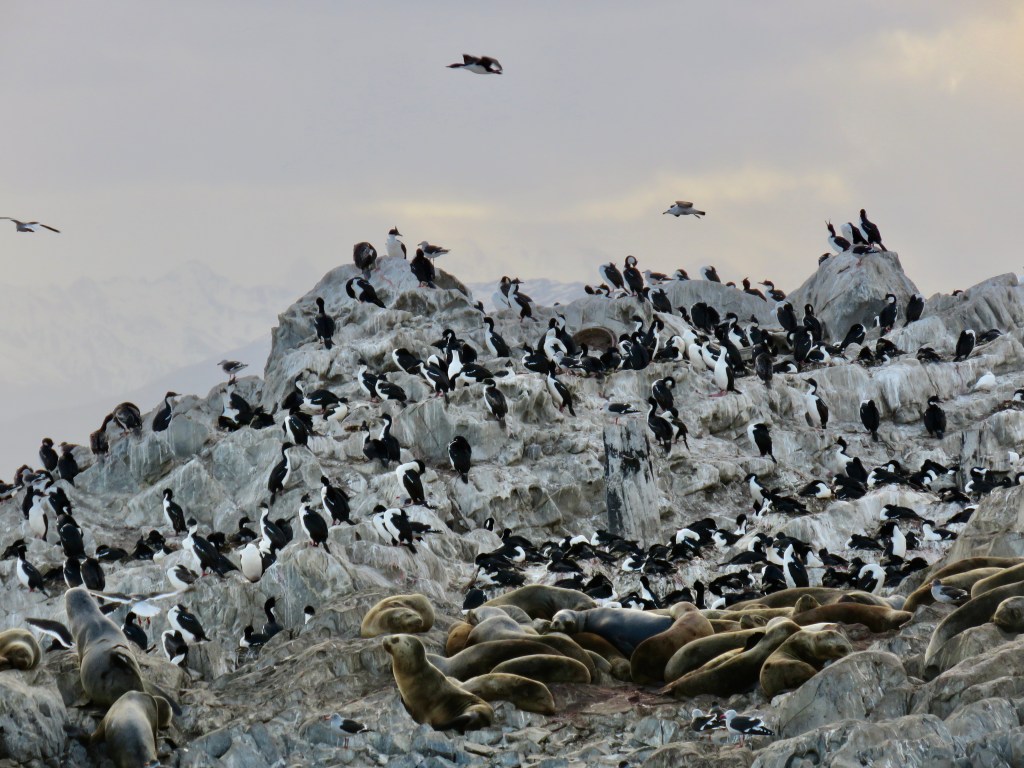
The residing alpha male seal top, a hopeful contender, bottom.
Be afraid.
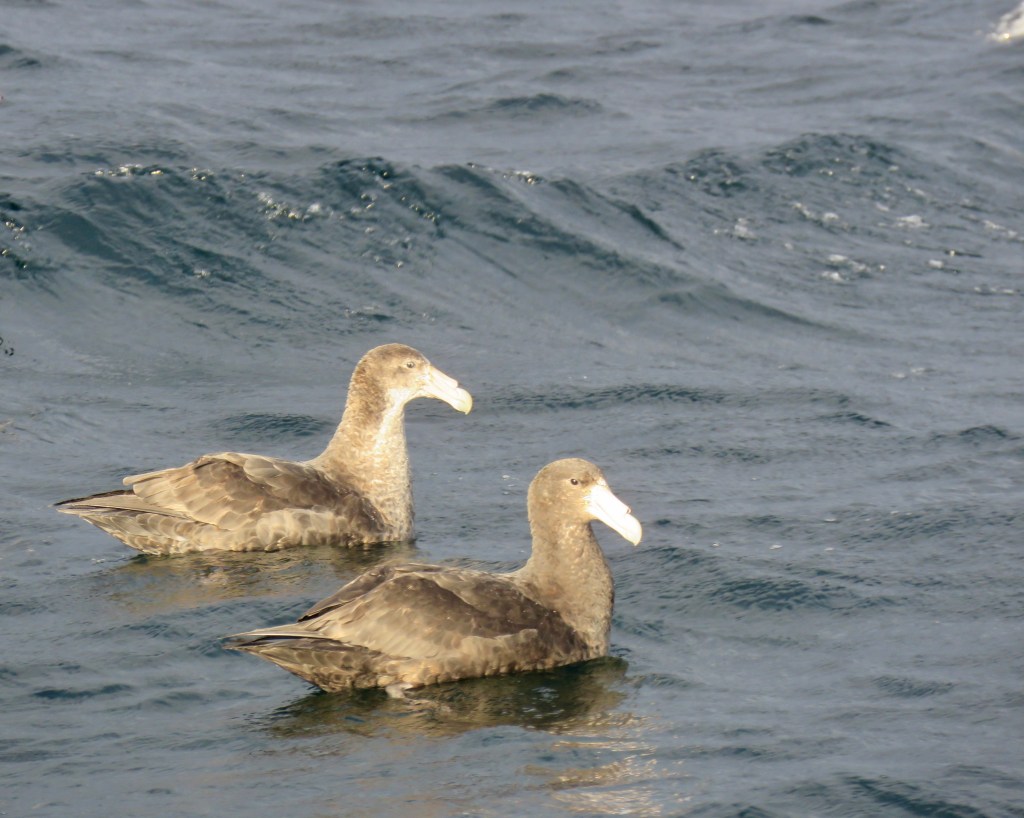
We watch as a Southern giant petrel drowns a seagull and then eviscerates it to feed on its innards. There’s something psychopathic about this – you expect to see birds fighting in the skies, perhaps to the death, but the petrel just sits on the bird in the sea until it drowns. It turns out drowning your prey isn’t unique to petrels, as orcas do it too, lying on top of a whale’s blow hole so it suffocates; then it eats only the lips and tongue. Nature, red in tooth and claw.*
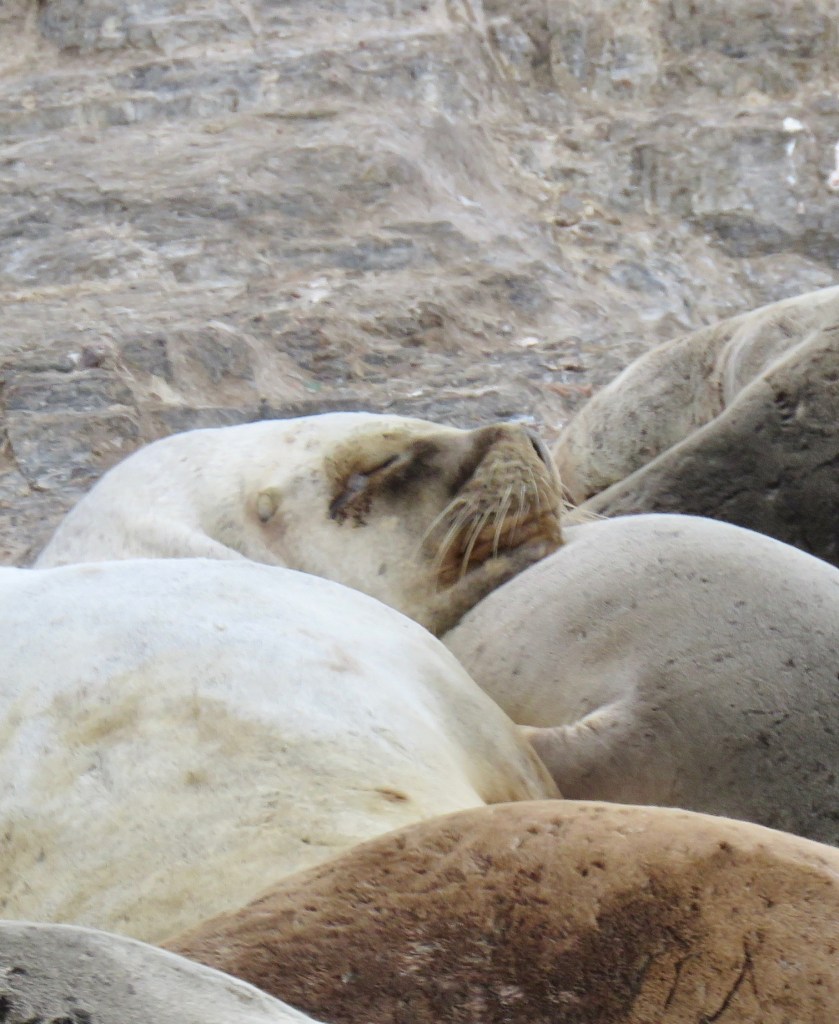
The boat takes us really close to a colony of cormorants and seals. Seals are coming up to mating season, the time for a lot of argy bargy when settled alpha males fight off young upstarts hoping to steal some of his harem of 20 or so females.
The petrol after drowning a seagull and then eating it.
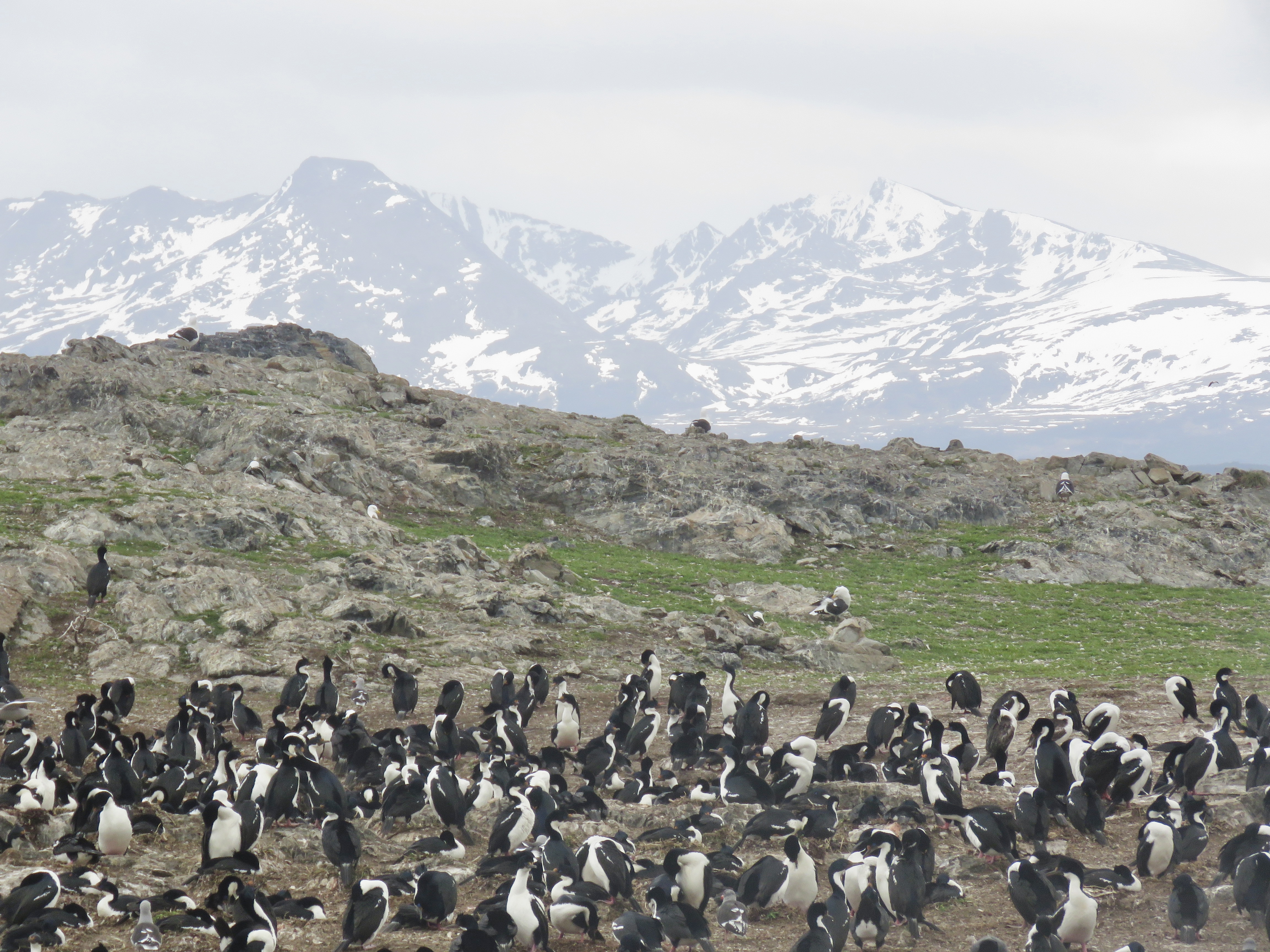
A napping femaleImperial Cormorants have piercing blue eyes.Southern giant petrols aka stinkpots.
Magellanic cormorant – no blue eyes, but has orange colour around eyes.
New Forest mud maestros.
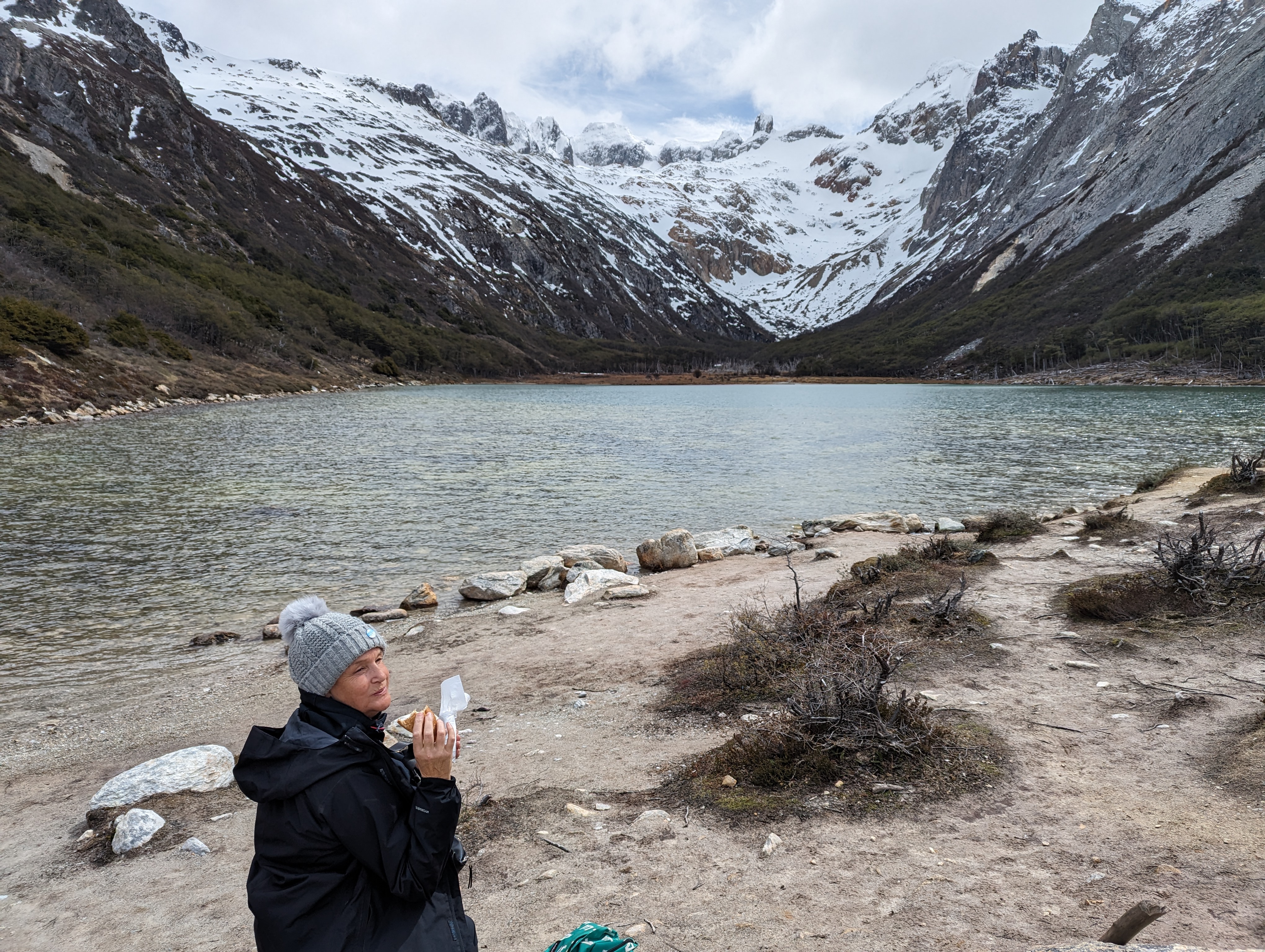
The next day we’re walking to the Emerald lake behind Ushuaia, yet another glacial lake and hobbit walk through dense, dark woods, river beds, gnarly paths, steep climbs, but with the added thrill of mud, mud, glorious mud. I feel we are mud maestros, having walked in it, through it, over it with kids, dogs and grandma’s for 25 years in The New Forest – we know mud. And so it proves. We can hear the cries of laughter as groups get stuck sinking thigh deep into the infamous bog as we take the firm left hand side by the river, gratifyingly overtaking them all. (No-one dies).
A crested carcara, after my sarnie.
I don’t know if it’s the altitude we have been at and all the walks we’ve been doing but we fly up to the lake and back, and when we share a taxi back to Ushuaia with a Canadian he jokes that we beat everyone on our bus, most of them under 40. Except him. Competitive – moi?
When a man is tired of penguins, he’s tired of life.
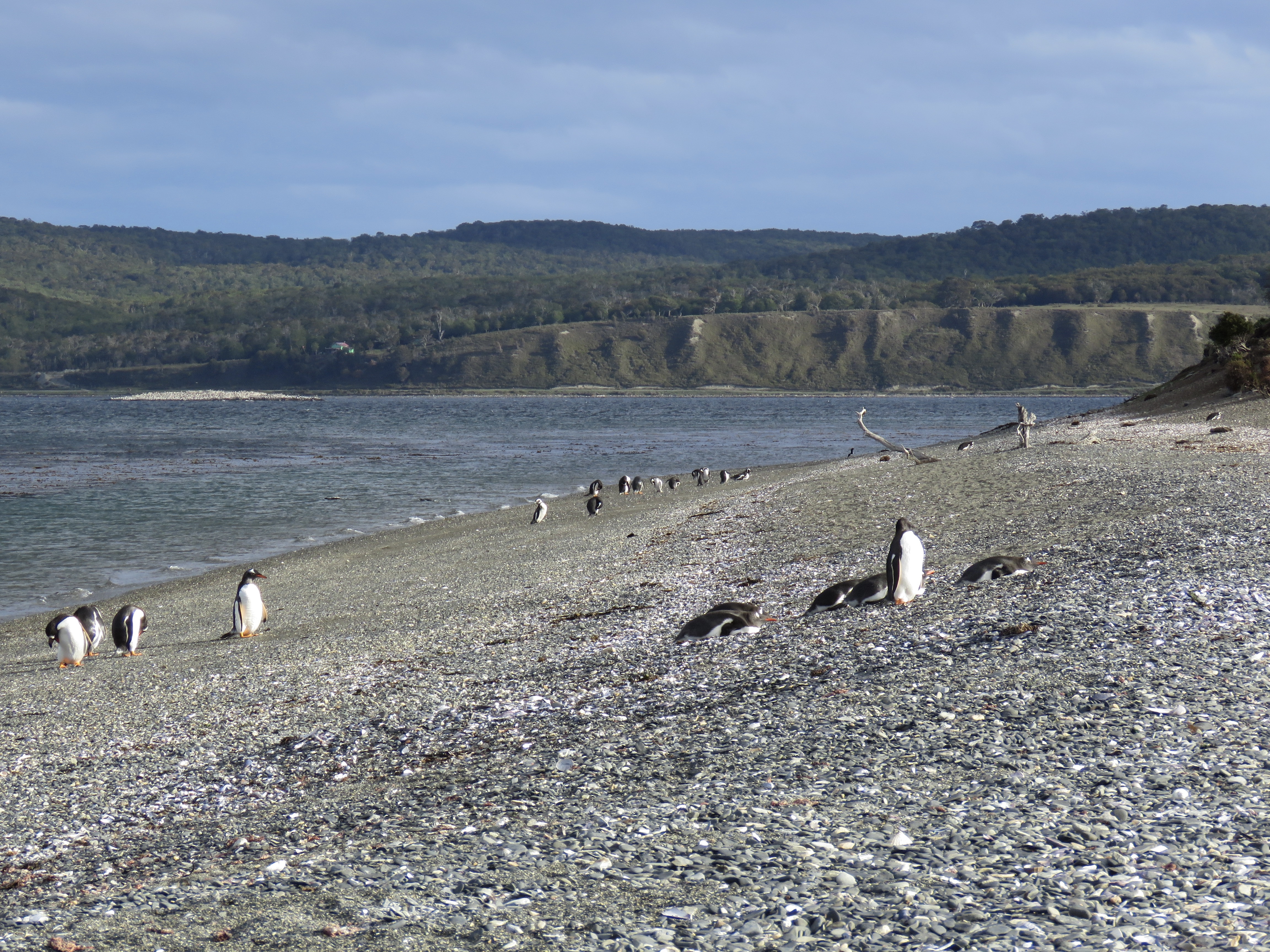
Below – penguins oiling their feathers on Martello island.
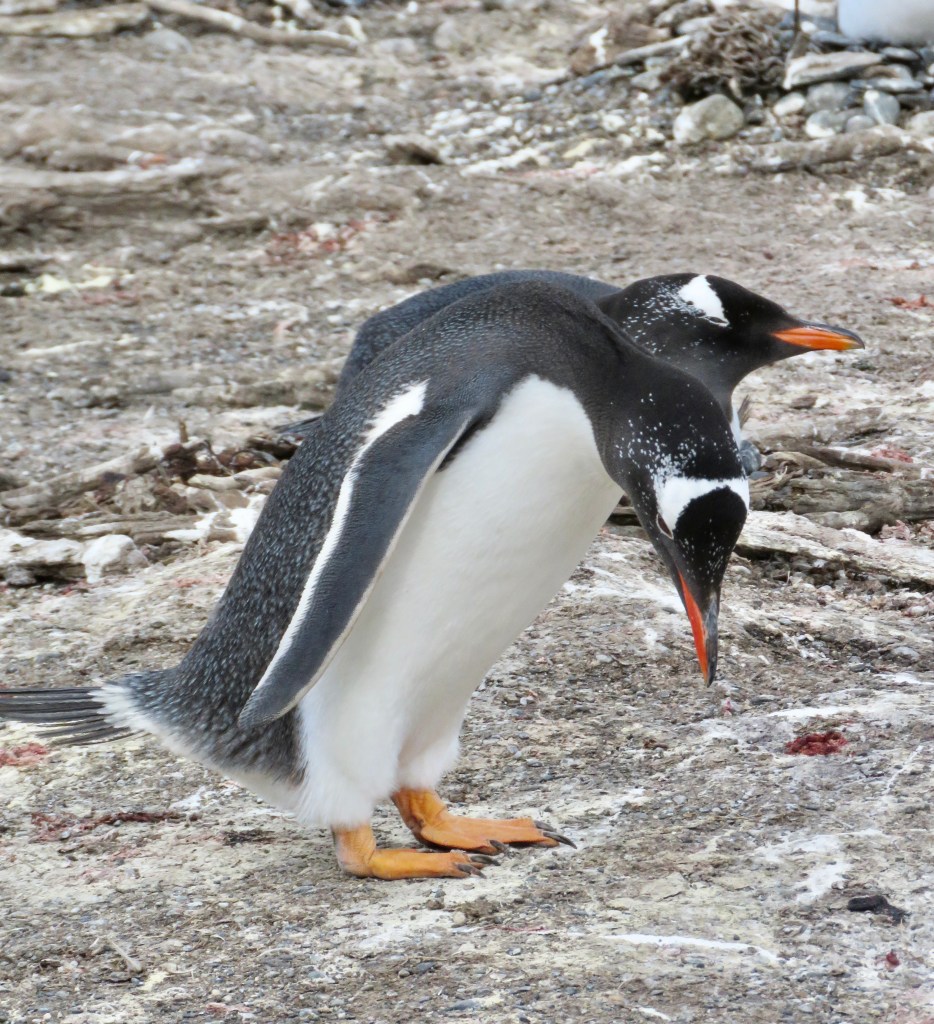
Gentoo penguins.
A Gentoo penguin nesting on their egg/son it’s stone plinth.
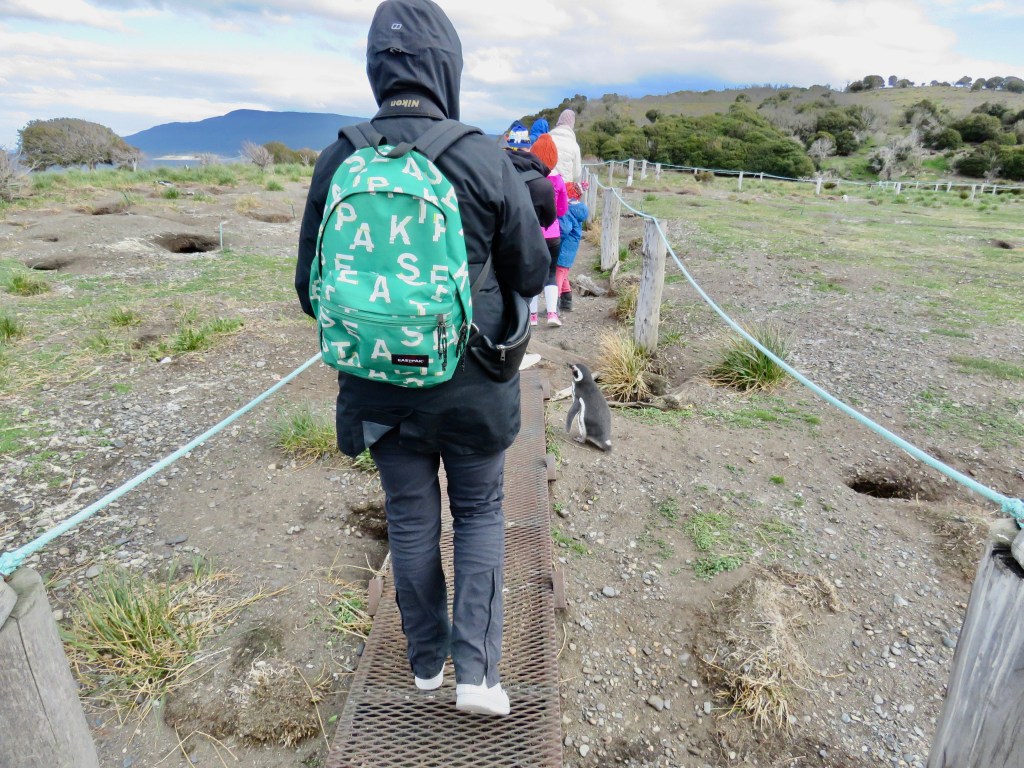
I move out of this Magellan penguin’s way.
“Well, I never did…”
On our last day we visit Martello island to walk among Gentoo and Magellanic penguins, and one stray King penguin. It’s a peaceful place buffeted by a gentle breeze around 20 minutes by rib from Harberton Estancia, a sheep ranch owned by an English family for 150 years. The farm was the first estancia (ranch) built on Tierra del Fuego in 1886.
Photos above show the estancia loo, sensibly placed I feel, then a barn oozing history and dust, and lastly Clive by the rib that took us to Martello island.
No selfies and no coughing.
Our guide gives us strict instructions about staying 3 metres away from them, not poking them with a selfie stick or breathing near them. Avian flu is on the rise and they absolutely do not want it here. Some of the Magellan penguins didn’t get the memo though, and stand in our way on the path. There’s quite a few small children in our group and I am surprised by how good they are, even the toddlers tiptoing silently around the penguin who doesn’t seem bothered by us (they are very shortsighted out of the water).
Monogamous penguins.
The Magellan penguins are here year round and are monogamous on a yearly basis, and as they are currently breeding, we can see one or other parent down in their hole on the egg/s while the other is at sea feeding or oiling themselves down on the beach to stay sleak in the water.
Romance very much alive in penguin world.
The Gentoos arrive every October to mate. The 2-3 year old males display their worthiness by presenting single females with their best stone, rubbed smooth by the sea, to lay on their future nest. They lay their eggs on a pile of bricks as they think they’re on ice although they’re not; it’s touching to see their mate hovering near the nest, gently tucking in a stray feather here and a bit of fern there under their mates bottom to keep the eggs snug.
A Gentoo penguin lining their nest.
Next stop a Welsh colony – and some whale watching.
We are now heading North for some whale and dolphin watching in Puerto Madryn on the east coast, plus a spot of Welsh breakfast. It’s 25 degrees, apparently, which I just cannot imagine.
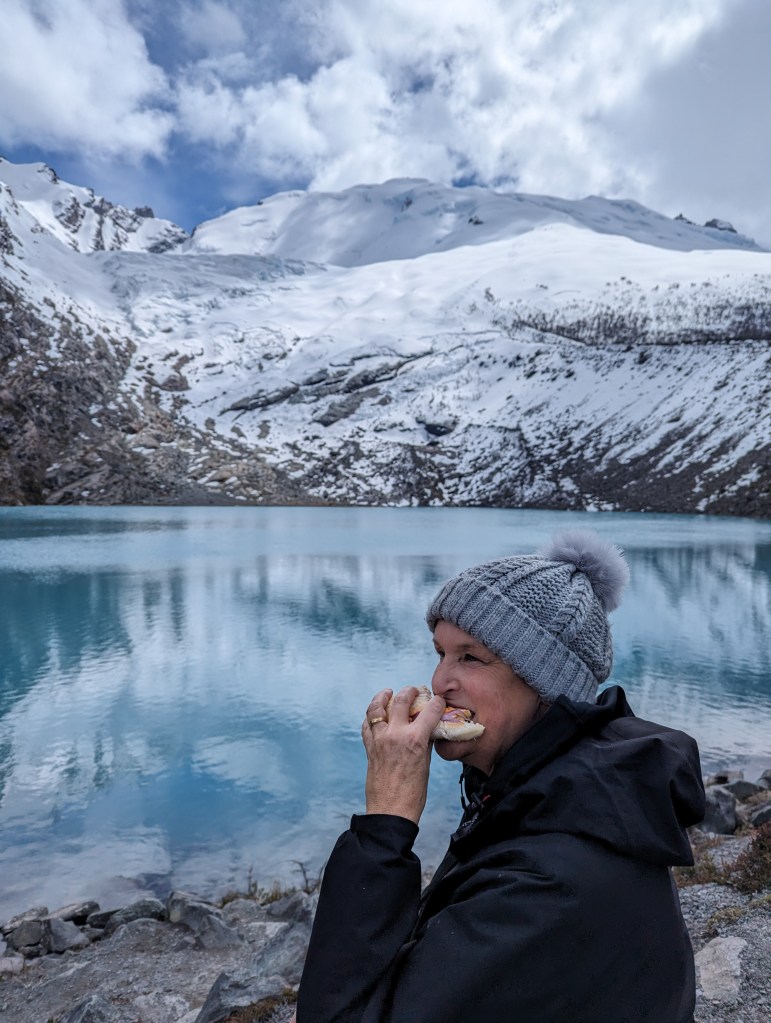
The word for blue in Spanish is azul, which seems like the perfect word for the blue of the small glacial lake we’ve just climbed up to. On a scale of 1-10, 8 for me being Ben Nevis, this is maybe a 6. It’s only an hours climb, and quite steep. Our lovely airbnb host told us there’d be a 30 km bus ride and I’d imagined a number 59 bus taking us along a tarmacked road to the start of the walk; silly me – we took a bone rattling minibus crammed in with 14 others, along a rough old track alongside a river with trout making their way upstream, and mountains on all sides. It snowed intermittently, but we were lucky, and as we climbed through the forest the sun came out, and we made it to the top and the glacier. It turned out to be a good training walk for the big one we do a couple of days later.
Laguna Torre
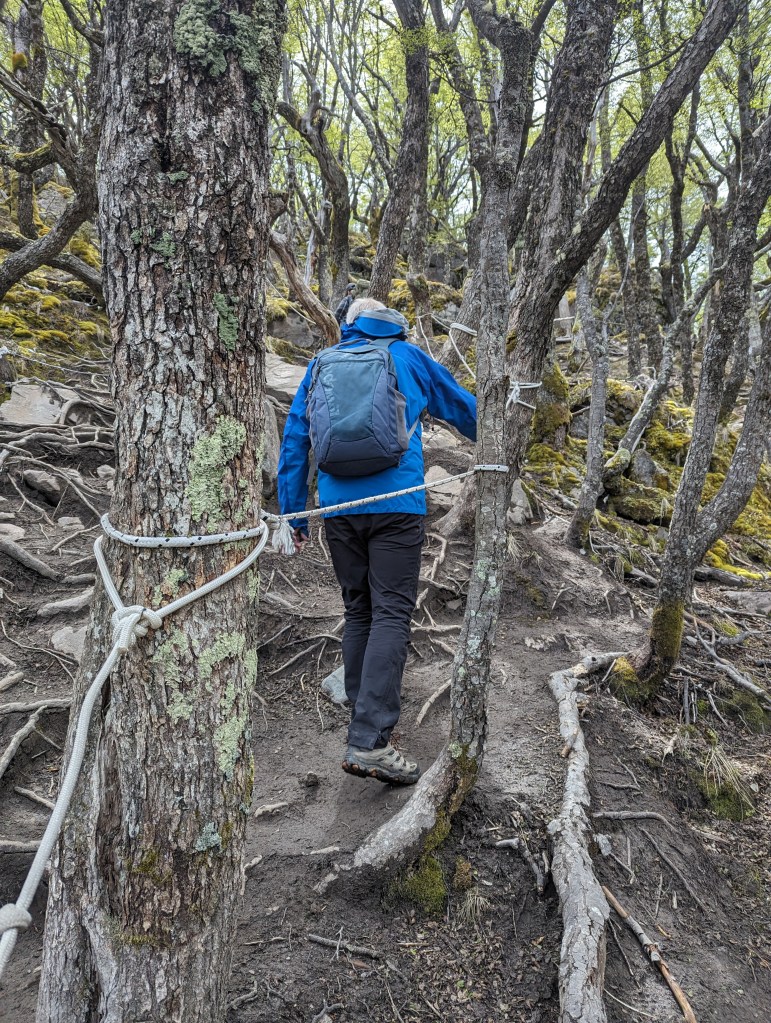
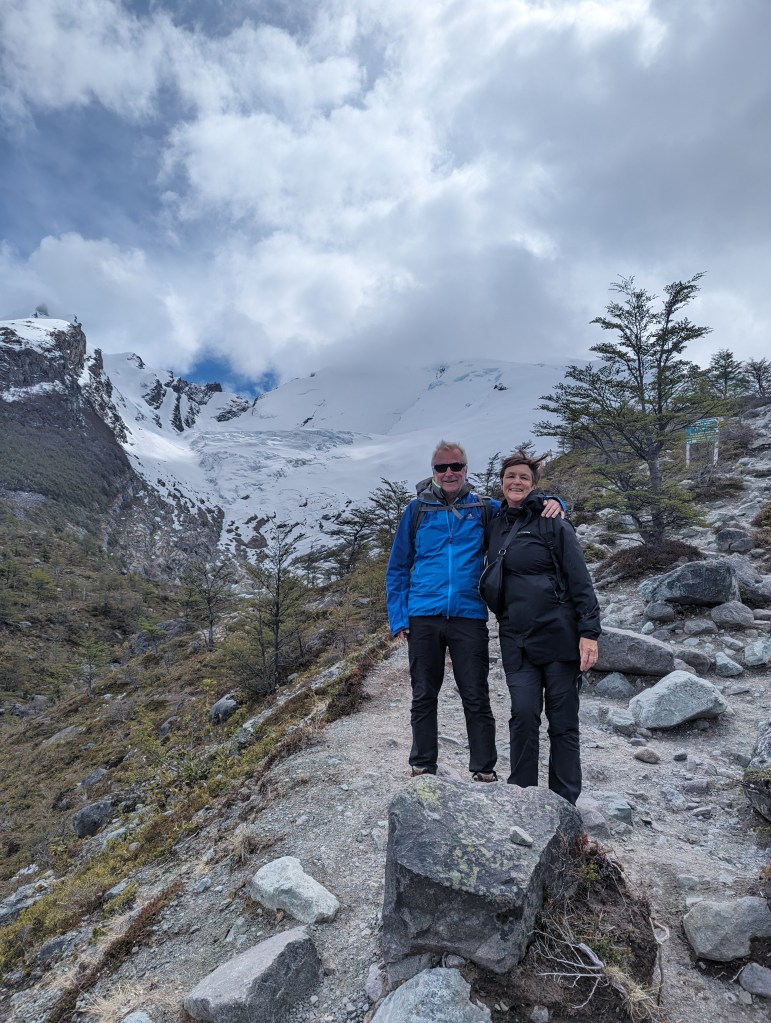
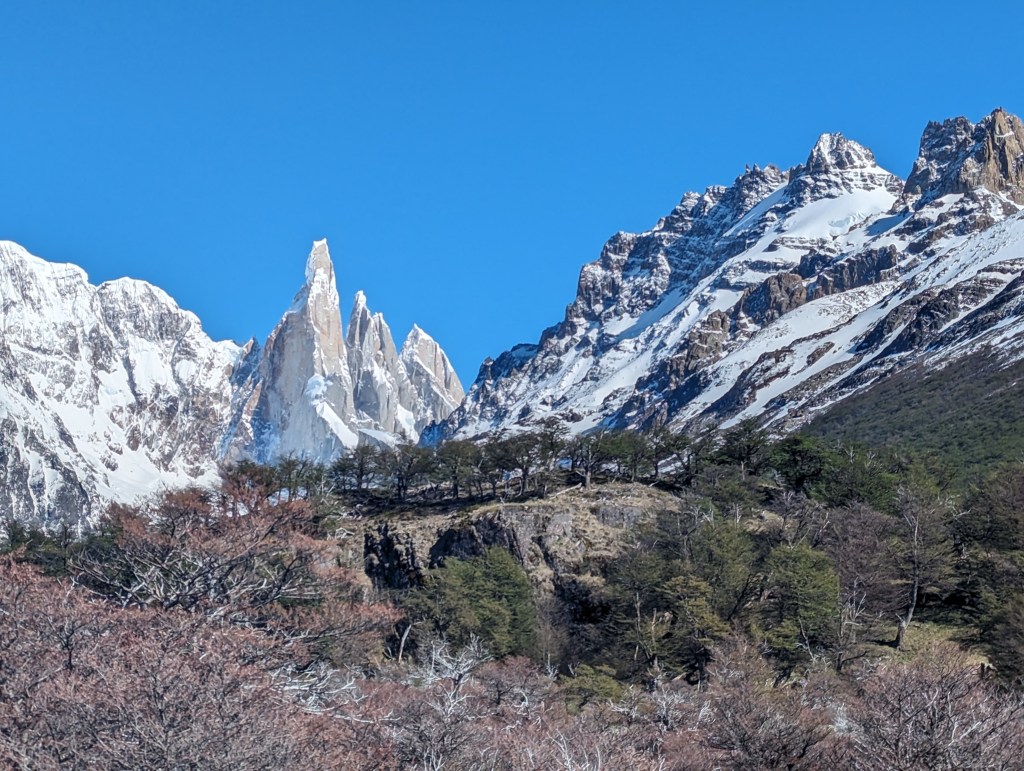
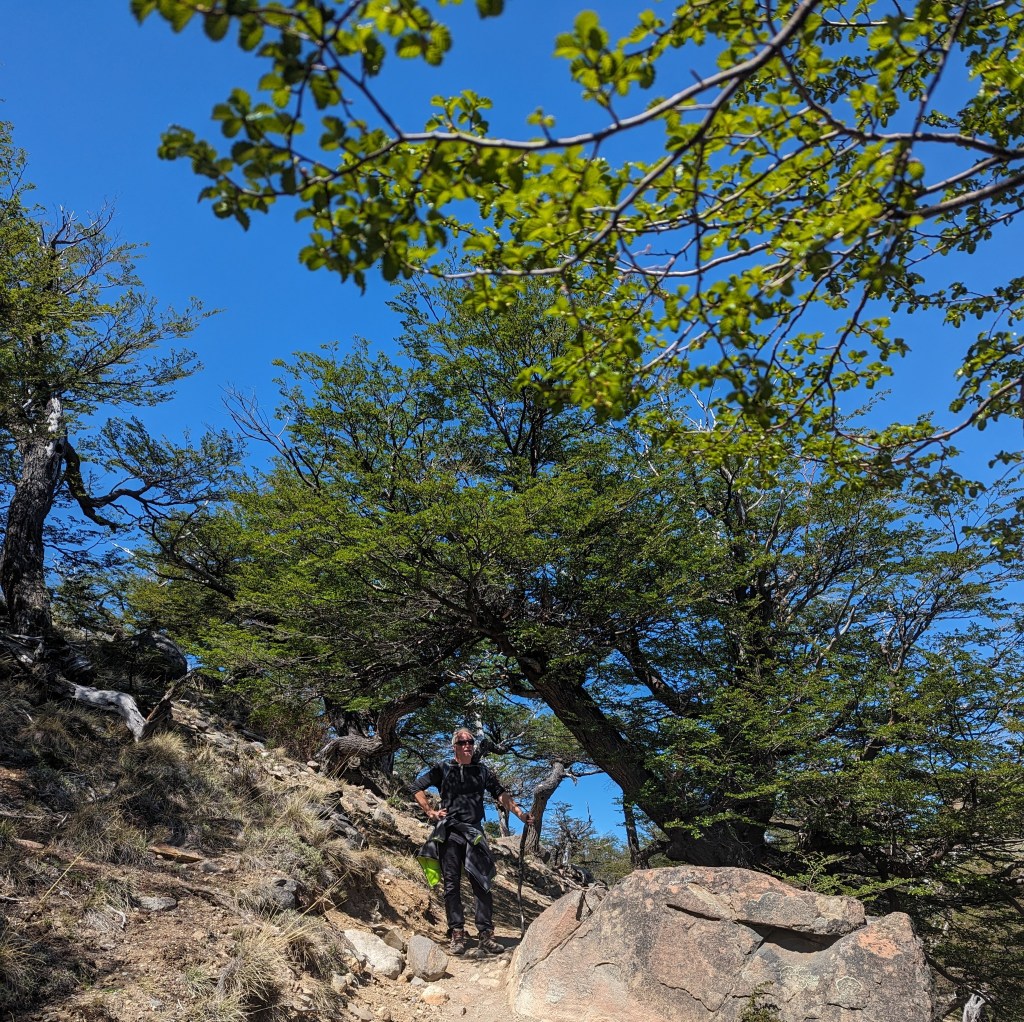
With steep climbs requiring chains to pull yourself up, passing through gnarly old woods, dried out river beds, and paths laced with tree roots, it was quite the hands down hobbitiest walk I’ve ever done. A 24km round trip, culminating in another Glacier above a glacial lake lined at the edges with a lot of exhausted people, mostly a good 30-40 years younger than us – yay for the oldsters!
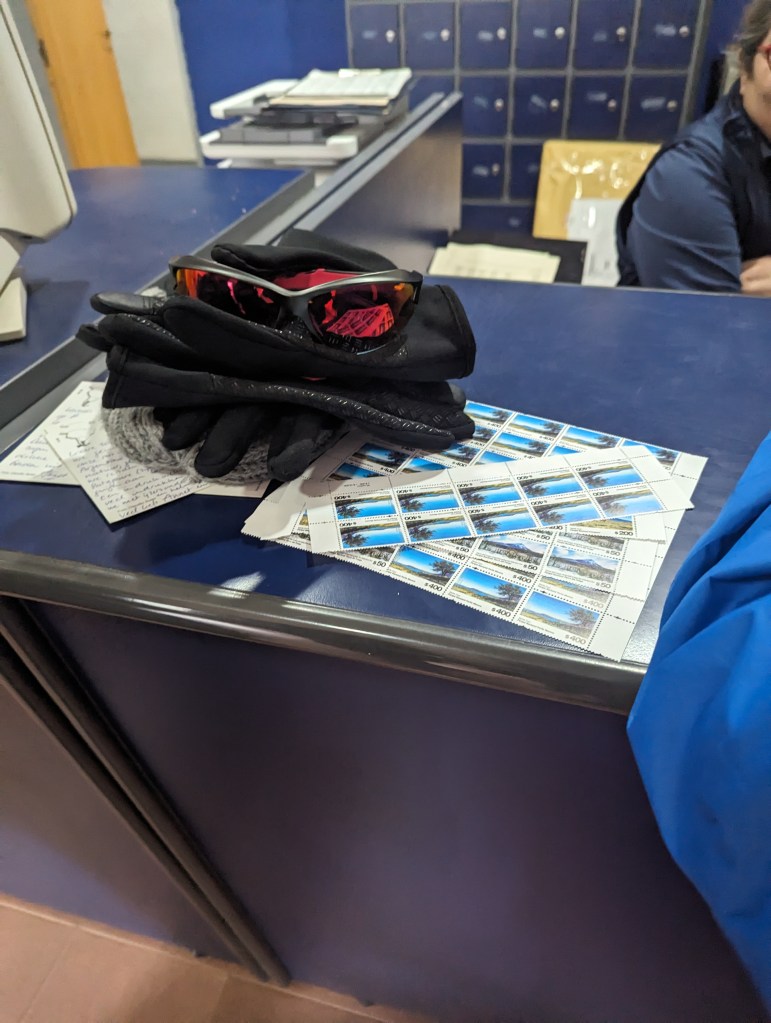
Stamp inflation
Lucky I’d left a gap for the 7 stamps
We have an amusing interlude in the Correa (post office), as it seems impossible to buy stamps anywhere else. The lady behind the counter sends us all , one by one, into a queue for stamps, where no one sits behind a counter, and she busily avoids our eyes as we eventually bond with the rest of the queue as we wonder why she can’t sell us stamps for our postcards, and how late Ng we’ll be waiting. Eventually another lady appears, the stamp lady, clearly, and shows us how to put the 12 stamps required per postcard costing £2.25 red rate onto each card. I end up buying 18 quids worth, due to my useless Spanish. Inflation has hit the stamps as well as the money.
Torres del Paine.
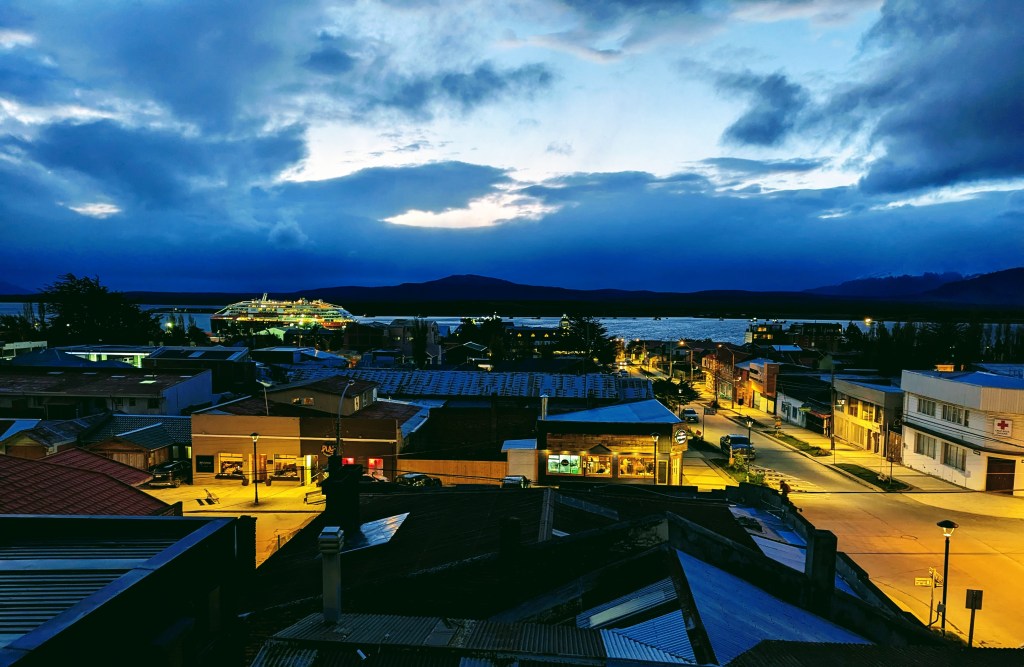
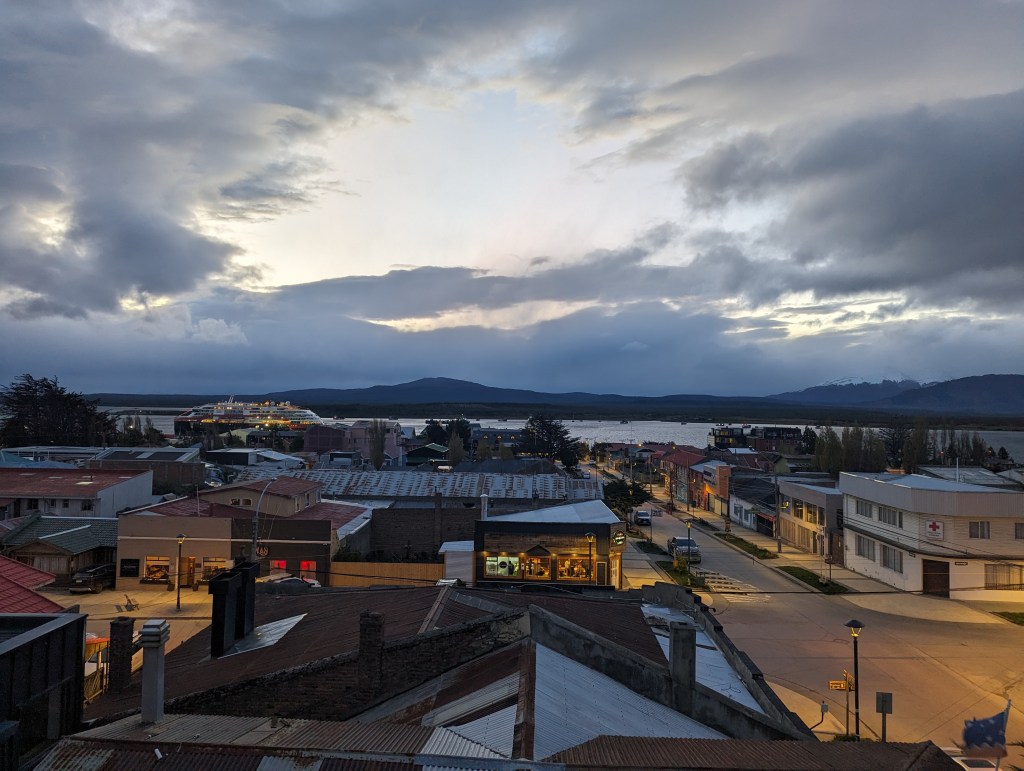
Puerto Natales from our windowAnother hotel viewAnd another. That’s a Hurtygurty cruise ship in the harbour – I have had ambitions to go on one ever since my friend Margaret sent me a goodbye-old-friend-I’m – about-to-die- in- a-storm email from one. She survived.
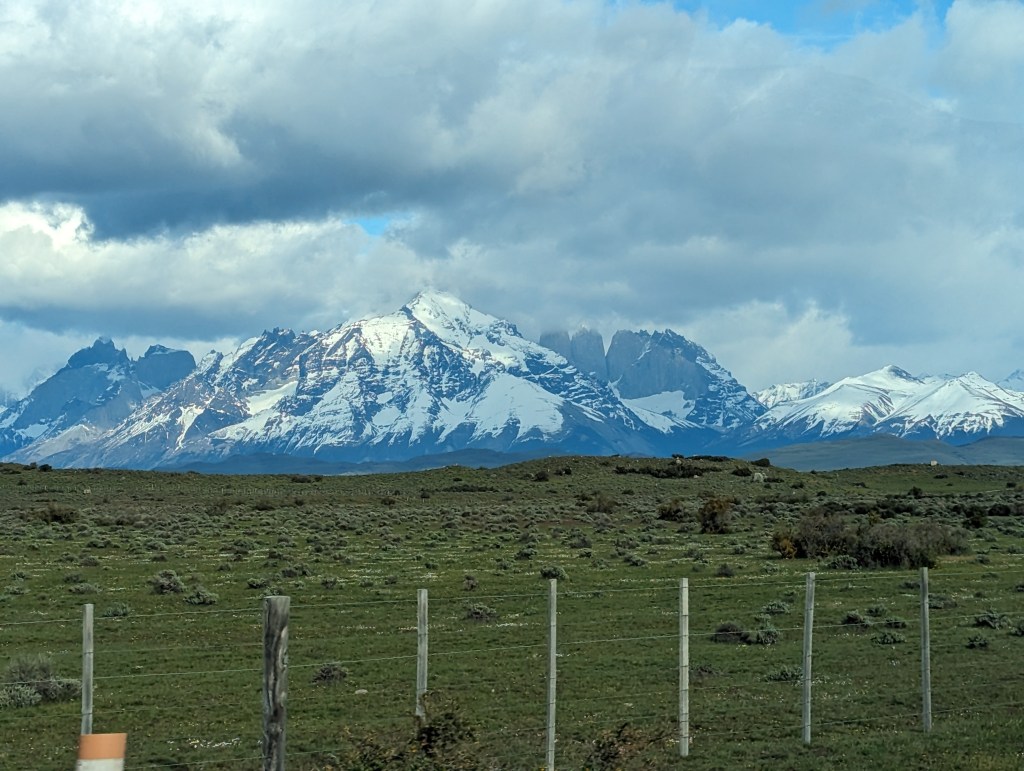
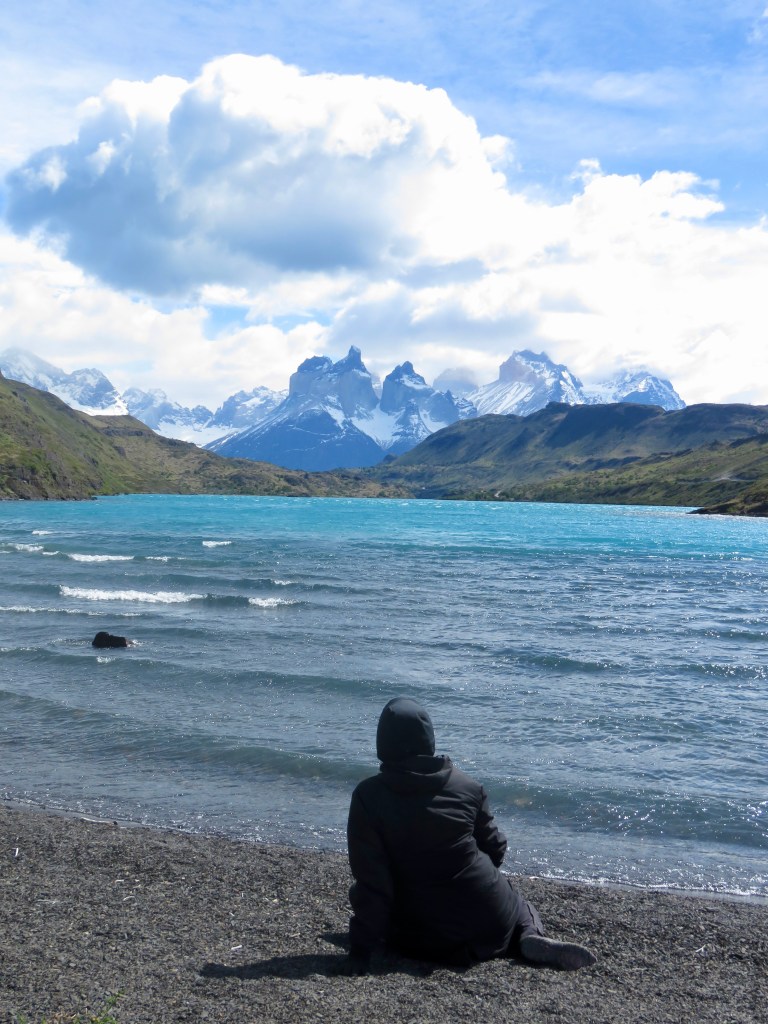
We left El Chalten and 8 hours later arrived by 2 buses in Puerto Natales, a very smart little town in Chile we’re using as a jumping off point into Torres del Paine National Park. In Spanish and a native language called Teheulche this means Towers of Blue.
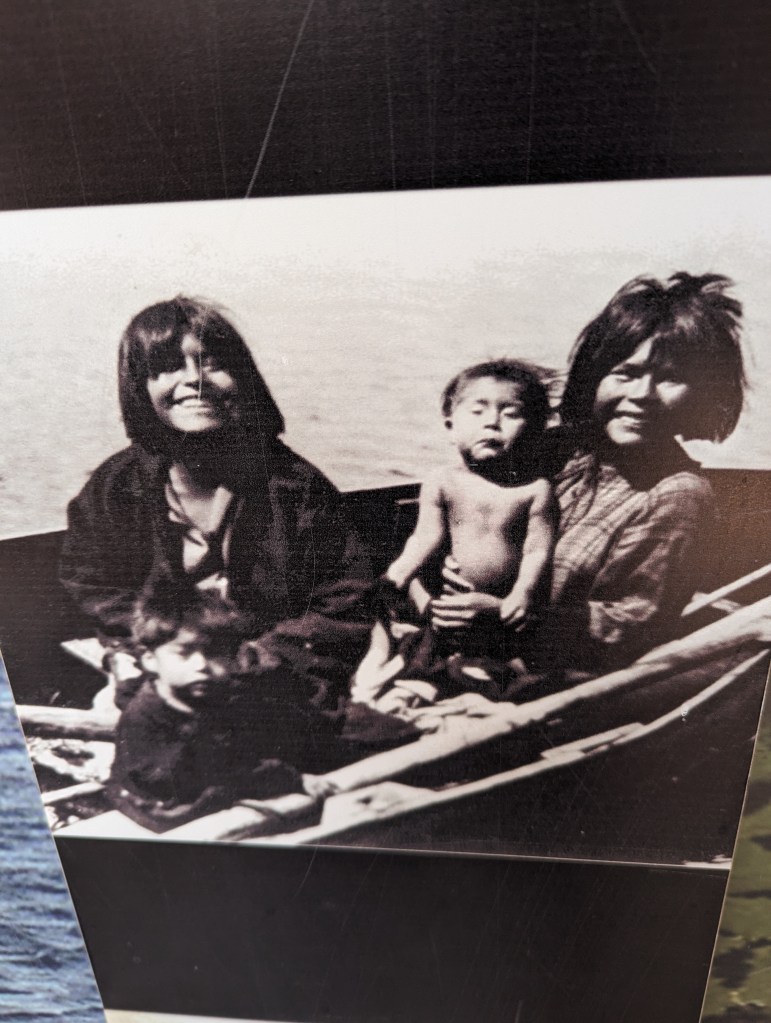
There were several different aboriginal groups living in the area for thousands of years, both around here and down in Tierre del Fuego where we are going soon. Ferdinand Magellan called it “The land of fire” in the 16th century, because of the many bonfires lit by the natives seen on shore by the first European explorers.
Lakes are different colours due to the algae and minerals in the water.
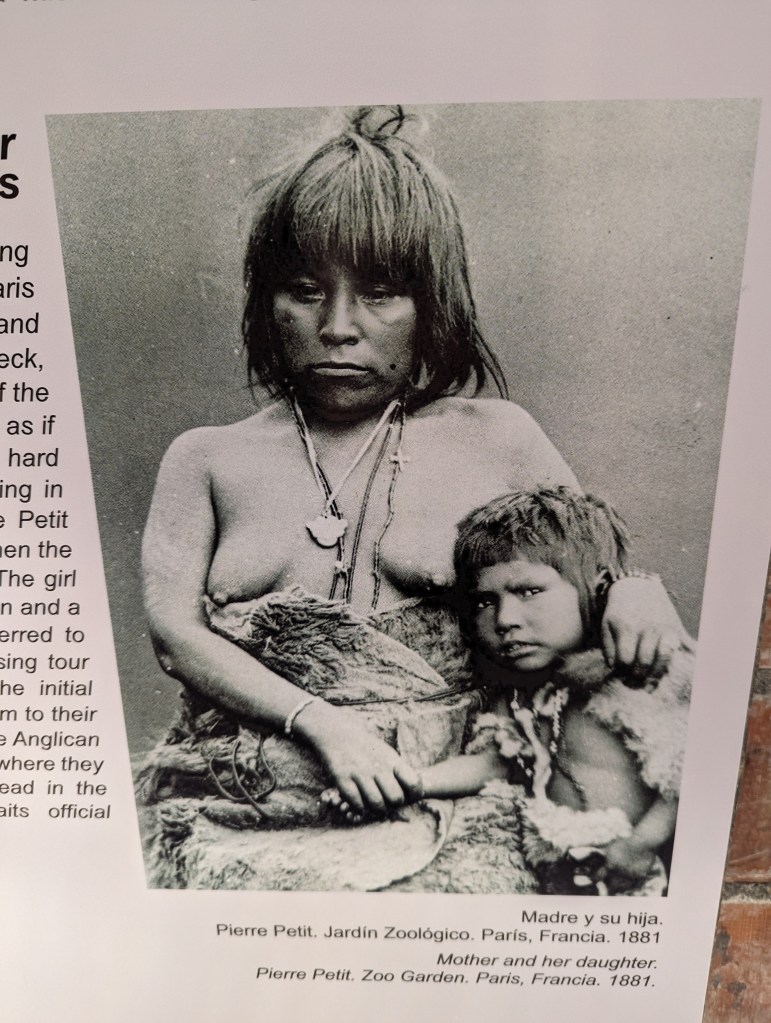
Unbelievably, considering how cold it can get here, these people were often naked, even the babies, seemingly undisturbed by snow, rain, wind, whatever the weather brought. They used the fires to keep warm.
This mother and child were in a zoo when this picture was taken. The young girl died soon after it was taken. One of the oldest photos of indigenous people. The young males in the tribes dressed as devils. I’m not sure why. I’ll get back to you on this.
In the 19th century they were almost completely wiped out by measles, brought by missionaries and settlers, to which they weren’t immune, but also by hunters, paid to find and kill them. Some were shipped off to zoos in Europe. The barbarity seems almost impossible to believe nowadays, done so that settlers could farm sheep on the land. The last laugh definitely goes to vegetarians, although it’s a somewhat hollow one.
A ridiculously hairy, extremely friendly “wild” dog.A street dog kennel
Puerto Natales has a lot of dogs, usually long haired ( because it is freezing here most of the time), and always friendly, that loll about everywhere in a state of stupor unless a motorbike or a car with a dog drives past when they suddenly all jump up and run at the car or bike, ibn a pack, barking like mad. The whole thing is hair raising to watch and no doubt leads to some horrible injuries to the dogs. These dogs look well fed and healthy, but aren’t owned by anyone, and have kennels on the side of the road and are clearly fed by someone, although who remains a mystery.
Mylodon Cave.
Another visit takes us to see a cave where they’ve found Mylodon bones, a long extinct giant sloth I’d heard of from Bruce Chatwin’s “In Patagonia”. It’s huge, very chilly, and not at all the safe, cosy hideaway I’d imagined.
The cave where they’ve dug up Mylodons’ fossilised remains. There are wooden Mylodons all over the place
Pisco Sours should have health warning.
Being back in Chile we are being very careful not to just pile into the nearest restaurant as prices are pretty much the same as in the UK, sometimes higher. However a Pisco Sour in the bar upstairs is only £4 and it is delicious. You should only have one though as they are very strong. So obviously I had two.
It’s raining, windy, and freezing. Feels like home.
My first thought on emerging from our taxi in Punta Arenas is:
“Dear God, please let our hotel have central heating.”
It’s 5 degrees celsius, but feels colder as there’s a gale raging, and horizontal rain pummels us, driving all things sideways – hair, clothes, eyebrows (Clives). Our hotel is in the centre of the city, a guft of warm air embracing us as we climb the stairs up to reception. Our room, up another elegant wood panelled stairway, overlooks the main square, and glory be to god, has a radiator emanating warmth. For the first time since leaving Argentina, my spirits lift. Moods often follow no rhyme or reason, but hazarding a guess, Santiago felt dangerous, La Serena desolate, but this feels like home.
At the one place that is open, as most museums are shut for renovation, a lady tells us that sometimes “you have to hold onto railings as it is so windy you will be blown over!” As I have already been nearly blown over I think she’s joking, but it transpires that Punta Arenas can be much windier than the day we visited, with gale force winds a pretty regular occurrence.
Where Shackleton and his men were welcomed back to.
We are only here for two nights, ostensibly to recover from our late arrival, as the next leg of our journey is another long bus journey up to El Calafate. After a not-great dinner that costs a lot, we are off the next day – back into Argentina – yeehaa!
An interesting feature in the only museum open in Punta Arenas, and our hotel.
We get a coach to El Calafate, but you can fly there. The landscape is undulating, pale green, treeless – not unlike Shetland. But the houses remind me of Iceland, presumably for the same reason – both places have a tendency to blow your roof off. It seemed awfully strange to hear Spanish being spoken in such a Nordic setting.
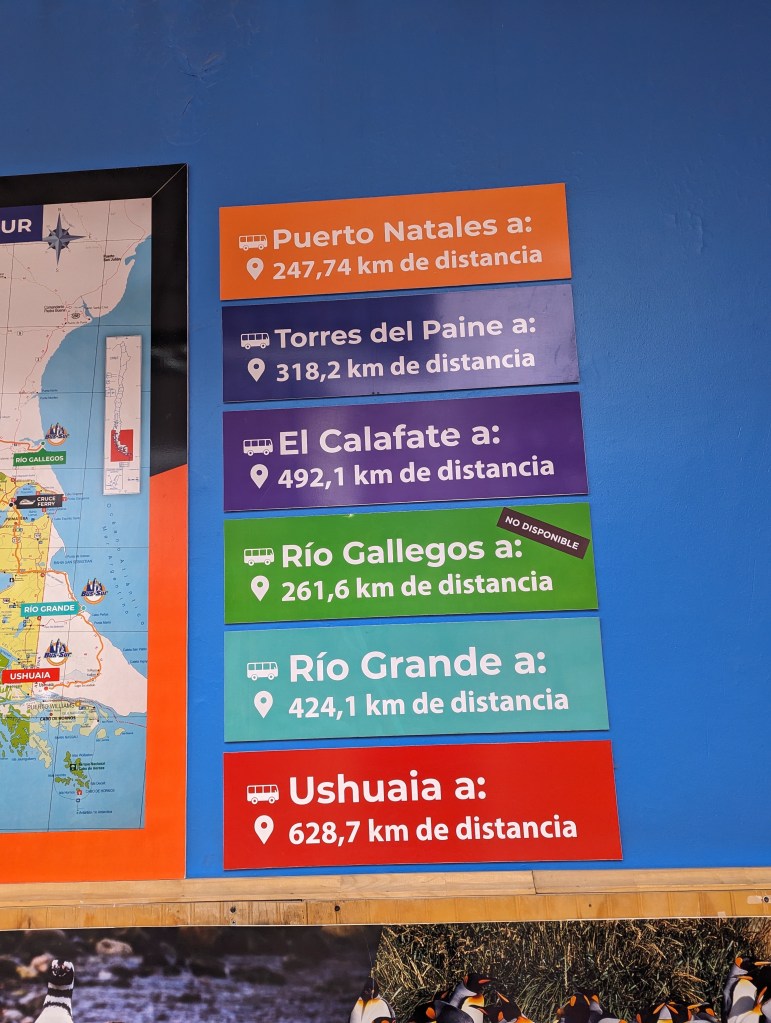
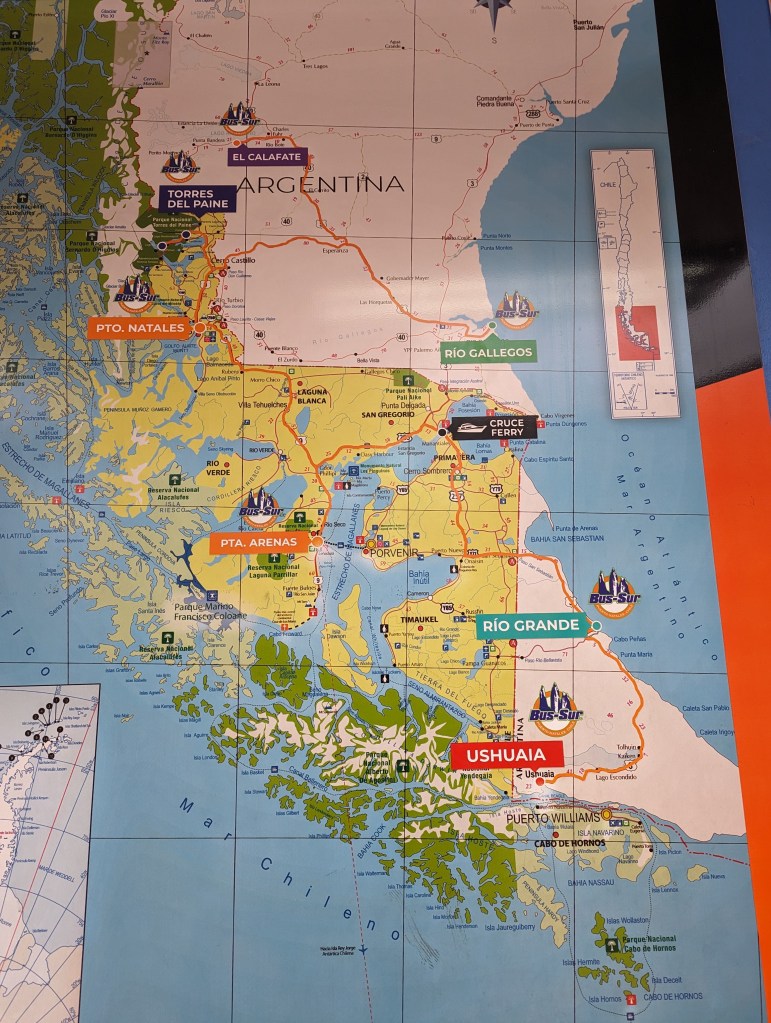
Distances from Punta ArenasOur route from Punta Arenas to El Calafate then El Chalten. Clive in Puerta Natales, in a 2 hour break between buses we went pizza hunting.
El Calafate is a cheery one street town with many Parillas, restaurants with – vegetarians look away now- whole pigs being roasted round a fire in the window. It’s expensive compared to other places we’ve been to in Argentina, because it’s a tourist hot spot, but still cheaper than Chile. Clive orders a huge pile of lamb which is only a half serving, while I have seafood spaghetti because I’m lambed out.
We’re pretty much all here to visit the Moreno glacier, and the day after we arrve we take a tour and a boat to get up close. It’s worth the 90 minute drive. It’s the third largest glacier in the world after the Antactic and Greenland. The water we shower in, and clean our teeth with, is straight from this glacial melt.
The glacier from above El Moreno Glacier with a boat cicled to show scale.It’s 74m high. The glacier, not the boat. The striking blue colour is because the high density ice absorbs all colours other than blue.
Clive sounding extremely pleased with himself.
Defcon 4 knicker alert.
Today we’ve made our way to El Chalten, which is only accessible by bus, where we’re self-catering. Our apartment is adorable, and snugly warm. Our host, smily, bright-eyed, bearded, same age as us, tells exactly where we should walk in the next few days, bearing in mind weather and routes that are open, and in the absence of any other plans, and suspecting he’s also taken our apparent physical fitness into the equation, we decide to follow his lead. We walk to a local waterfall, and go to the local supermarket on the way back to stock up. It seems that spag bol is the go to meal for every nationality as we all line up at the meat counter and ask them to mince our lamb. I am stiff as a board once back home. I’m looking forward to cooking for ourselves and catching up on washing, as I am pretty sure we both reek, and I am at the inside-out pant level wearing stage. Desperate times.
Chorrillo del Salto waterfall near El Chalten El Chalten On the way to the waterfallOur home for the next 5 days.
Condoooooooooor. Only people over 55 will get this joke.
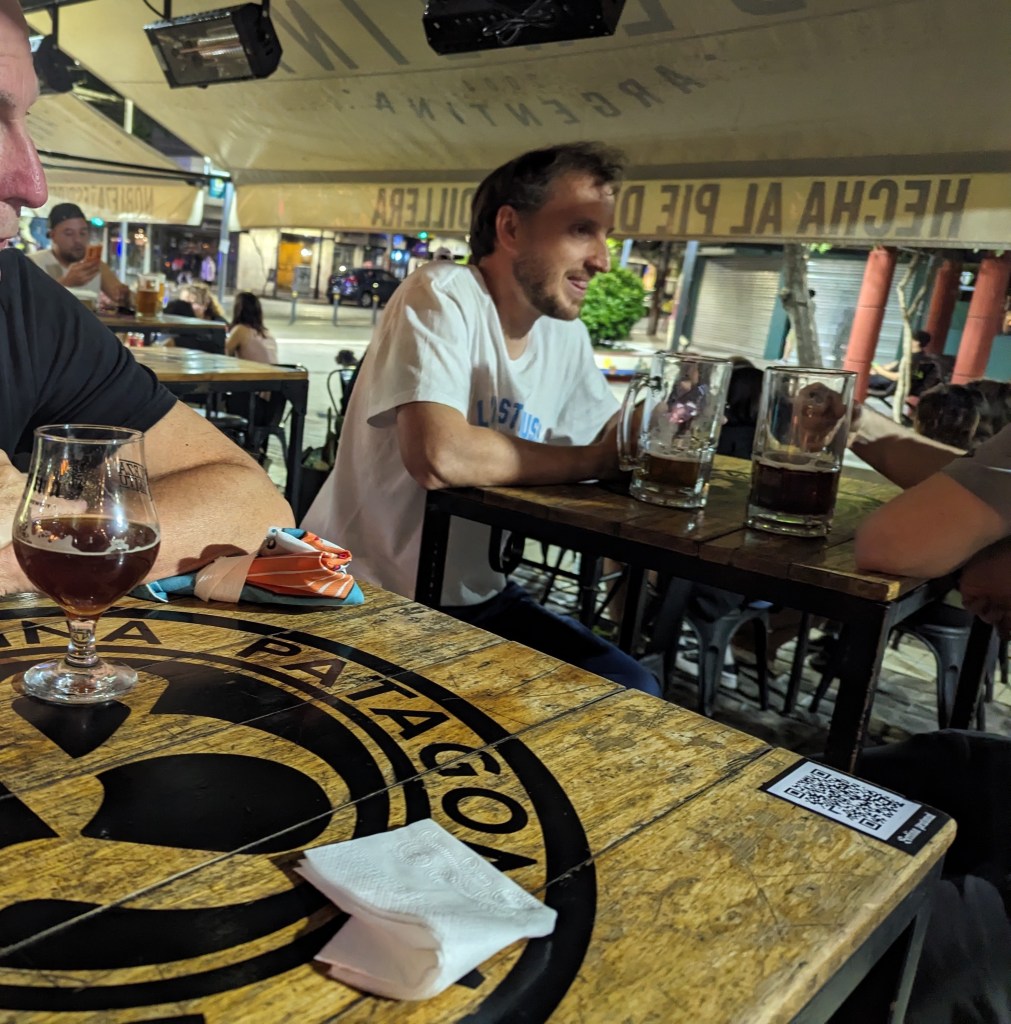
Being mistaken for an Argentinian at Buenos Aires airport is possibly one of the most thrilling things that’s happened to me so far on this trip. I’m usually met with a sweeping glance, the unspoken thought “pasty faced chubster = English,” game over. But Argentina has the most diverse population anywhere in the world, as we saw up in Salta, where the 500 year old children’s facial features exactly match those of the people wandering the streets, and now in Mendoza where there is a strong Italian thread running through it’s veins; we met two of them in an Artisanal beer bar – Mendoza’s that kind of place – who define themselves by their Italian roots, despite their family being here for 140 years. They also seemed to be very dubious about the upcoming elections, telling us that as Milei decided to run for president after seeing a psychic who told him one of his dead dogs wants him to do it, they fear he may not be entirely sane.
An artisanal beer bar Note the ridiculously huge beer tankards the Italian/Argintinian lads are drinking from.
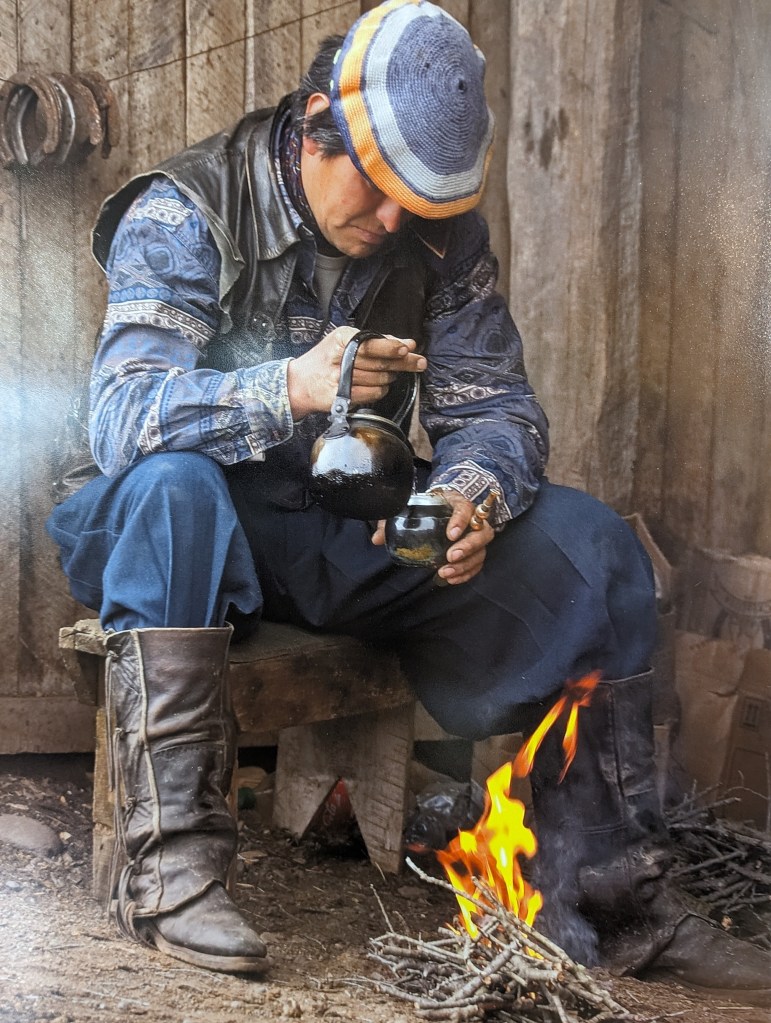
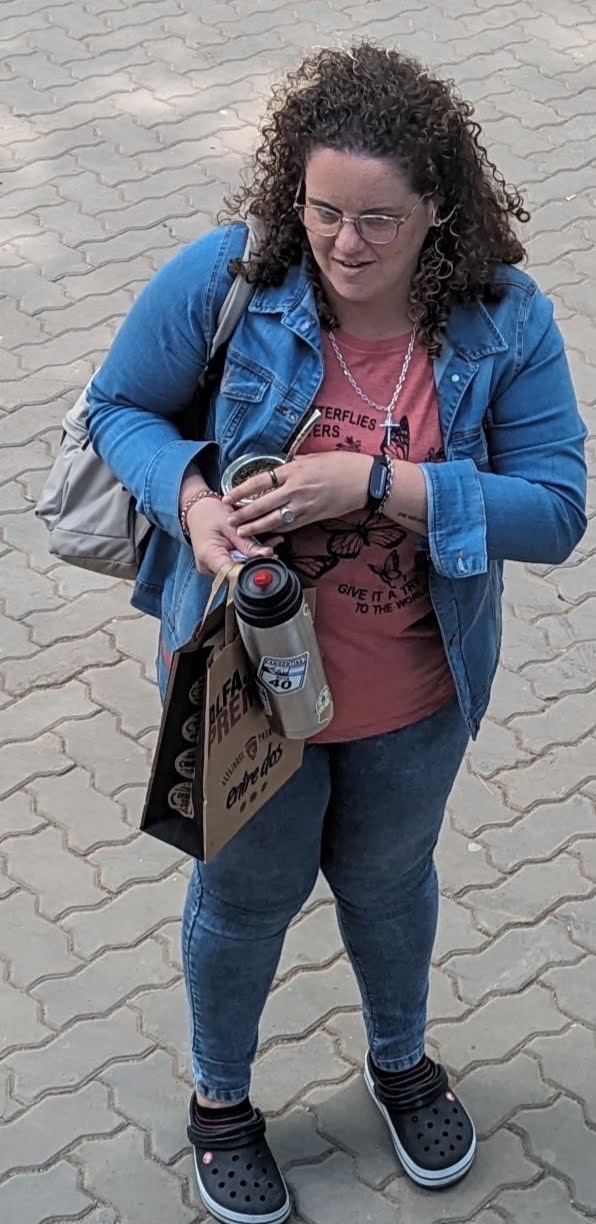
Staying with airports, at Heathrow security they insisted on dismantling Clive’s drug flask as thoroughly as an AK47, sniffing suspiciously at the freezer block in particular. Here, the Argentinians obsession with mate, which puts our tea habit into the shade, has meant that Clive’s experience taking his drugs in a flask through security has been entirely stress free, as they assume it is a flask of boiling water for his mate, just like every single Argentinian in the queue with us. I honestly think this stuff must be way more addictive than coffee, and the airport staff would rather wrestle with a terrorist than deal with a stream of wild eyed Argentinians withdrawing from their mate habit.
A common site in Argentina – a woman with her mate mug to which she just keeps adding water to the increasingly disgusting looking mush. Pat would approve I feel, Katy.
All things mate.
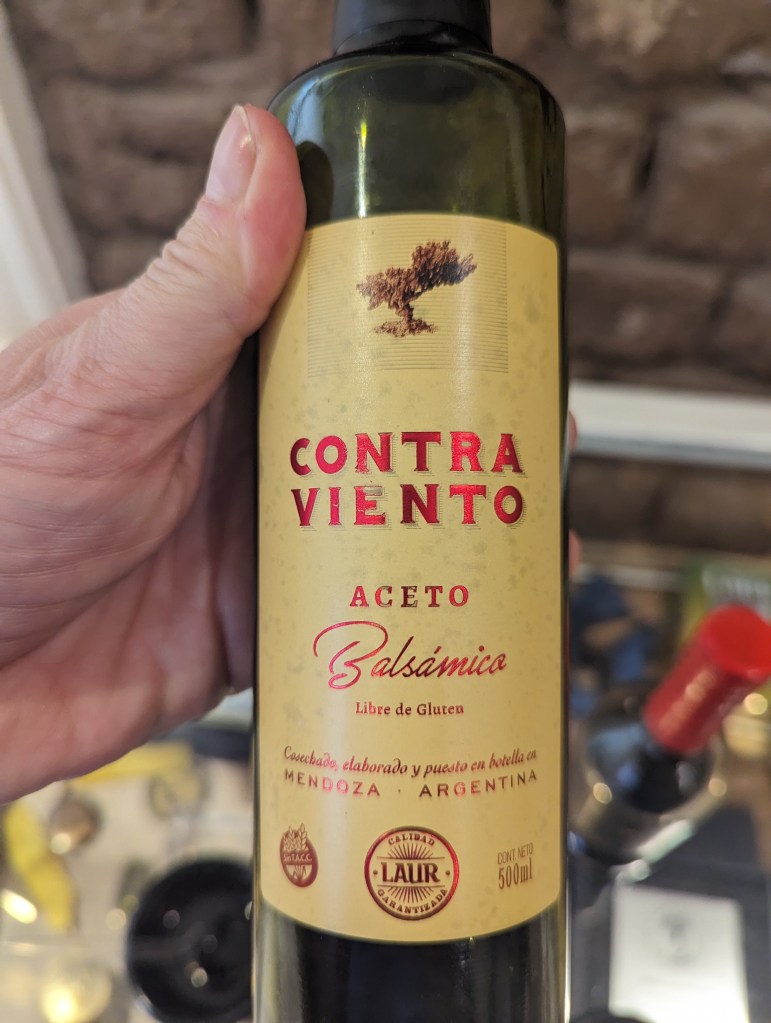
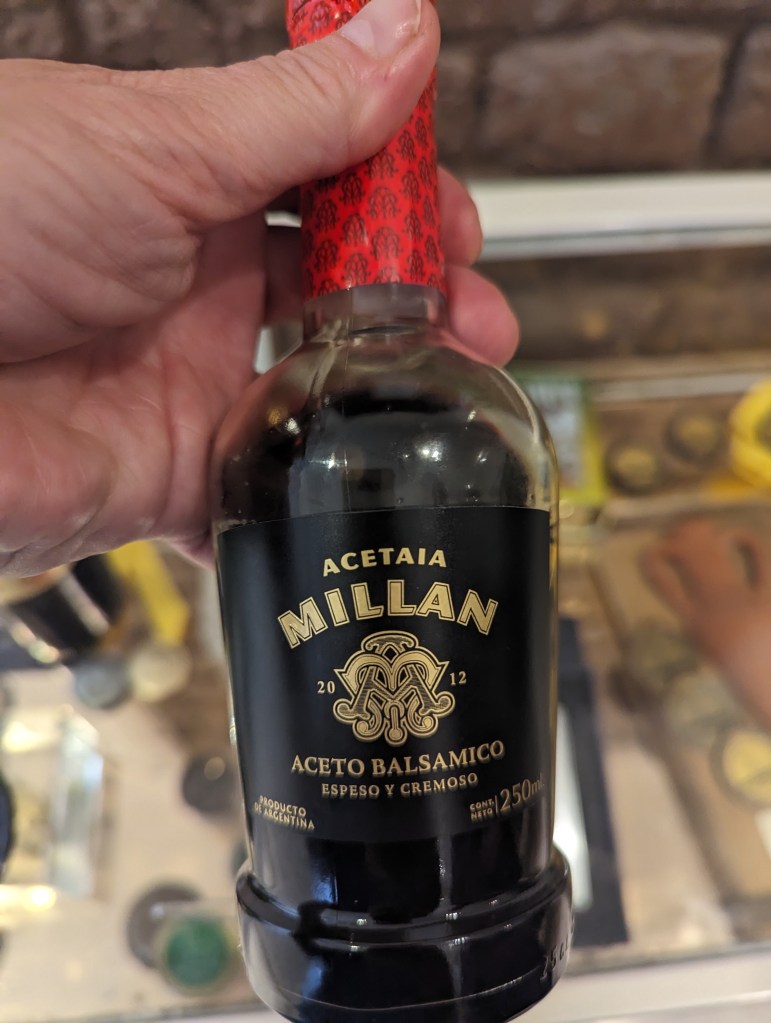
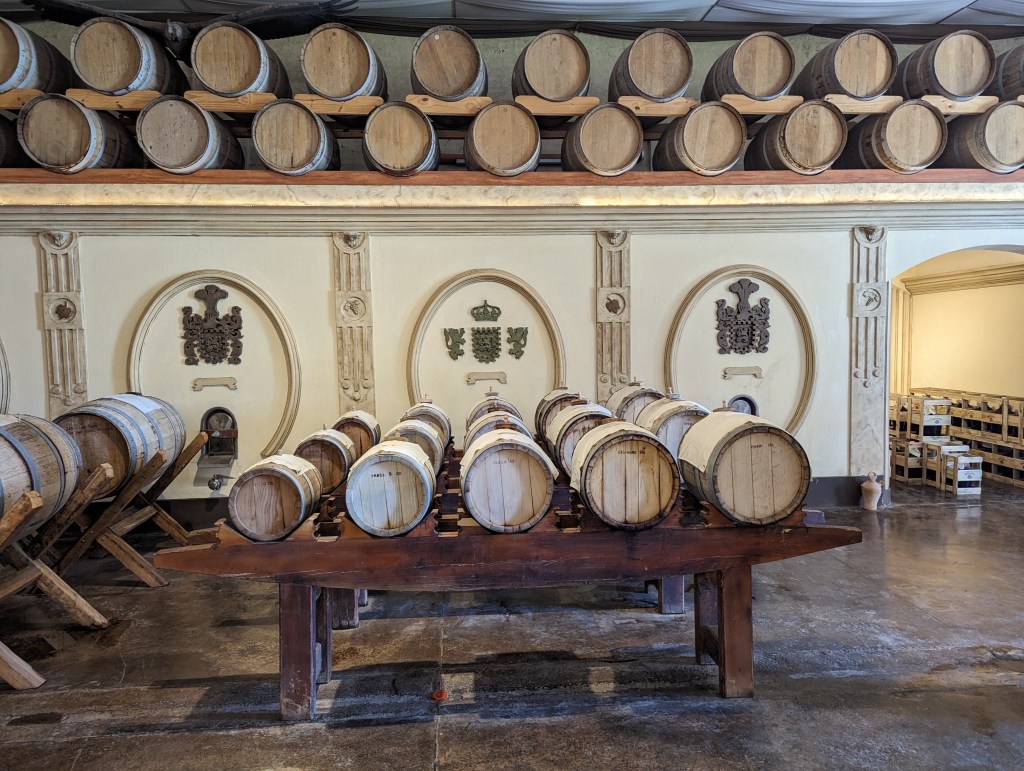
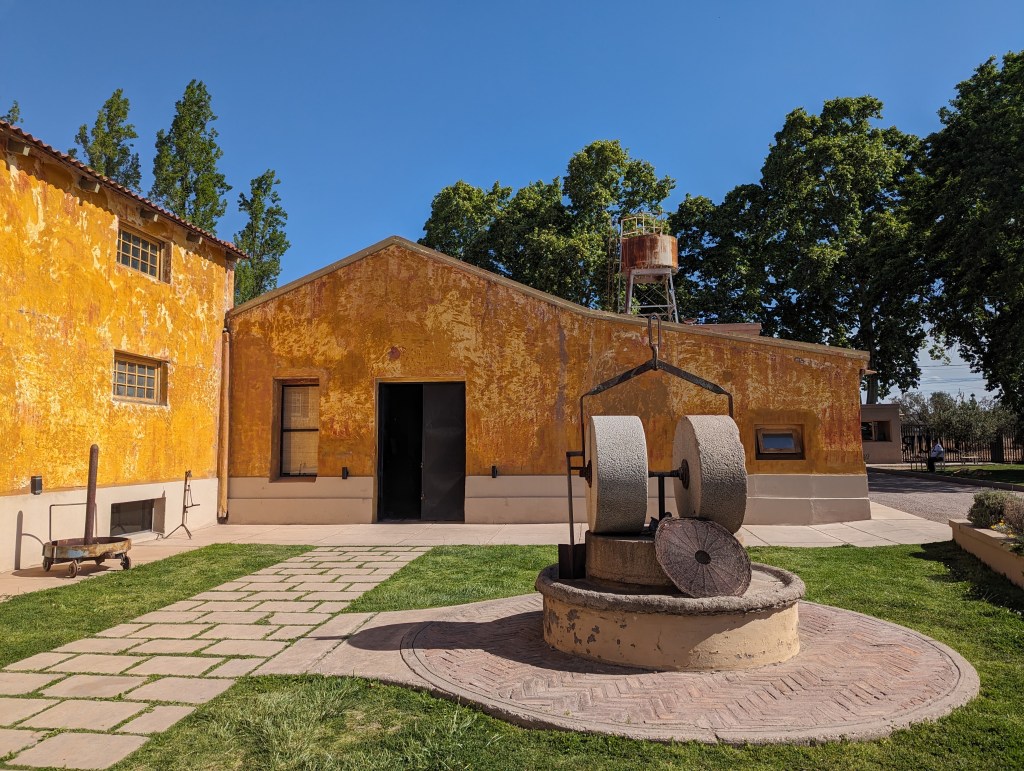
Mendoza is the biggest supplier of Malbec in the world. We visited several vineyards and an olive oil farm, where they make the most divine and delicious balsamic vinegar. Never again will I buy the cheap and nasty stuff, now I understand how much tastier the pure stuff is; it’s made from the grape skin mush left over from wine -making, mixed with white wine vinegar, heated up, left for 3-7 days depending on how sweet you want it to be, and bobs your uncle, Balsamic so moreish I could slurp it straight from the bottle.
What a terrible photo. Anyway, numnumnum. My plant ap said this is called Golden Shower. No comment. An old olive press.More old olive making paraphernalia. How they used to make olive oil – cold press.
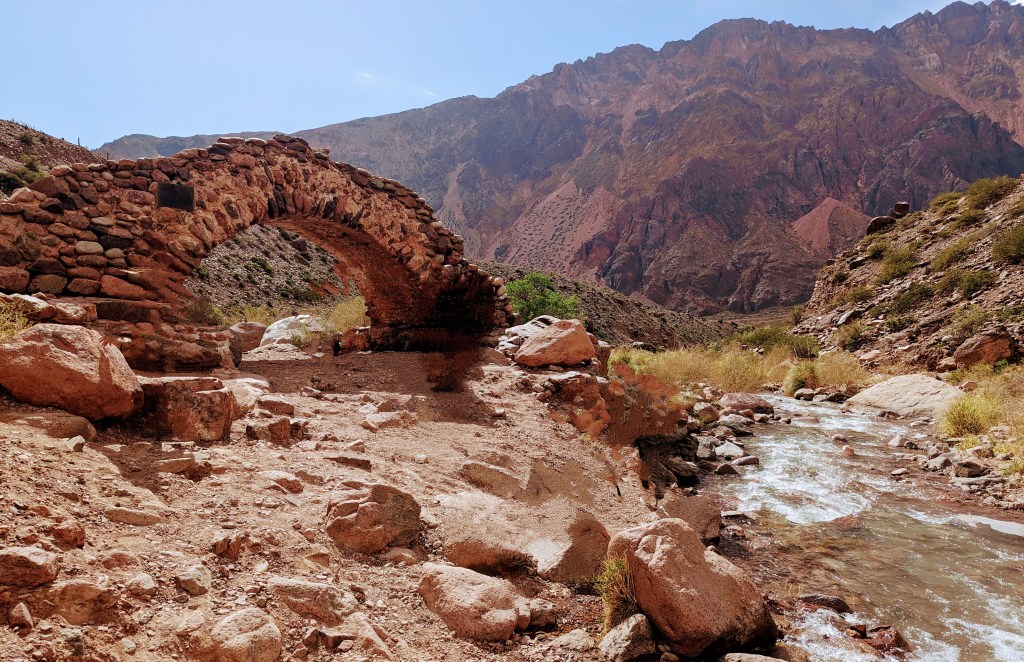
We also took a trip into the Andes, as although that’s the way we’ll go to Chile today, we aren’t sure how much the bus will stop so we can properly see the Andes, and take photos. Mendoza is basically a desert oasis, fed by the snow from these mountains. It hardly ever rains, which Gisella, Clive’s Spanish teacher, told us last night that she sometimes yearns for, “to feel the unique misery that rain brings.” Yeah, been there, done that, got the t-shirt G.
The trip into the mountains we took yesterday.The 1800’s bridge that took travellers across a now non-existent river, as they walked to Chile. An old thermal spa, abandoned in 1982 when Chile tried encroaching into Argentinian land.Spring arrives in the Andes.
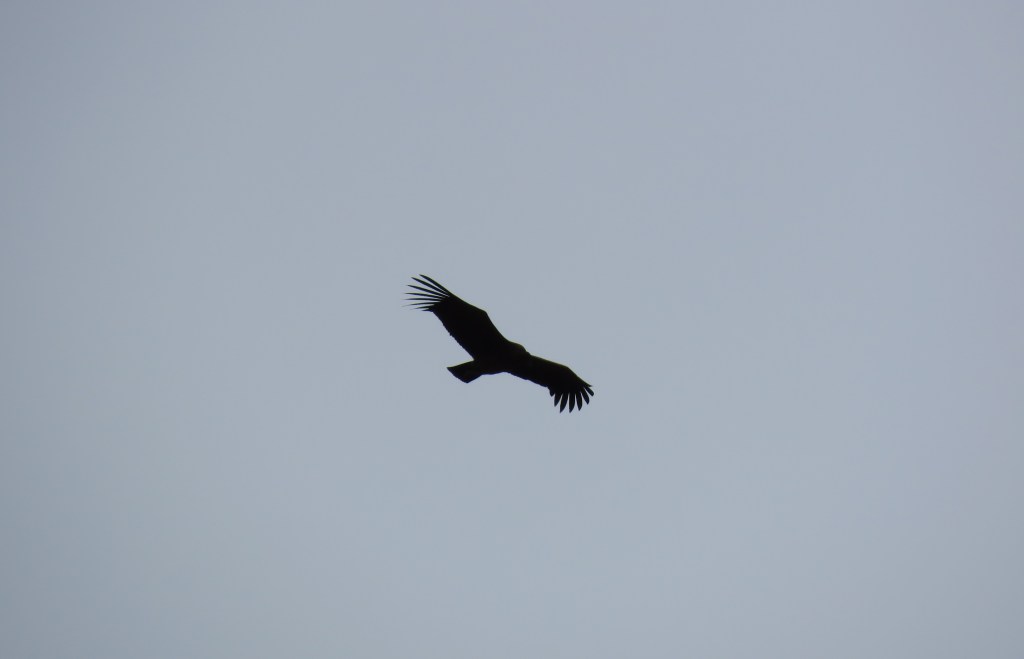
The Andes on the Argentinian side are bleak, beautiful , and blooming cold. Condors circle high above us, and our guide tells us that Condors mate for life. If the female dies, whatever age the male is, he kills himself rather than live without her. I wonder if, as he soars downwards in ever decreasing cirlces towards the ground and an untimely death, he feels regret at what might have been? The females on the other hand, shed their feathers and beak, grow new ones, and find a new male. Pretty pragmatic, and a baffling decision from a genetic point of view for the male. No time to research this today.
Last night Giselle took us out for tapas, but we got to see her flat first. Clive wanted to see it so much, having had the same truncated laptop view of it for the last 2 years. She is a Portenas, born and bred in Buenos Aires, but the rent she gets for her tiny flat in BA buys her rent for this lovely, airy, light apartment she shares with her 11 year old son, who on hearing we support Arsenal, ignores us in disgust for the rest of our visit.
Gizella, who has italian roots, and moved her to be near her sister and mum.
Gizella chose this from a selection of a gazillion other Malbecs; very delicious and 7.50.
Disaster occured on our return to the hotel last night. Having washed three of my remaining six pairs of pants, one of them had blown off the window sill. I can’t find it in the hotel outdoor space and am too embarassed to ask if they have them at hotel reception. 2 down, 5 to go.
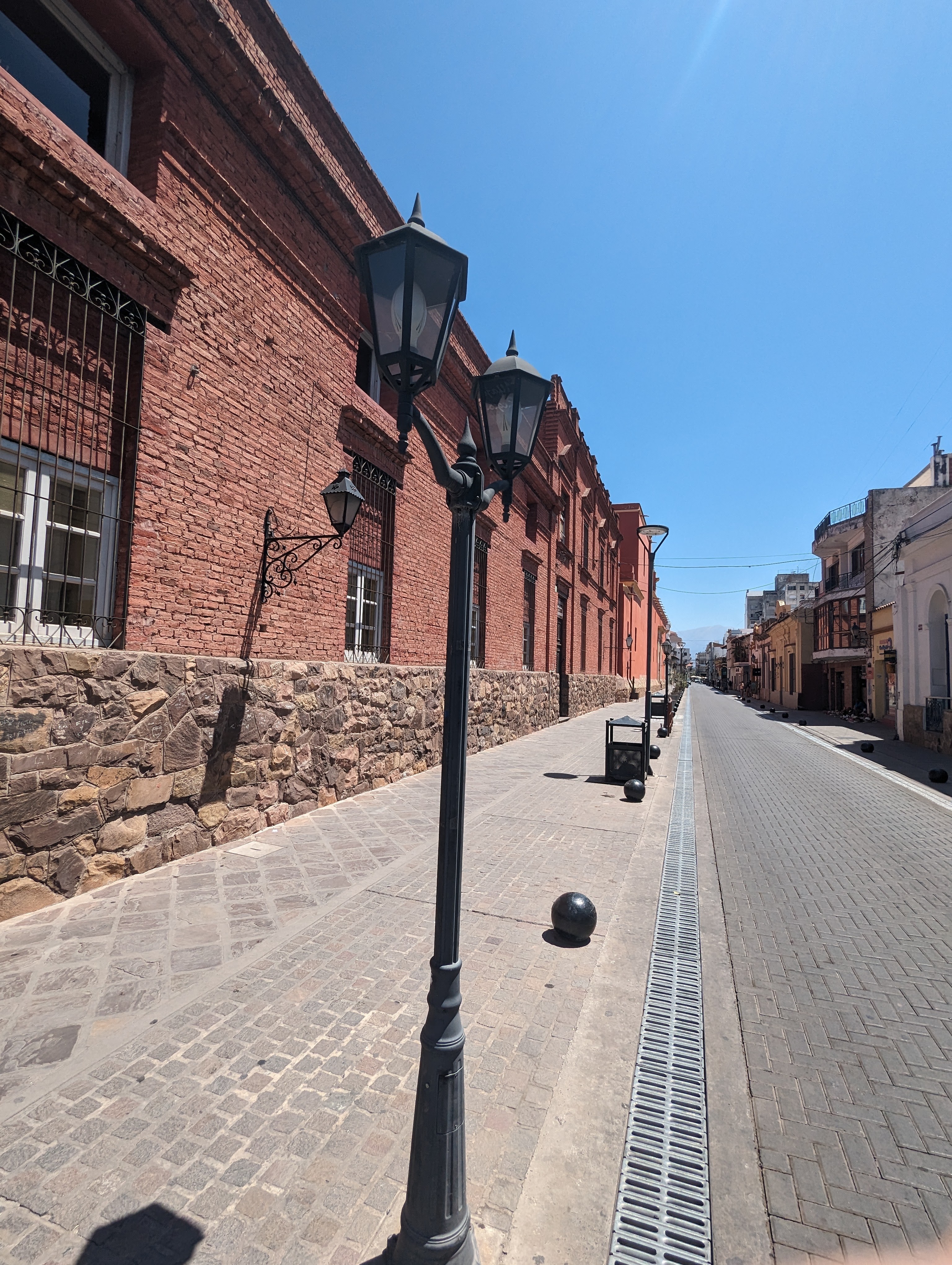
Arriving in Salta early on a sleepy Sunday morning the streets are deserted, the shops shut, the locals enjoying a lie-in. Our apartment is on the less salbubrious side of town and there is a slightly menacing feel in the air as we drift into town, unable to book in until 3pm. It turns out this is entirely paranoia, and the next day with people milling up and down and the roar of traffic, we cease half-expecting to have our throats slit. The traffic system at junctions is bonkers, whoever gets there first has right of way, until the waiting traffic gets fed up and barges in, waving and shouting.
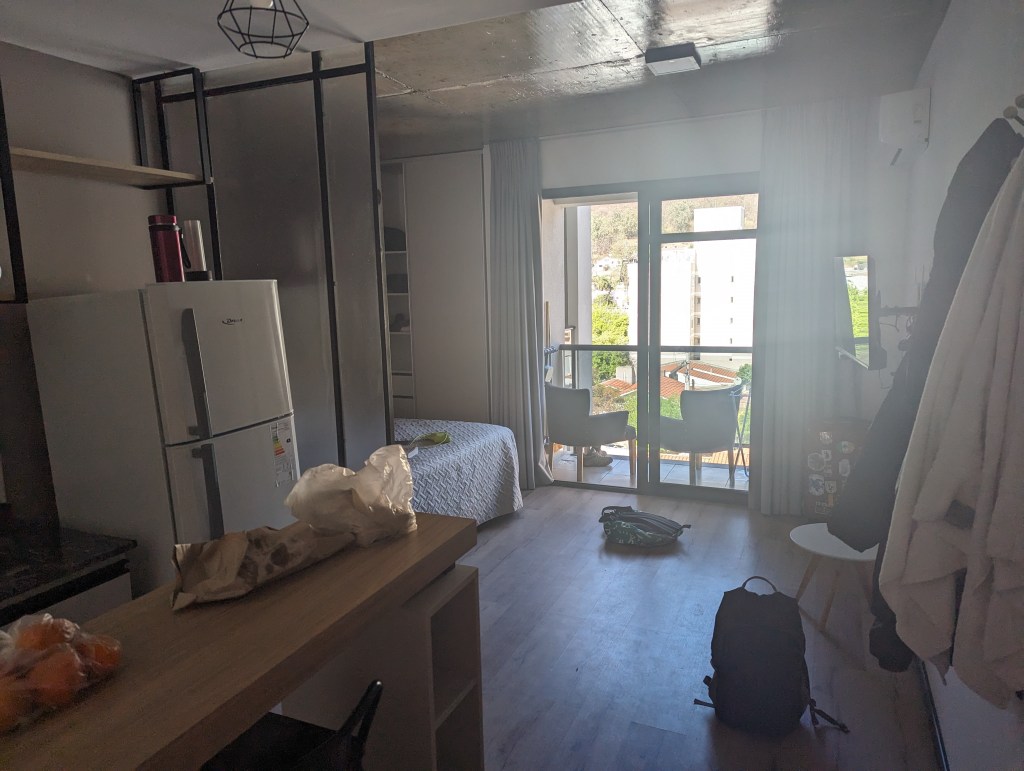
Our apartment in Salta.
Our apartment is great. We have a coat rack! A large fridge! An air dryer! Domestic bliss. We have it for a week although we will be spending two nights away, one going South, the other North. The only meds we’ll take away are lomotil, as buses and bowels don’t mix well.
Visit to art museum.
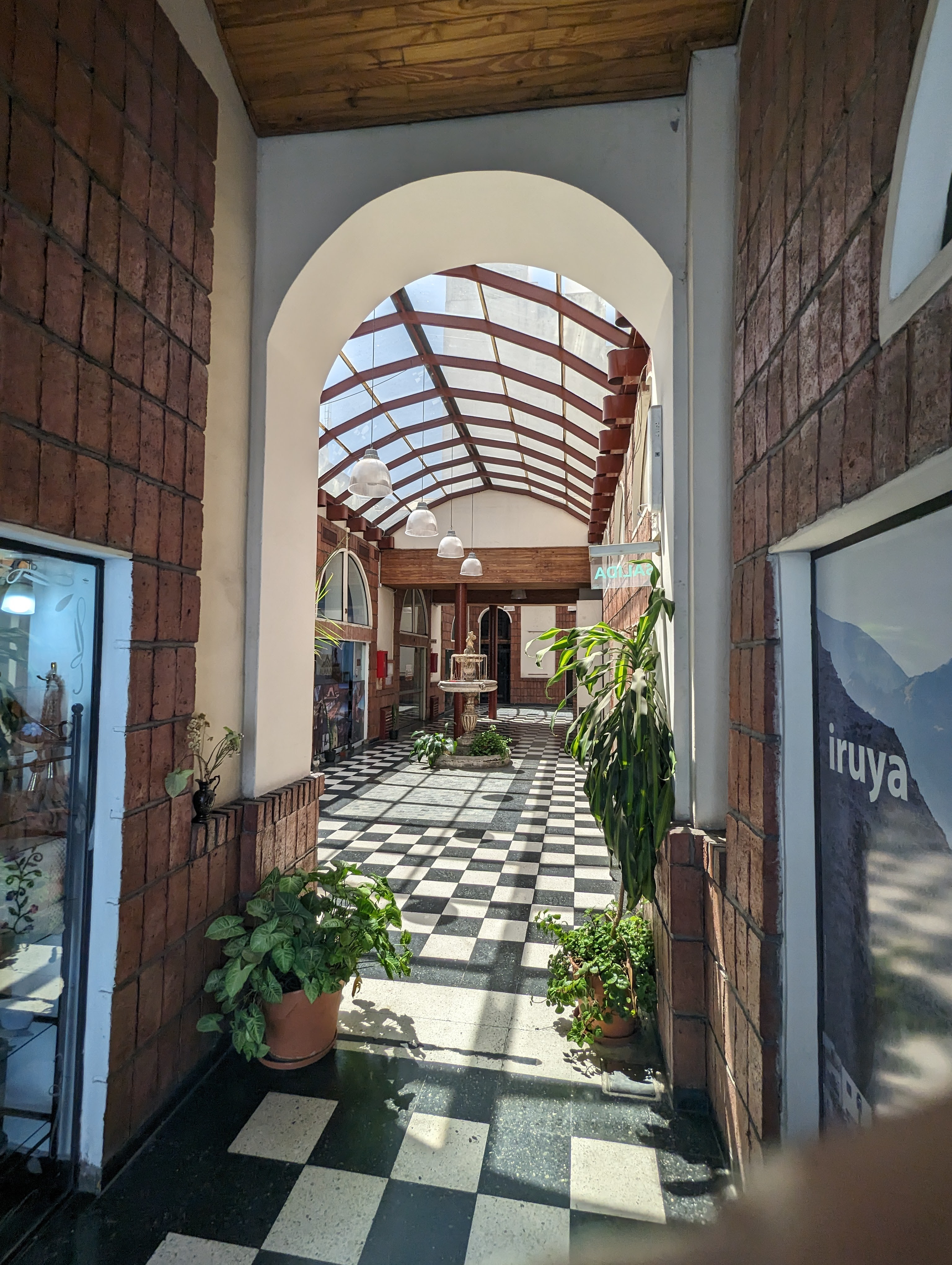
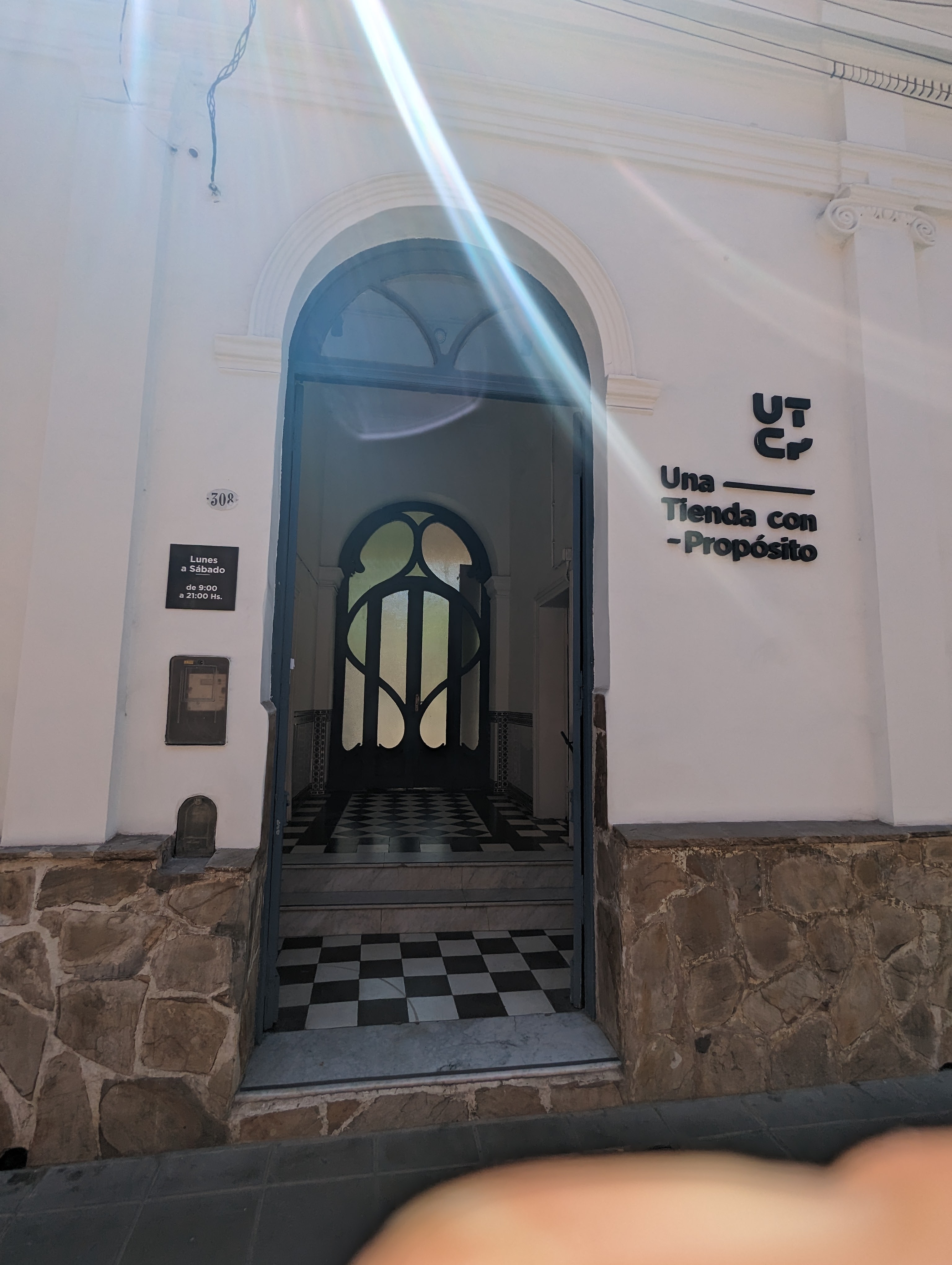
Doorways in Salta.
After lunch we took the cable car up a hill for a view of Salta from above, but we felt hot and tired. We wilted like steamed spinach onto a patch of grass in the shade and then retired down the hill and back to our flat for a siesta. Mad dogs and Englishmen…..
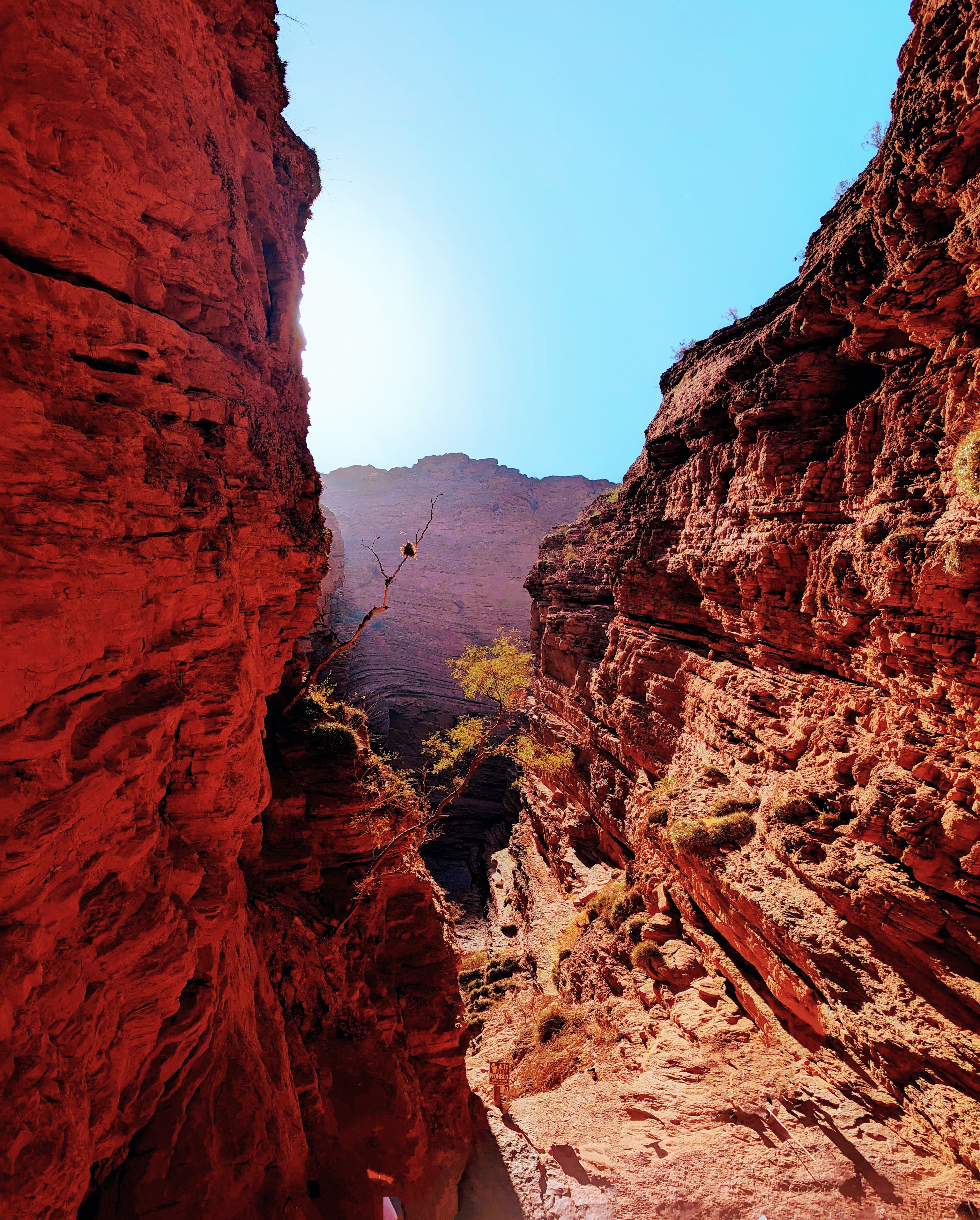
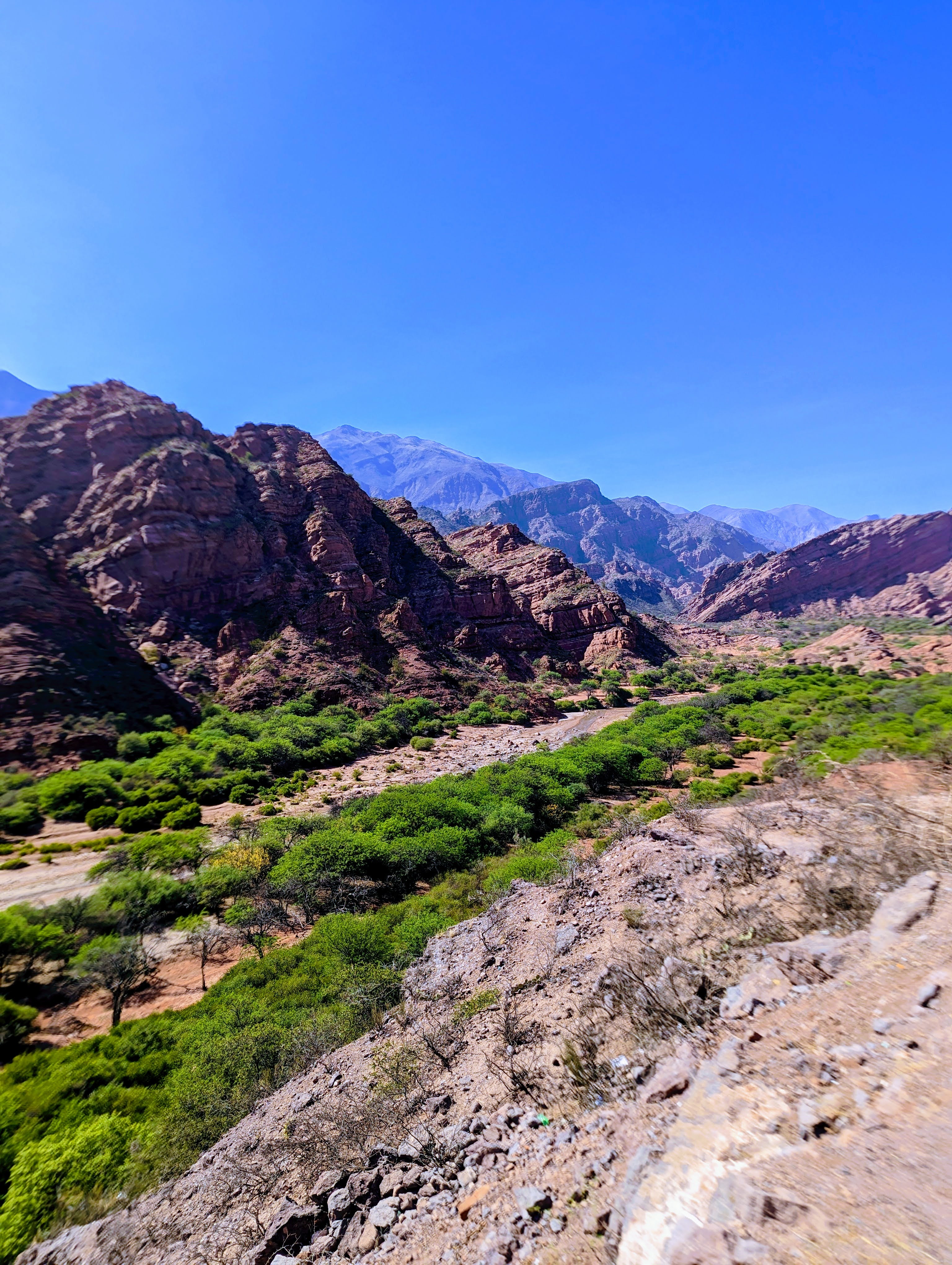
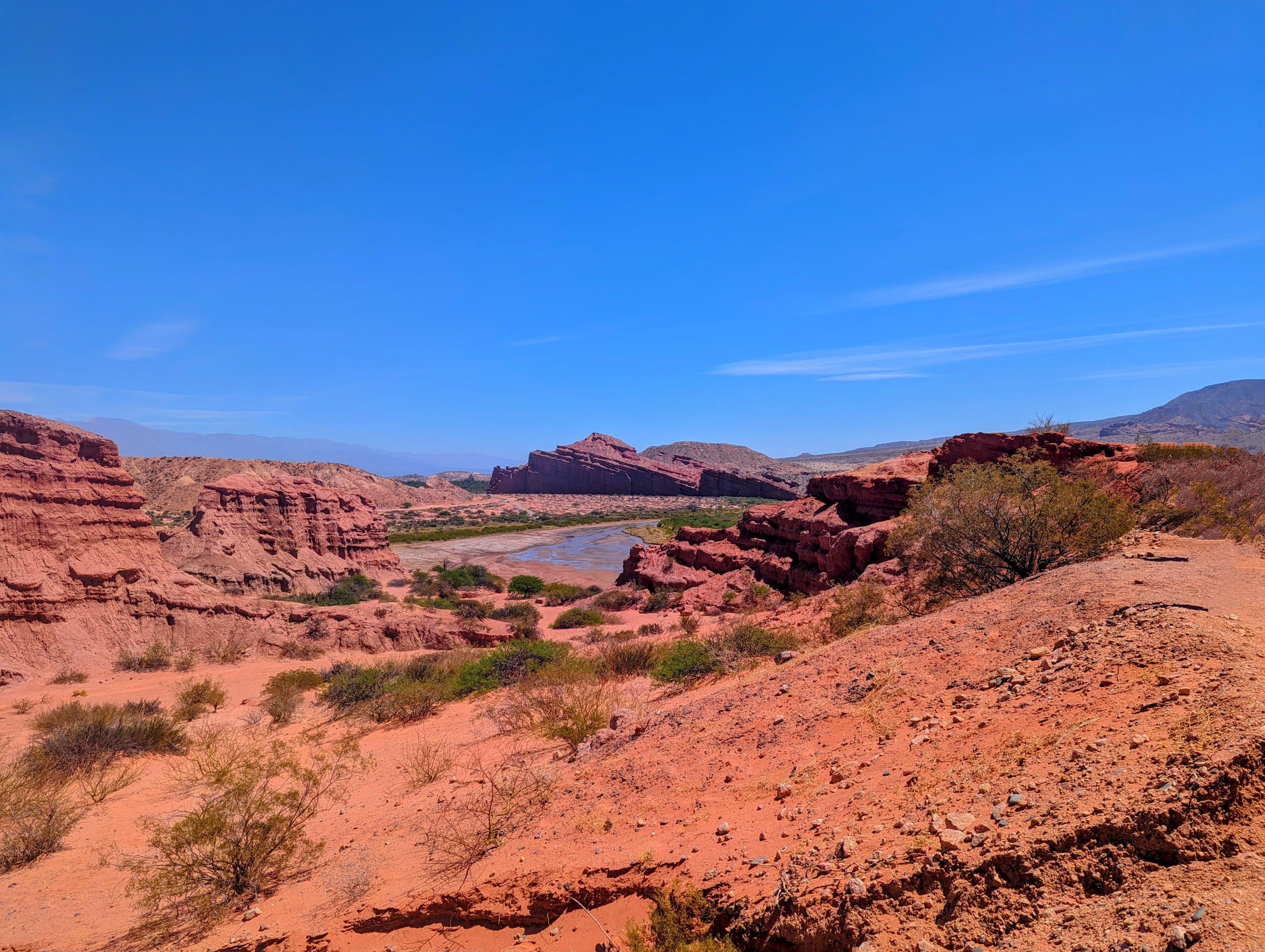
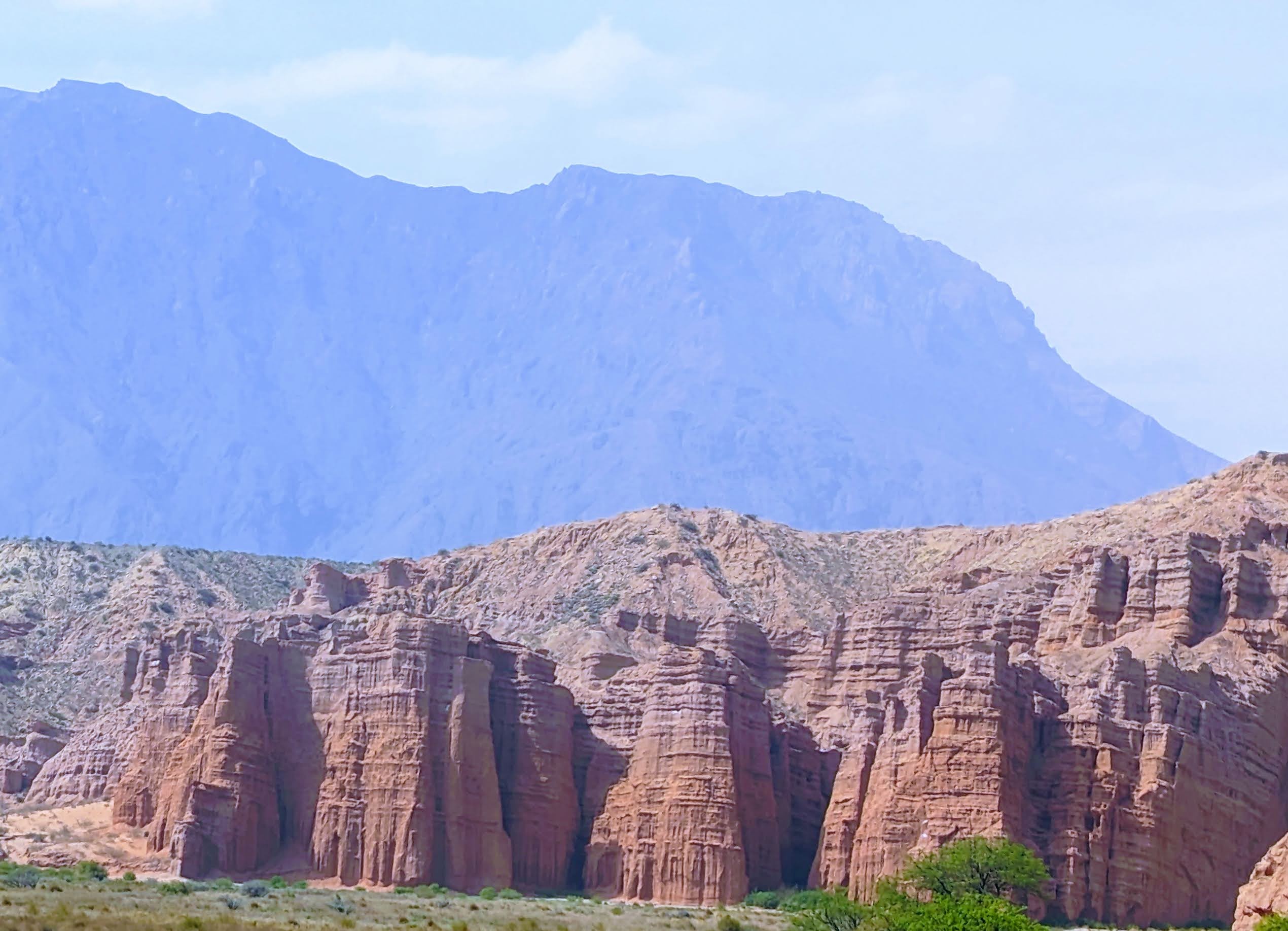
Yesterday we headed south though the Calchaquai Valley, past massive rock formations up to Cafayate, a really sweet little town surrounded by mountains.
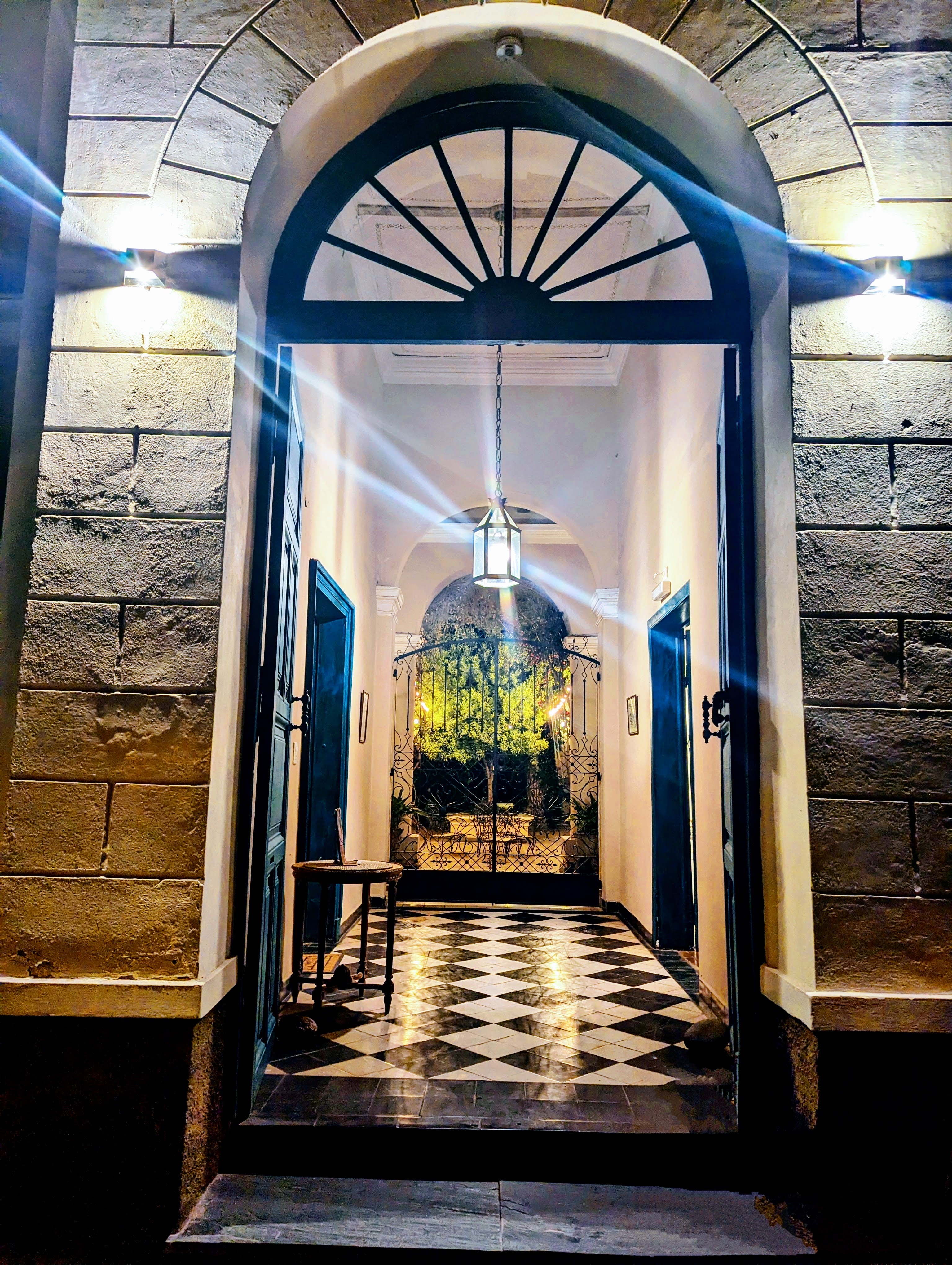
In Cafayate Clive booked us into a decent bnb (£22) for the night, right in the central (and only) square
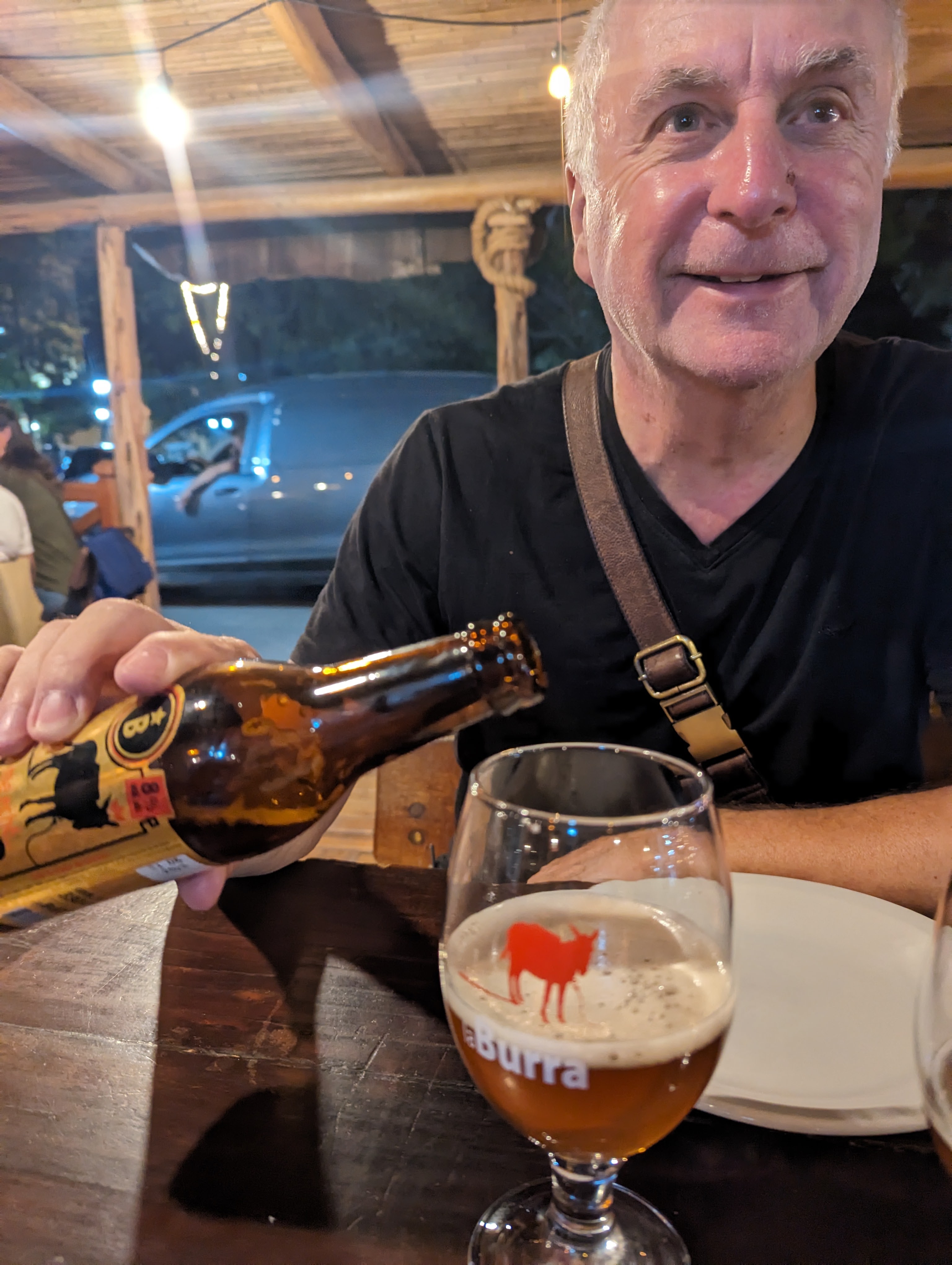
Burra beer – with a kick like a donkey. (8% alcohol).
Clive’s Spanish is opening all kinds of doors. Last night we drank the waiters recommended Malbec which tasted divine, cost 6 quid but sells for 35 in the uk. In Salta a waitress gave us two free glasses of wine because she said most English people don’t speak Spanish. Today we walked just 5km to a local waterfall but my legs told me we are 1700 meters high (Ben Nevis is 1345 m high – which is why this region makes wine – it’s high, sunny, and dry ) and even though we set off early the sun beat down on the dusty road and I walked slower, and slower, and slower. By the time we arrived the cavalry sat by the road, aka Jose, who became our guide.
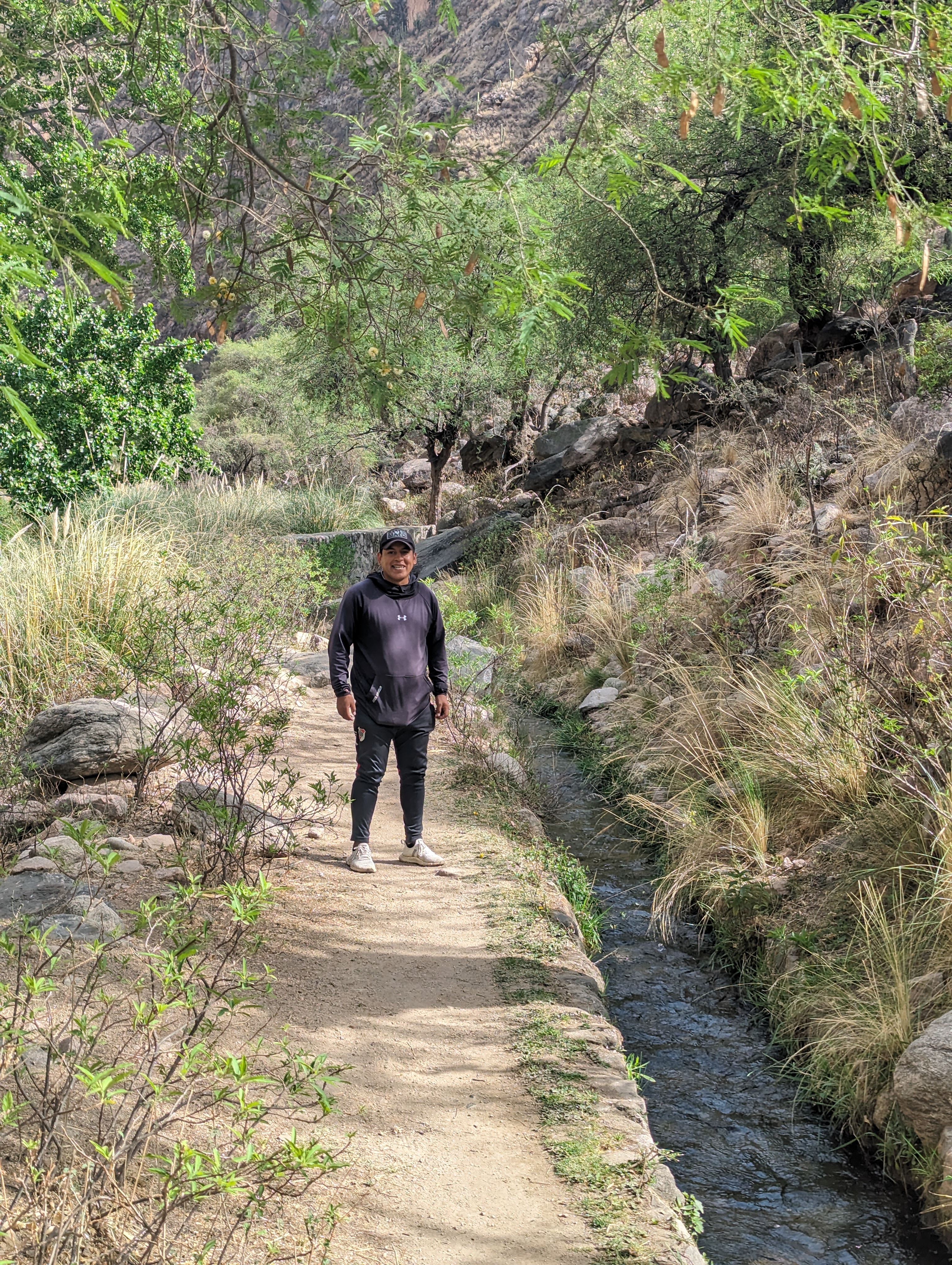
He was from one of four families living around the mountains who do the guiding. He showed us a tree that makes Mate tea, which Argentinians are obsessed with to the extent they take huge flasks of boiling water even onto planes so they can drink it whenever they want. I bought a mate straw today – like my own personal tea strainer. He held my hand as we climbed up to the waterfall in ever steeper steps, such a sweetie. The price he asked? 4 quid. The thing is the guides get paid in cash, which obviously we added to for a tip. There are queues everywhere for the ATM’s at all times of day – long, long queues, we think because they can only get out 20,000 pesos (20 quid blue rate, 60 red) a day out, and because of inflation everyone wants their money out of the bank (you only need to look at my savings to see that economics is not my strong point so please correct me if I am wrong). So anyone working in an industry that pays cash is at a distinct advantage.
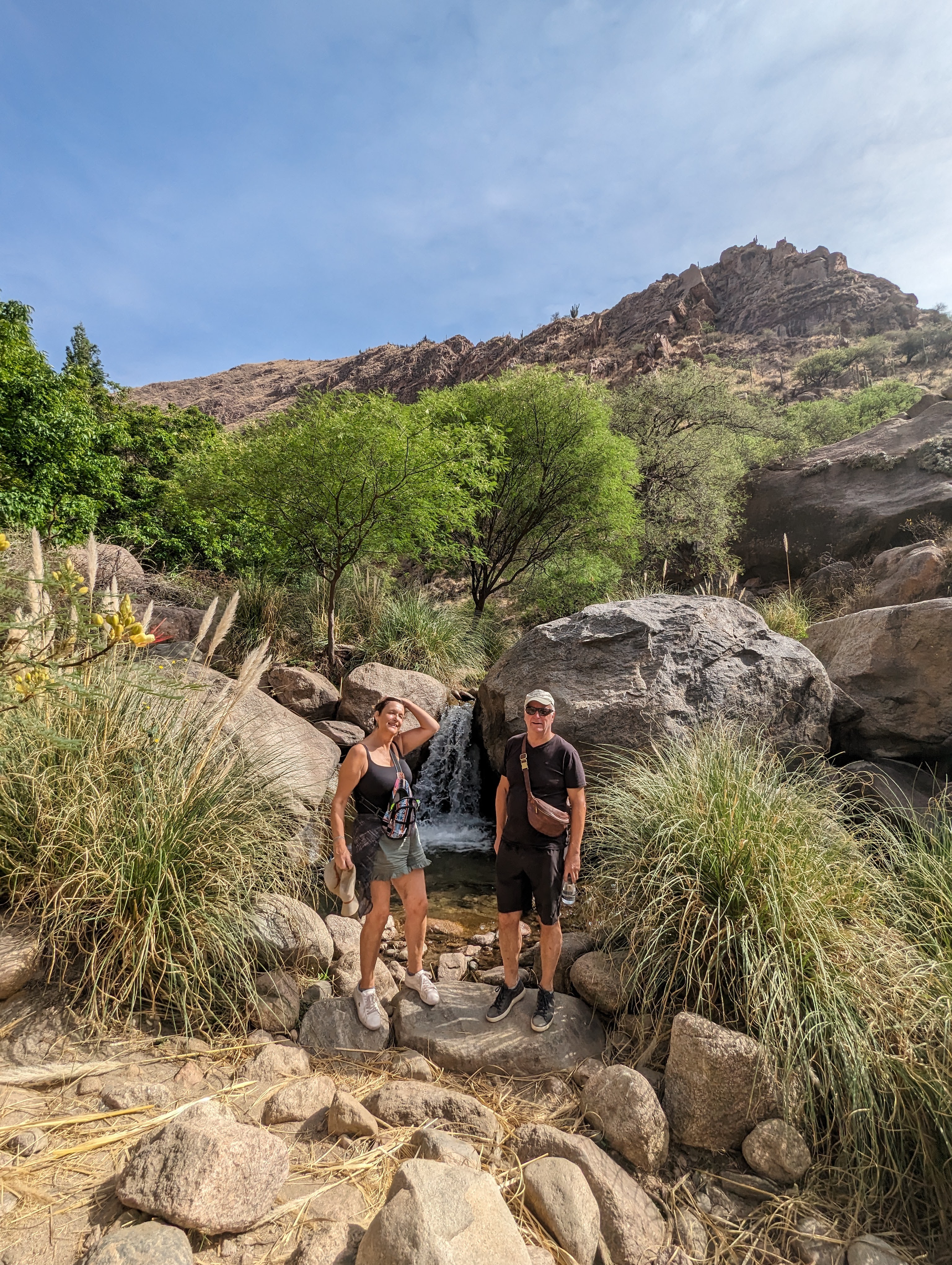
There is no way in a million years we’d have found the waterfalls without Jose, which although minuscule compared to Iguazú, meant we could take a much needed dunk in the icy cold water. This water is channelled into a canal and feeds the town of Calafate.
After trying the wine ice-cream (horrid) we sat waiting for our minibus to return us 200 km back to Salta.
Tomorrow we go North, to the hill of seven colours, lama stew, the salt flats, and Humahuaca, which sounds like a smokers cough.
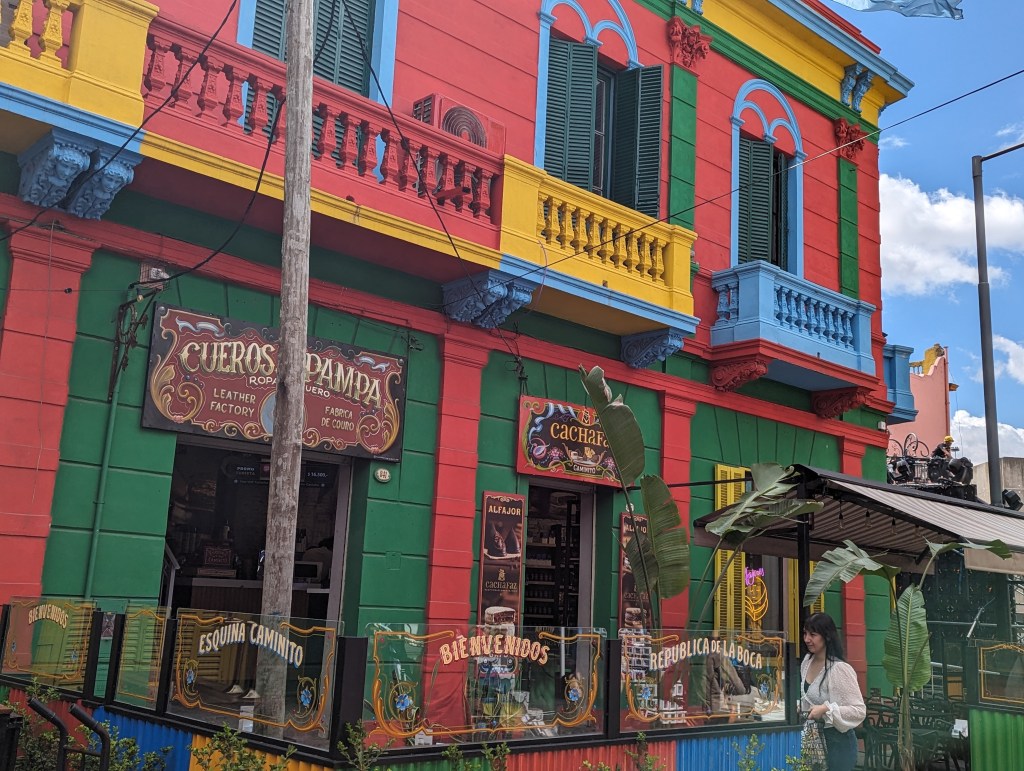
Our guidebook warned us implicitly not to go near La Boca. We have even drawn a ring around it on the map to make sure we don’t stray into it ,American Werewolf in London style, and yet here we are, cycling through it’s streets, lined by houses made of corrogated iron, painted in a mishmash of colours, apparently born of necessity in the days when they were inhabited by immigrants just off the boats, boca meaning mouth of the river, and the only paint they had came from the port left overs.
Camilla, our guide for the day, scoffed at the idea we could be robbed in broad daylight although she conceded it may not be wise to be here at night. We have her for 6 hours, and it isn’t until half way through the day that I see we haven’t just hired her to show us the sites,but to pick a Porteno’s brains about vital questions we have like best restaurants, museums, sites to visit, and where to buy knickers (more of the latter later). She also gave us a potted history of Argentina from the perspective of a libertarian anarchist. If she had her way she’d occupy the cemetery, (although she says manifest rather than occupy, I don’t correct her as I have learnt from the daggers drawn looks Ana, our Spanish lodger, gives me when I do this) . She’d empty it’s crypts of coffins and make it a collective of bijou residences, as many of them are two stories high, and bigger than some peoples flats. She lives in La Boca with 8 other artists, musicians, and writers, 3 dogs and 3 cats. Their rent is half a million pesos a month – around £150 per person. She’s an artist, paints watercolours, which she doesn’t sell but barters. She wears nothing but vintage clothes, is a fount of political, literary, film and historical knowledge, and is all round fabulous. I ask why Eva Peron has just a little plaque in Ricoleta cemetary – she says that Peron, Evita’s husband, had her embalmed when she died at the shockingly young age of 32 from uterine cancer, and when a military coup overthrew his government a week later, the junta smuggled her embalmed body out of Argentina where she stayed drifting through Europe in hidden cellars to stop her becoming any kind of symbol for the Argentinians who adored her. By the time her body returned to Argentina Peron had remarried and rumours of black magic carried out on her body by his much loathed third wife perhaps explain her muted memorial. There’s an election coming up soon and one of the candidates (Javier Milei) is apparently a Trump like figure who against the odds might be voted in as a protest at the absolute mess the countries economy is in right now ( to our benefit, let’s be honest).
Typical area where people lived
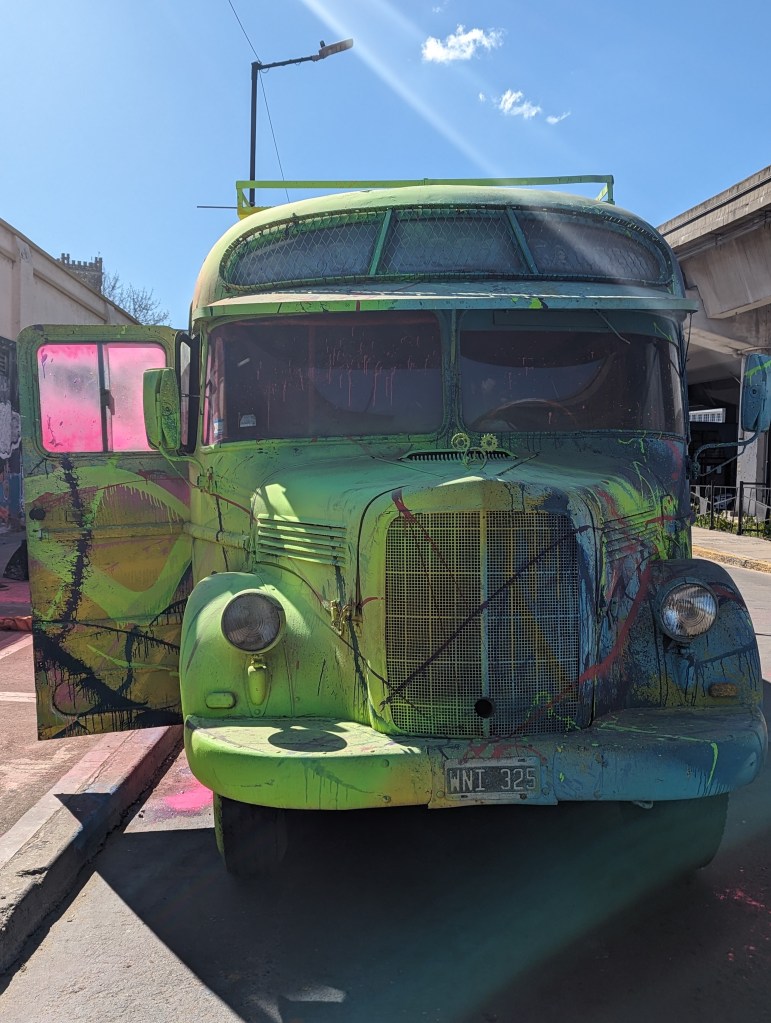
Art bus in uni area
La Boca
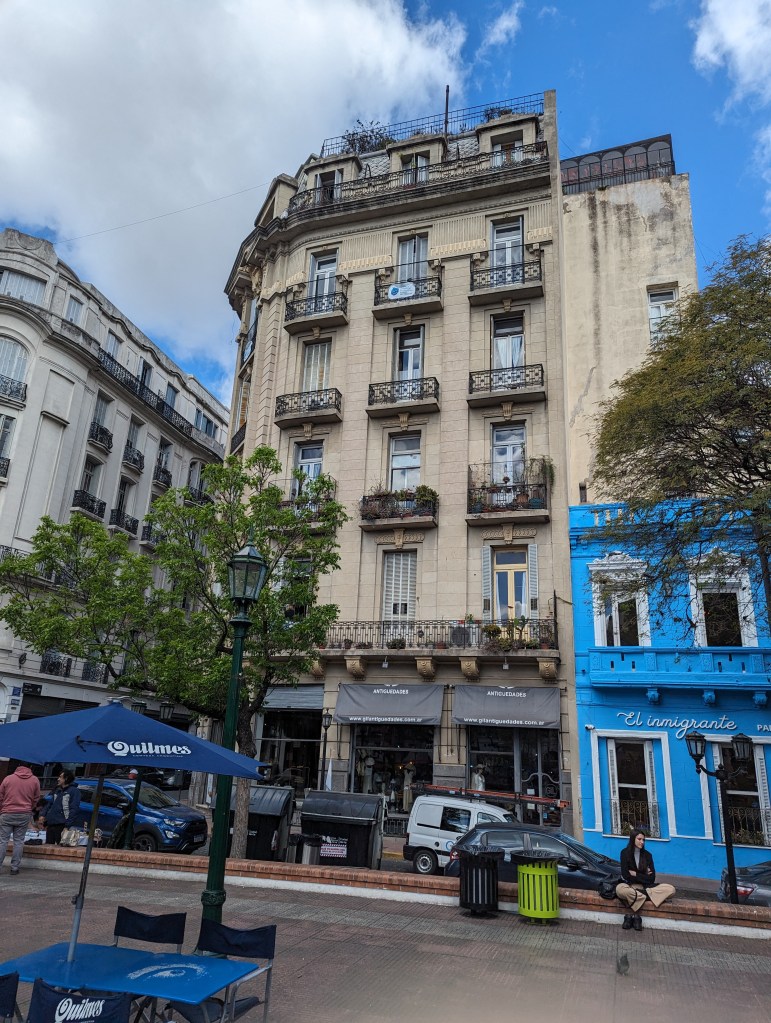
San Telmo – so Parisian
La Boca
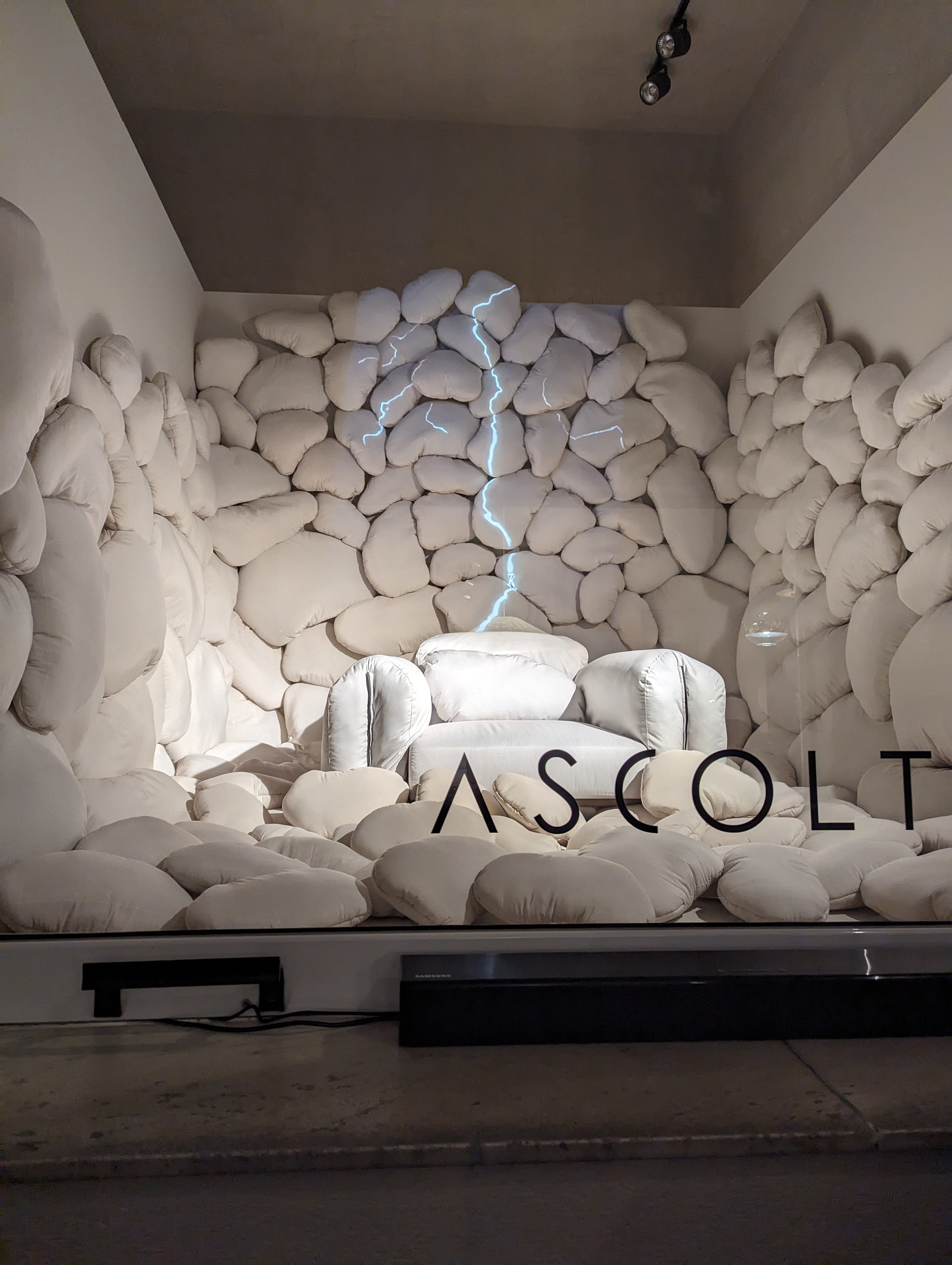
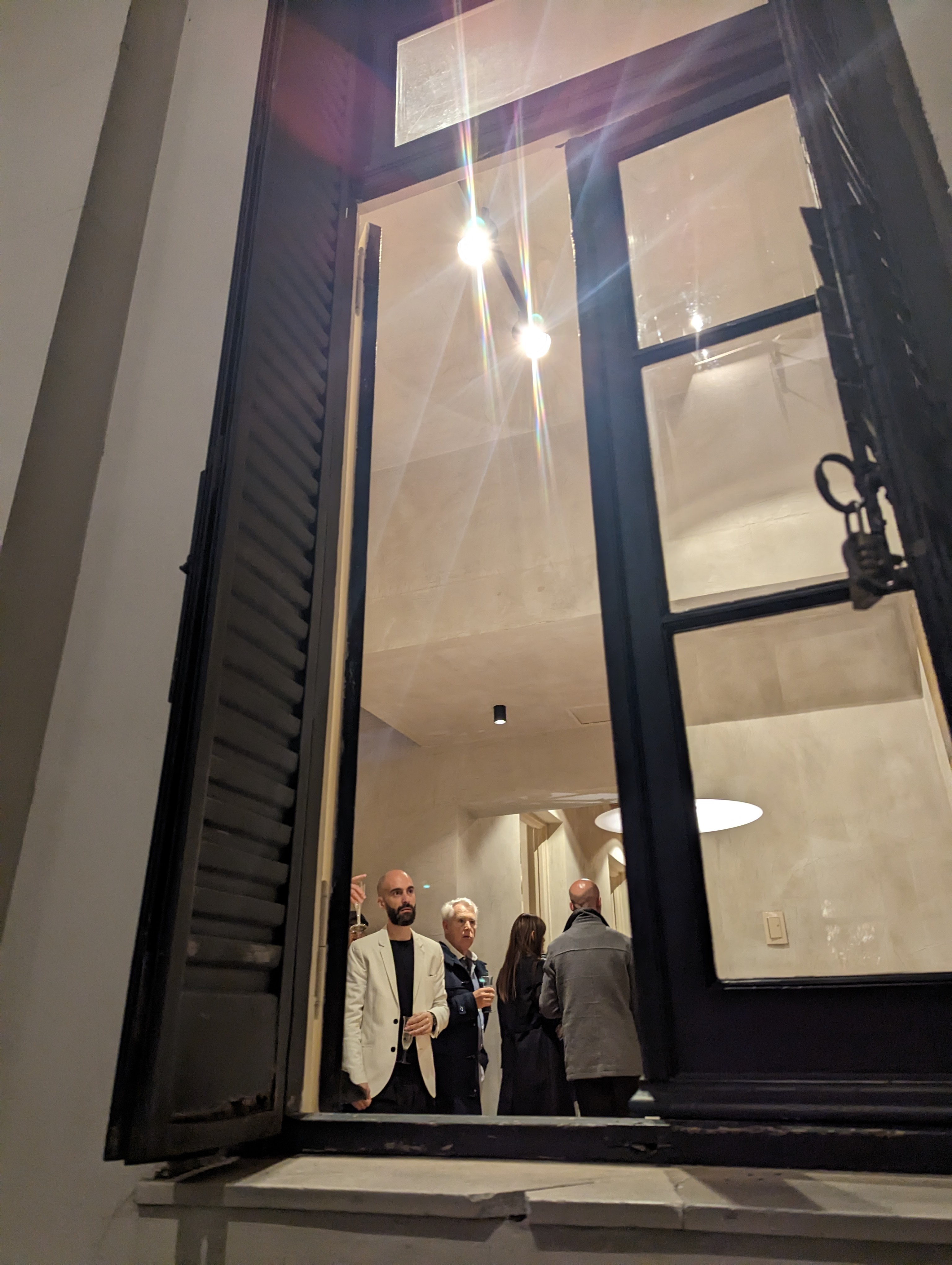
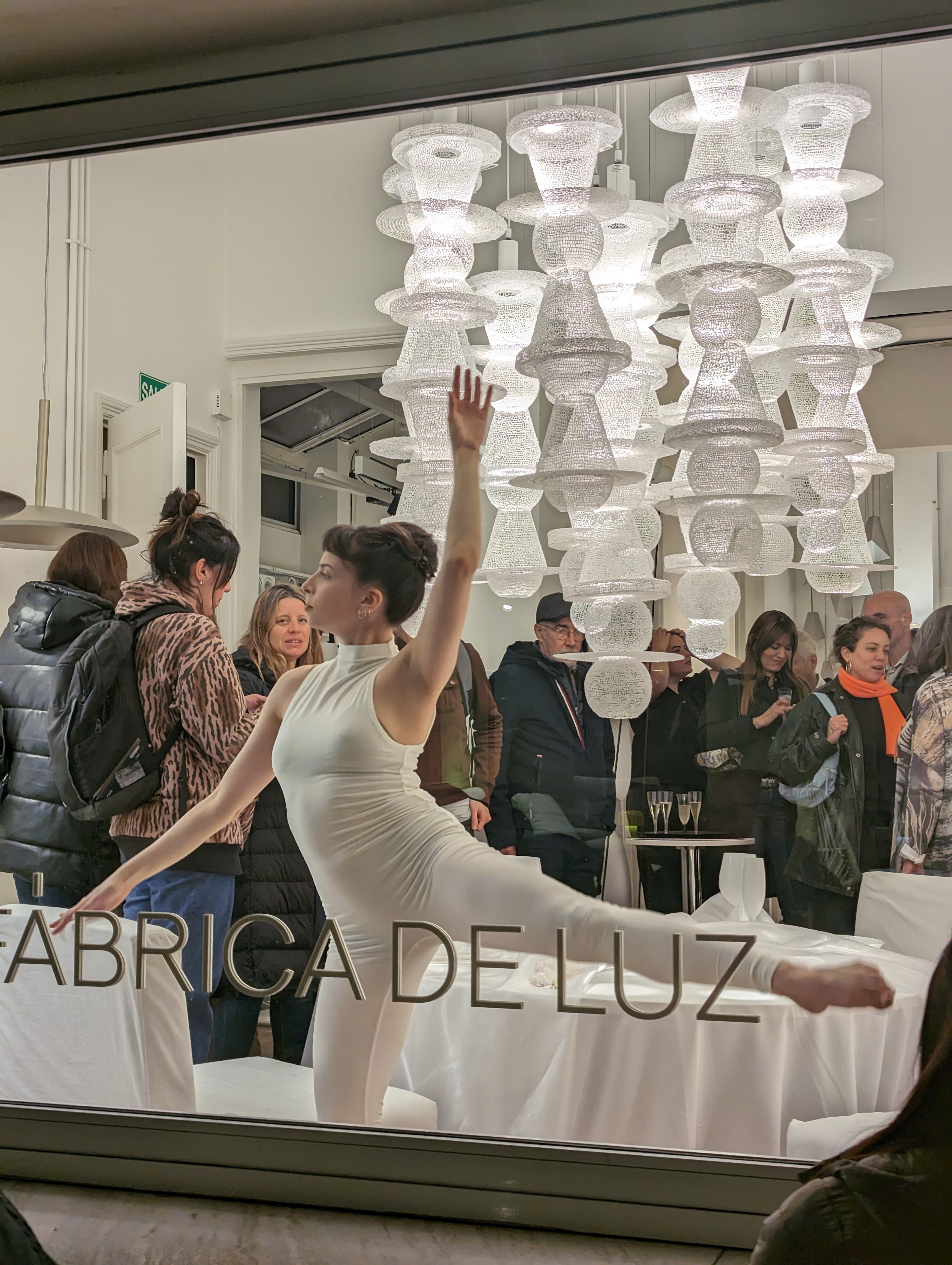
Later that day, my brain fried by the onslaught of information Camilla has machine gunned at me for 6 hours, we returned to out hotel and Clive started cursing like a navvy because of complications caused by an attempted fraud on booking.com a few weeks ago that meant he had to cancel the card he has booked everything on, and I mean EVERYTHING. I could hear music, drumming, and singing even with headphones on to drown out his shouting, which seemed to be happening just up the road from us. After scoping it out with my binocs on the balcony I decided to escape the shocking language and explore. I discovered the silent street we’d walked up not 2 hours ago now heaving with people, weaving about holding glasses of wine, children with balloons and candyfloss, a ballet dancer gyrating in a lighting shop window, drummers dancing wildly, smartly dressed Portenos sipping cocktails at drinks parties glimpsed through windows. I have no idea why, nor did the hotel. Where was Camilla when I needed her?
Ah, knickers. In case you are wondering, I am keen to replace my supply not because of any unseemly incidences, but because my pants are so darn heavy. I’ve gravitated towards them from the thong era of the 80’s through the M and S years, and these have just become my go-to’s. They-are-so-comfy. But I only have 15kg on some flights, 12kg if you take out the weight of my case, so every gram counts, and my case currently weighs 16kg. Interesting fact from Camilla while discussing pants – even she doesn’t wear vintage bloomers – one of the joys of BA is that there are no chain stores. No ubiquitisation of their streets. I won’t bore you with why but also there are no department stores. Devastating. So to buy lighter weight knickers I have to go into a tiny shop, where Clive cowers in the corner looking terrified, point at my arse saying “big bottom”, and they produce a pack of three size 4 ‘s. I love buying stuff abroad when I have no idea of the sizings so my inner troll can’t bombard me with derision. Anyway, doing a blind test Clive agrees they are MUCH lighter than my old pants (that’s a lie, he rolled his eyes and said he honestly didn’t think he could tell that much difference.)
Update : they are REALLY uncomfortable. I think I’m a size 5.






































































 Travellinglight